
Marketplace Seller Trends 2026: What’s changing and how sellers are responding

33% of sellers rank profit margin per marketplace among their top success metrics. In this webinar, held on Oct 13, 2026, Marketplace Universe and ChannelEngine explore profitable growth, operational efficiency, AI adoption, and changing marketplace strategies.

Featured image for this blog post
Marketplace Seller Trends 2026: What’s changing and how sellers are responding
11:36

More marketplaces don’t automatically mean more profit. As sellers expand across channels, rising costs, operational complexity, and tougher competition make it more challenging to turn sales growth into profitable growth.

In this webinar, Valerie Dichtl, Founder of Marketplace Universe, and Jorrit Steinz, CEO of ChannelEngine, explore what’s changing in marketplace selling and how businesses are responding. Drawing on findings from ChannelEngine’s Marketplace Seller Trends Report 2026, they discuss shifting priorities, the operational challenges holding teams back, and the growing role of AI in marketplace operations and product discovery.

The research highlights a clear shift in priorities. Profit margin per marketplace is now the leading success metric, with 33% of respondents ranking it among their top metrics. Meanwhile, 82% of organizations are adopting AI in marketplace operations, yet 3 in 5 still manage marketplace operations mostly manually or with only partial automation.

The message is clear: growth still matters, but how you achieve it matters just as much.
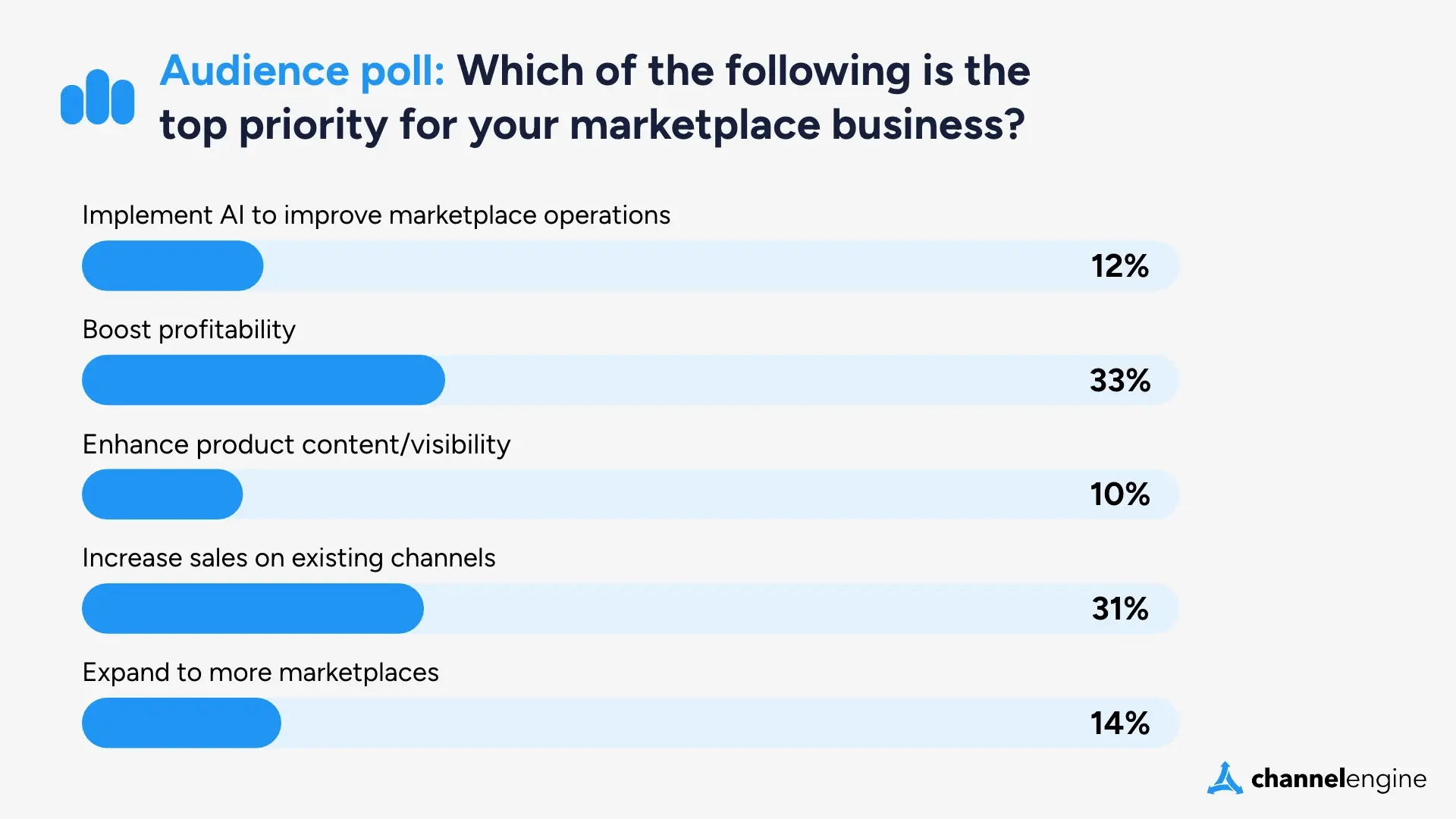
Marketplace Seller Trends Report Webinar - Poll 1

In a nutshell


Marketplace success in 2026 means making every channel work harder. Sellers are focusing on profitability, growing on the marketplaces they already sell on, and reducing manual work. AI is creating new opportunities in operations and product discovery, while the fundamentals still determine how well a business can scale, including accurate product data, reliable stock and price synchronization, and processes teams can execute.


🎥 Missed the live session?


Watch the full webinar recording here.


🎙️ Prefer reading? Jump to the full webinar transcript.

 Top 5 takeaways


1. Focus on growing profitably, not just expanding: Grow on your existing marketplaces, add new ones selectively, and understand profitability at the marketplace and SKU level.

2. Make operational efficiency a priority: Manual work raises costs, slows expansion, and leaves teams in firefighting mode.

3. Put AI to work where it already helps: Customer service, advertising, workflow automation, and demand forecasting are practical starting points, and many tools you already use include AI.

4. Prepare product content for AI-driven discovery: Rich product information and answers to likely questions help with product discovery.

5. Build a strategy your organization can deliver: Centralized expertise, shared playbooks, and integrations with core systems help teams scale across regions.

Best practices and key learnings


Grow where the numbers make sense


The Seller Trends Report found that 39% of sellers now manage seven or more marketplaces, up from 34% in 2025. Each additional channel brings more listings to maintain, prices and inventory to synchronize, and marketplace-specific requirements to manage.

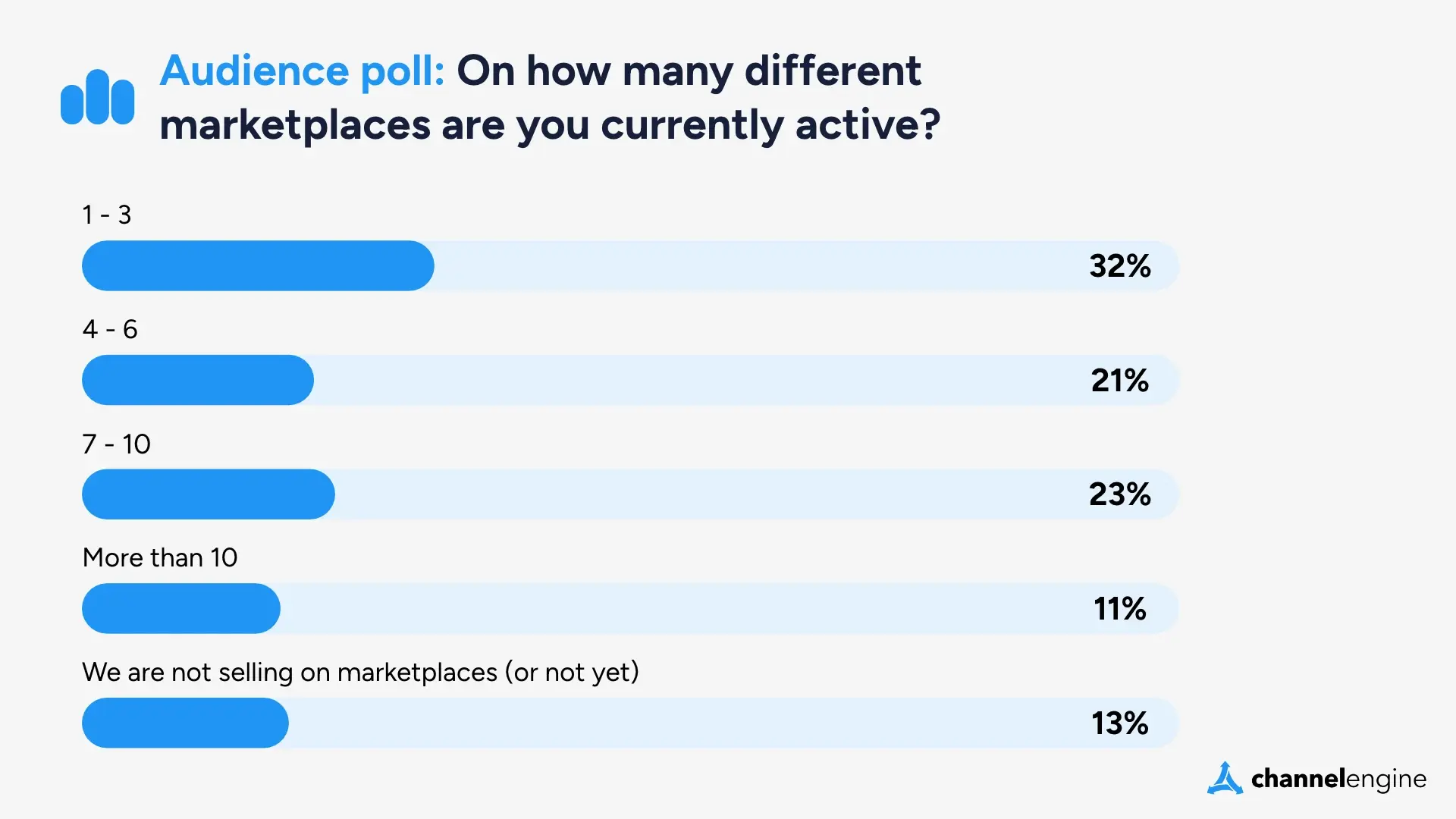
Marketplace Seller Trends Report Webinar - Poll 2

“Instead of just focusing on adding more marketplaces, we're seeing sellers concentrate on growing their existing channels and strategically expanding where it makes sense. Some are even dropping marketplaces that require too much effort or aren't profitable, so they can focus on the ones that perform well.”

Jorrit_ChannelEngineJorrit Steinz
Founder & CEO ChannelEngine-Logo-Horizontal-Default

Expansion hasn’t stopped. The research shows that half of respondents added two to three new marketplaces this year. Once a business has established a successful approach on one marketplace, it can be easier to expand to the next.

Some of that growth is happening on newer channels. The report found that 55% of surveyed sellers are active on TikTok Shop. Jorrit predicted that the channel could rise into the top four or five marketplaces next year, although adoption remains uneven. Operationally, it still requires the familiar fundamentals: product listings, order management, and stock. The difference is how sellers drive traffic and conversion, which calls for a different P&L. Businesses entering the channel may benefit from working with an agency that knows TikTok Shop or bringing TikTok-native expertise into the team. Europe also lacks some of the live-commerce infrastructure that has helped the channel thrive in Southeast Asia.

Get out of firefighting mode


Manual marketplace processes make it hard for teams to focus on growth. The report found that 3 in 5 organizations still manage marketplace operations mostly manually or with only partial automation.

“If you’re constantly firefighting and dealing with manual processes,  you don’t have time to think about growth, expansion, or internationalization. You're spending your time solving operational problems instead of focusing on strategy.”

Even with an integration solution, some manual work remains, such as filling attribute gaps. But automating critical processes such as inventory synchronization, order management, and pricing can help teams reduce errors and free up time for more strategic work.

Pricing, for instance, is a practical place to start with automation. Set boundaries based on purchase price, marketplace fees, VAT, shipping, and handling, then let prices adjust automatically within them. That can include responding to changes in the Buy Box. Promotions can also be scheduled in advance, so teams don’t have to switch them on manually at midnight. With Black Friday and Cyber Week approaching, making sure promotions start and end on time matters.

📖 Additional reading: Marketplace pricing strategy - How to set your minimum price on marketplaces

Start by identifying where manual work creates the biggest bottlenecks, then prioritize processes that affect stock accuracy, pricing, and your ability to expand.

Make profitability visible


Marketplace profitability depends on more than the gap between selling price and purchase price. Operational costs and performance matter, too. That’s why profit margin per marketplace is the leading success metric in the report, with 33% of respondents ranking it among their top metrics.

The pressure comes from several directions: price competition within and between marketplaces, rising marketplace and advertising fees, and more expensive shipping and fulfillment. Sellers can get squeezed from all sides. Larger, more expert teams with strong automation may be able to reach the scale where better shipping rates, packaging prices, and purchasing leverage start to help. Purely reselling third-party products at small scale, however, can be difficult to make profitable.

There are practical ways to improve the picture. Some sellers with a few hundred SKUs review which products are actually profitable and create virtual bundles to raise average order value.

A channel that generates revenue but continually pressures margins may need a different approach. In some cases, improving performance on an existing marketplace is worth more than expanding into another.

Put AI to work on real problems


AI adoption is rising quickly. The Seller Trends Report found that 82% of organizations are adopting AI in marketplace operations. Jorrit suggested that AI adoption could approach 100% next year, partly because many tools now include AI by default. In his view, businesses may already be using AI without having made a deliberate decision to adopt it.

Practical use cases include customer service, advertising, workflow automation, and demand forecasting. AI can handle routine “Where is my package?” questions, answer straightforward product queries, and feed those questions back into product content. It can also support compliance and regulatory work, where new providers are emerging. Jorrit’s view was that, at scale, AI use will become increasingly difficult to ignore as competitors put it to work.

Choosing the right tools remains a challenge. New products appear constantly, and it can be hard to distinguish genuinely useful capabilities from a thin layer built on top of a general AI provider’s API. Start by looking at providers with a long track record in the relevant workflow, such as service desk tools. Some now use outcome-based pricing, charging for cases solved without human involvement rather than per seat.

Data handling matters, too. ChannelEngine uses AI models within the Azure stack in Europe for GDPR compliance and is launching a bring-your-own-key option for companies that want to use their own models.

Make product content ready for AI discovery


AI is also changing how shoppers discover products, making the quality of product information increasingly important. Content published across marketplaces can also help AI-powered shopping tools understand and recommend products.

 “The biggest step you can take now is to make sure your product content is as rich as possible. Think about the different use cases for your products and the questions customers might ask. The more information you provide across marketplaces, the better prepared your products are for AI-driven discovery.” 

Jorrit_ChannelEngineJorrit Steinz
Founder & CEO ChannelEngine-Logo-Horizontal-Default

Product feeds matter as well: the Google Shopping feed is also used for Gemini, and a similar feed with extended fields works for the Microsoft merchant network.

While AI-driven product discovery is already happening, transactions directly through AI are still at an early stage. The practical advice is to make products discoverable now, then make sure the experience delivers; where checkout takes place matters less than keeping stock updated and shipping on time.

For many brands, the challenge starts internally. Product attributes may sit with different departments, so involve the people who own that information as early as possible.

📖 Additional reading: Building the perfect marketplace management team: How the best brands do it

Build a strategy your teams can execute


Not every company is equally ready to experiment. Some are moving quickly on marketplace selling, social commerce, and AI, while others face internal resistance. The speakers’ broader message was that businesses need to keep adapting as the market changes.

Large brands can also get stuck in internal politics, such as deciding which team owns a marketplace P&L and how it affects incentives. Successful enterprise teams often centralize the work, using one playbook, one integration with ERP and PIM systems, and a central team that operates like a small internal startup. Costs can then be allocated to each country’s P&L instead of every country building its own approach. It takes more effort to establish, but it can help companies scale faster.

Partners can help sellers reach the scale needed to improve purchasing power and automation. For example, once a European brand reaches a certain volume, expanding to the US may be more manageable than expected, thanks to fulfillment networks and providers that support legal entity setup and taxes.

Final thoughts


Marketplace growth is no longer just about reaching more customers or adding more channels. It’s about building a business that can grow profitably without adding unsustainable complexity.

That means understanding which marketplaces deserve more investment, automating the work that slows teams down, and improving product content as discovery evolves. AI can help, but it works best when it supports clear business goals and solid operational foundations.

The next step is to assess where your business stands today, including which channels are delivering returns, where manual processes are holding you back, and what changes would make the biggest difference. Use those answers to focus your resources and build a marketplace strategy you can scale.

Download the Marketplace Seller Trends Report 2026

The Marketplace Seller Trends Report 2026 surveyed 550 ecommerce marketplace decision-makers across the US, UK, France, Germany, and the Netherlands.

Explore marketplace expansion, the cost of complexity, shifting profitability priorities, AI adoption, and the differences between five key markets.

👉 [Download the full report here]

Read the full webinar transcript 👇

Welcome and speaker introductions

00:02:25 Valerie Dichtl: Welcome again to our Marketplace Seller Trends Webinar 2026, actually the second edition. My name is Valerie Dichtl, and together with Jorrit Steinz, we are doing this webinar today with you. We want to have an interactive webinar. If you have any questions about the presentation or the topics, write them in the chat and we will try to answer them during the webinar, at the end, or we will come back to you.

00:03:18 Valerie Dichtl: Let's start with the first interactive session. We would like to know what your seller profile is. You can choose in the poll: are you a marketplace seller who sells brands, or articles from your own brand? Are you a retail seller selling third-party products only? A marketplace service partner, or a marketplace itself? If you don't match any of these, you can also write it in the chat.

00:03:54 Jorrit Steinz: I see lots of brands selling their own articles, third-party products, and the marketplaces themselves.

00:04:04 Valerie Dichtl: Brands are really the biggest part. The biggest group is definitely the brands and sellers.

00:04:23 Jorrit Steinz: And a lot of marketplaces are listening in as well.

00:04:27 Valerie Dichtl: True. All excited about the results of your study. My name is Valerie, and I would now hand over to Jorrit to introduce himself.

About ChannelEngine and Marketplace Universe

00:04:44 Jorrit Steinz: For the people who don't know me, I see a lot of familiar people in the chat. I'm Jorrit Steinz, founder and CEO of ChannelEngine. I have spent a lot of time in e-commerce over the last 13 years with ChannelEngine, purely focused on helping sellers do well on marketplaces worldwide. Worldwide means 1,300 marketplaces in different regions. Most of our focus is on customers in North America and EMEA, but we also have customers selling in Southeast Asia, Australia, New Zealand, the Middle East and Latin America, with a team of roughly 200 people and offices across the globe. I spent a couple of weeks in the US, the last few weeks as well, so it is great to see so many people popping up in the chat.

00:05:39 Jorrit Steinz: Maybe to the next slide, to give you an overview, because a lot of people don't even know that there are 1,300 marketplaces, and the number is expanding. This is our network. It keeps growing, and some of the marketplaces represent a lot of different regions, which you can manage separately with your assortment, different currencies, different languages, et cetera. We keep expanding this network for the sellers on this call.

00:06:21 Jorrit Steinz: A question for the people in the chat: how long have you been selling on marketplaces?

00:06:35 Valerie Dichtl: Some are just getting started, which is also interesting. Some are not selling. Maybe you are a service provider or a marketplace yourself, so then you're not selling at all. Fair enough.

00:06:47 Jorrit Steinz: Lots of people over five years. It would be fun to hear how many people are over 10 years or even 15 years.

00:06:54 Valerie Dichtl: That's true. Or maybe you could reframe the question: how long have you been in the marketplace space? I was not selling for more than two years, but I think I have been in the industry for over 10 years. The biggest part of you has been selling for more than five years, so great.

00:07:35 Valerie Dichtl: A quick one about myself. I have been more than 15 years in the online fashion business. I used to work for Amazon on the vendor side. I left because Amazon is squeezing out its vendors, and still is. That's why I moved to the other side, to one of the brands I used to buy from. In 2019, I became self-employed as a marketplace consultant and founded Marketplace Only. Since 2024, I'm the co-founder of Marketplace Universe. We share weekly insights about the European B2C marketplace business through webinars like today's, but also through our newsletter, our podcast Let's Talk Marketplace, and events we run together. Maybe you also saw my co-founder, Ingrid Lammer, somewhere already. I also shared a link to our newsletter list, because every Monday you get all the interesting news about the European marketplace business in your inbox. We are mainly based in Germany. Now I hand over to Jorrit again.

Webinar agenda and research overview

00:09:16 Jorrit Steinz: During the session, feel free to ask questions, and at the end you can get access to the full report. We will be exploring how priorities are shifting, growth versus profitability. I think that's top of mind for everyone, not just the sellers but also the marketplaces, so everybody is battling for that. We will also cover manual operations holding everyone back, and part of the solution coming with AI, and then what marketplace teams should be preparing for in 2027. Feel free to keep asking questions in the chat. We might address them during the session, and some we will save for last. You will get the full report in your inbox if you stick to the end.

00:10:08 Jorrit Steinz: Right, let's dive in. We did research. It was not me asking all the sellers. We had Sapio Research do independent research, so these are not ChannelEngine customers. They pinpointed sellers in different regions: 150 in the US and 100 each in Germany, France, the Netherlands and the UK, to get broad insight into how sellers are doing at the moment. You see everything from pure 1P sellers to 3P sellers. Over the years I see a big shift towards hybrid, meaning brands selling both 1P and 3P. Sometimes it's a full assortment, sometimes just backfilling, size filling, or augmenting the collection. A nice range of C-levels and owners, directors, VPs and SVPs filled out this questionnaire. These are serious sellers. In revenue, some are under 50 million, but there is also a big chunk between 50 million and 500 million, and even above. So it gives you a good representation of the sellers.

Growth with a strategic focus: number of marketplaces

00:11:23 Jorrit Steinz: Growth is continuing, but the focus is changing. I've seen it over the last few years: everything is still growing, but it's really strategic. Instead of trying to grow as fast as possible at all costs, it's now about which channels you want to be present on, and it needs to be more and more profitable. Just curious, how many different marketplaces are you currently active on?

00:12:06 Jorrit Steinz: More than 10, good. We see customers, sometimes even with 60 marketplaces, which is a lot.

00:12:13 Valerie Dichtl: But within the 60, are there 60 different marketplaces, or if you sell on Zalando in five countries, does that count as five?

00:12:22 Jorrit Steinz: That counts as five if they separately manage those.

00:12:28 Valerie Dichtl: In terms of the hybrid model, I think that is becoming more and more important. If you started as a 1P seller, many marketplaces, and Zalando is a good example, really push you to become a 3P seller, and then you are immediately a hybrid model user. The same goes for Amazon, to be very honest.

00:12:58 Jorrit Steinz: I do see a mix. Mid-size or smaller sellers are definitely pushed out of the vendor model into the seller model. With very large brands, the vendor managers are trying to keep them purely on vendor and scaring them out of the seller model. Both are happening.

00:13:15 Valerie Dichtl: Yes, depending on the strategy they are following in the current year. We actually have quite a good mix here, 25 to 30% almost.

00:13:39 Jorrit Steinz: We see more and more marketplaces popping up, so it also depends on how sellers prioritize. The 7 to 10 group is increasing. Over the years, I see customers first selling on Amazon, then on one of the local heroes, and then expanding. In fashion, it's more Zalando, About You, Otto, and then expanding to other marketplaces. Once you nail it, it's easy to expand to new marketplaces as well. I also see sellers dropping marketplaces. If a marketplace is too small, still means a lot of effort, or is not profitable, they drop it strategically to put more focus on the ones that are performing well. So it's not a dumb deal. I see a lot of dynamic shifts in the market.

00:14:23 Valerie Dichtl: There are also marketplaces who are changing strategies or partners, or who originally set up software, and that is a big challenge. Some marketplaces close down and open up again and again, so sellers are sometimes annoyed or just tired of saying, okay, let's do this again. Interestingly, if we compare the results from your study with what we see in our polls, they are quite similar.

00:15:05 Jorrit Steinz: Absolutely. And it's nice to see that half of them are expanding to two to three new marketplaces this year alone. These numbers are not the full seller base, but the 550 people that we asked. It's nice to see that trend over time.

Top marketplaces and TikTok Shop

00:15:33 Valerie Dichtl: Given that almost all of you are on three or more marketplaces, you can write in the chat what your top three marketplaces globally are based on annual GMV. That's super interesting because later we will have an overview of the biggest marketplaces, and we can see whether there is an overlap or whether we need to change something.

00:16:06 Jorrit Steinz: I see Amazon and Otto. What are you selling, David? Is it fashion, home and living?

00:16:12 Valerie Dichtl: Then we have Amazon, eBay and Superdrug, which looks like the beauty category.

00:16:17 Jorrit Steinz: Zalando, Bol, About You, fashion and apparel. Home and living, I would expect so. It's really reflecting what we see in the seller base as well.

00:16:49 Jorrit Steinz: When we did the questionnaire across all the sellers in the different regions, you see Amazon on top everywhere. Even in the Netherlands, where Bol is typically higher in GMV than Amazon, among the sellers we interviewed Amazon was prioritized higher. You also see Decathlon coming up, which is an interesting one. I see that in our customer base as well. Some sporting goods are doing really well on Decathlon. Zalando is of course performing super well. And in the US, Target is coming up.

00:17:25 Valerie Dichtl: Walmart actually is not mentioned anywhere in the chat yet. That's quite interesting.

00:17:31 Jorrit Steinz: I think that's mostly because of the number of people from Europe here. I do see some European companies doing really well on Walmart. Typically you start in the US on Amazon. You can even use Amazon Multi-Channel Fulfillment to sell on Walmart, or Walmart Fulfillment Services to sell on Amazon, so you can leverage either of the two. The expansion to Target and eBay is definitely there.

00:18:05 Jorrit Steinz: The one that I expect might pop up next year in the top four or five is TikTok Shop. It is growing super fast in GMV. I don't see adoption across all sellers, also in our seller base. A selection of sellers is really embracing it and doing extremely well. There is also a bunch of sellers that embrace TikTok Shop but don't really know how to drive traffic. It's a different ballgame. It's a different way of working, using influencers and making sure you can do live shopping and promotions. The ones that are doing it are doing extremely well. We see the biggest, most sophisticated ones in our customer base at the moment, even in the US. I know Southeast Asia is doing extremely well, but in the US, in our customer base, you see some very sophisticated large sellers doing high volumes. Cosmetics and fashion are strong, but we've also seen consumer electronics and home appliances doing well. So you see each vertical coming up and growing. A lot of attention goes to TikTok Shop. We didn't have a poll, but drop in the comments if you already sell on TikTok Shop, and maybe with a thumbs up or down whether it's going well or not.

00:19:28 Valerie Dichtl: In Southeast Asia, they are very much used to live commerce, so they are already set up for this kind of e-commerce. This is where we still need to ramp up in Europe. For example, in terms of live studios, what you would need to sell there, our environment is not there yet.

00:19:56 Jorrit Steinz: I haven't seen that many live shopping results yet, maybe because sellers haven't embraced it yet. We see a lot of social media and influencer-driven campaigns doing well. For those who don't sell on TikTok Shop yet, operations are the same as on a regular marketplace: your list of products, order management, inventory, et cetera. There are some nuances, but eventually it works the same as other marketplaces. You can leverage third-party logistics providers and Amazon MCF. The biggest difference is driving traffic and driving conversions, so it's a different P&L. I would definitely recommend, especially in the beginning, hiring an agency that is experienced with TikTok Shop, or hiring a younger generation of TikTok-native people for your team, if you don't have the experience yourself. I do see massive results. We are migrating some accounts that do 40 to 50 million for purely one brand.

00:21:05 Valerie Dichtl: That's already quite impressive. We also did an interview with TikTok Shop on the podcast, as well as with Philips as a brand. If you want to listen, go to Spotify, for example, and look for Let's Talk Marketplace. Those episodes were around July. They explain how it works and give insights into how the brand is doing it.

00:21:35 Jorrit Steinz: I don't see anyone in the chat using TikTok Shop.

00:21:40 Valerie Dichtl: Some of you wrote that you are onboarding now, or soon.

00:21:54 Jorrit Steinz: Everybody's onboarding. Everybody's going to fight for the same influencers. Or maybe you can create an AI influencer with some audience.

00:22:06 Valerie Dichtl: I also heard that for beauty products, for example a face cream, they are using AI influencers. I find it strange to use an artificially created model to sell you something. You cannot say, look, this is my before and after in reality, because there is no reality behind it. I heard it works, but I find it a little bit strange.

00:22:40 Jorrit Steinz: I think in magazines, the ads were also photoshopped for many years, right?

00:22:46 Valerie Dichtl: Also true.

Seller priorities

00:22:58 Valerie Dichtl: Which of the following is the top priority for your marketplace business? ChannelEngine also asked the sellers what their priority is and how it changes year over year. It's interesting to see where the priorities are going within the marketplace business.

00:23:26 Jorrit Steinz: Boosting profitability, implementing AI.

00:23:32 Valerie Dichtl: Obviously there are other reasons, so if you have another topic, you can also share it in the chat. We could only offer five different answers.

00:23:46 Jorrit Steinz: As you also see, increasing sales on existing channels is popular. We see that as well. Customers on multiple marketplaces focus less on adding many more marketplaces and more on really growing on the ones they have, strategically adding the ones that make sense, and making sure they do it profitably. Boosting profitability works, so our research is accurate for this group. In our research, boosting profitability moved up in the list of top priorities, along with implementing AI to improve marketplace operations. Indirectly, that also ties into profitability, because it's not just your sales price and purchase price but also your operational cost and performance. The more efficiently you can do it, the better it works. We've seen customers really dialing down: if they have a couple of hundred SKUs, they look at which ones are profitable, create virtual bundles to increase average order value, and are strategic about it because the bottom line counts. Enhancing product content and visibility is an interesting one we'll get back to as well.

Manual operations and their business impact

00:25:36 Jorrit Steinz: Operations and profitability in reality. Maybe we can go to the poll. How do you currently mainly manage product content and pricing updates? Options are an outsourced partner or agency, internal tools and spreadsheets, product feeds (internal tools can be your own created tools or using Claude or whatever), a direct integration, a marketplace integrator, or manual updates in the marketplace portals.

00:26:11 Valerie Dichtl: I hope you're all using ChannelEngine as your integrator.

00:26:16 Jorrit Steinz: I hope so. Marketplace integrator is popping up, especially with larger sellers. Manual updates are going to be very hard. I'm surprised that there are still six people doing manual updates in the marketplace portals. It is doable if you have very deep inventory, lots of items per SKU and not that many SKUs. As soon as it gets more complex, with multiple inventory locations, synchronizing between channels is going to be very challenging. Outsourced partner agencies, yes, and one direct integration, interesting.

00:27:00 Valerie Dichtl: Many marketplaces also don't offer open and direct integration. For some marketplaces you have to use an integrator or an agency.

00:27:14 Jorrit Steinz: Absolutely. The curated marketplaces are limited, so you cannot just go and get on Target, and there are a bunch more where you have to use a marketplace integration solution. Also, if you have multiple channels and you sell an item on one marketplace, you want to take it off the others directly, because otherwise you get overselling, and you have to cancel orders. That's not good for your seller performance. Maybe good to jump to the answers from our research.

00:27:43 Valerie Dichtl: It's a good match with our survey.

00:27:48 Jorrit Steinz: Absolutely. Fifty-nine percent use marketplace integrators, and that keeps growing. Product feeds are also used a lot. Typically it's a mix, so we can also ingest product feeds that go to the marketplace. It's more on the operational side: how do you handle stock updates, orders, shipments, cancellations, financial reconciliation, all those kinds of things. For direct integration, we still hear people starting that, then stopping and moving to an integrator, and then internal tools and manual work. It blows my mind that 32% say there is a lot of manual work. Of course, even with integration solutions there is always some manual work. If there is no content for specific products, or they don't have the attributes the marketplace requires, there is some work to be done. But if you want to be profitable, do this at scale and win, it's always good to automate. So three in five organizations are still mostly manual or only partly automated. If you're in that bucket, you're not alone, but here are solutions.

00:29:07 Jorrit Steinz: Where do manual processes have clear business impact? The top three: higher operational costs, which include errors, because if something goes wrong it needs to be solved, and that costs money as well; slower expansion into new marketplaces, which also counts for direct integrations; and increased listing, pricing or inventory errors that remain unresolved. Then there is a whole host of other reasons on the right that were answered.

00:29:39 Valerie Dichtl: It makes total sense. If you're firefighting the whole time with topics that are solved manually, then you don't have time to expand, to grow, to think about a strategy to internationalize, and so on.

00:29:57 Jorrit Steinz: And maybe the most critical one is not even the listing, because there is always some work with the listing, even with integration solutions. It's more about making sure your stock is okay, so you don't oversell, everything is synchronized and orders are flowing correctly.

00:30:13 Valerie Dichtl: Prices are correct, right? Prices are also a huge topic.

00:30:15 Jorrit Steinz: Prices are correct. You want to be competitive, but you also want to be profitable. You want to win the Buy Box, but not always. If Amazon has the Buy Box, maybe you don't want to compete, but as soon as 1P has sold out, you do want to compete. So there is a lot of optimization you want to do at scale.

00:30:33 Valerie Dichtl: I still hear there are some middleware tools where you still have to upload price sheets. How is ChannelEngine doing this?

00:30:46 Jorrit Steinz: Fully automated. We get the information when something changes in the Buy Box list, if there are multiple sellers on one ASIN, for instance on Amazon, but we also do this for other marketplaces. We automatically adapt the prices depending on your strategy. You can set all kinds of boundaries. We take into account purchase price, marketplace fees, VAT, shipping cost and handling, and within these boundaries you can set your strategies and ChannelEngine can automatically change the prices. You can also schedule promotions ahead of time. If you know there is a promotion for a certain product group, you can schedule it ahead of time and take it offline again. I know people have been staying up late to start a promotion at midnight and then take it offline again. You don't have to do that. It's fully automatic.

00:31:36 Valerie Dichtl: Hopefully these times are over. We are already in the middle of Q4, and soon there is Black Friday and Cyber Week. It is so important that your promos are right on time, online and offline, especially when you have several marketplaces and countries.

00:32:12 Jorrit Steinz: We've just seen the peak of 10.10 in Southeast Asia, Shopee and Lazada, and that is really all promotion driven. You see the promotions kicking in at midnight, then a big spike in revenue, then it goes down, so you can actually see people going to sleep and then waking up again, because the revenue spikes again. It's literally big enough that I could show you an anonymized graph.

00:32:38 Valerie Dichtl: That's quite interesting. But what do they celebrate on 10.10? I get 11.11 is a single day, but what do they celebrate on 10.10?

00:32:46 Jorrit Steinz: That's every month: the 8th of the 8th, the 9th of the 9th, the 10th of the 10th. 11.11 is the most well known, but during the other months the revenue is lower than in the peak months. Everybody is waiting for these peak days and everything sells, from consumer electronics to fashion. People are really waiting for that specific day.

00:33:10 Valerie Dichtl: I didn't know that. Again, something learned.

Margin pressure and operational efficiency

00:33:22 Jorrit Steinz: Margin pressure grows, and operational efficiency matters more. We see a lot of price competition, not only on a marketplace but also between marketplaces. Some marketplace fees are rising, also depending on whether you're 1P or 3P. That's also why you see a lot of brands diversifying into more channels. Shipping and fulfillment are getting more expensive. I know Amazon dropped some fulfillment prices as well. They're listening to the sellers, and they also see sellers moving away to 3PLs. Advertising fees are rising, and on the purchase side costs increase too. I hear shipping costs go up, and of course oil prices don't help. So eventually the seller is squeezed in between. Then there are manual inefficiencies in operations. I see a lot of sellers hiring just a few people who have to do everything to try to squeeze it in. But if you hire a somewhat more expert and bigger team and automate well, you can get to a larger scale where economies of scale kick in: better shipping prices, better prices for packaging material, better leverage when you do purchasing. All of that goes into being able to win this game at scale.

00:34:52 Valerie Dichtl: It's getting tighter and tighter. Every year there are new costs, and logistics fees are rising. It has really gotten tougher over the last years.

00:35:04 Jorrit Steinz: To be frank, if you look at the whole retail chain, retailers are having a hard time, especially because brands are also selling directly on marketplaces now, and distributors are selling on marketplaces. You see very successful retailers if they have a high level of automation but also purchasing power, and typically the retailers that are doing well also have their own brands. So if you're a small reseller purchasing third-party products and selling them online, it is a very hard game to play profitably.

AI is moving into operations

00:35:47 Jorrit Steinz: Next part: AI is moving into operations. We saw some people in the poll already. More and more people are using AI. Customer service makes a lot of sense, because a lot of the questions, especially for sellers, are "where's my package?", and you can just automate that part. Even product questions are relatively easy, and feeding them back into your product content, that loop is essential. I think a lot of people who think they are not leveraging AI are probably already leveraging it, because a lot of tools have AI embedded and it's getting easier and easier. So I would expect this number to approach 100% next year. I think every advertising tool now leverages AI in some form, as do workflow automations and demand forecasting, and every customer service tool is embedding AI at scale. Even if you don't build it yourself, you can leverage all the tools that you already use. And it helps profitability, of course.

00:37:08 Jorrit Steinz: AI interest is high. We see that with compliance and legal and regulatory risks, especially in Europe, with all the rules and regulations coming up. That's also where AI can help. Europe is making it increasingly harder to do business with all kinds of rules that are fragmented across the different countries. I do see new providers popping up that leverage AI to help with these things. Also, which AI model are you using, or are your providers using? We use AI models within the Azure stack in Europe, GDPR compliant. We are also launching a bring-your-own-key option for people who really want to use their own models and be safe there. I think that is going to be discussed more in the next months and years. But it is inevitable to do this at scale. Otherwise, your competitor is doing it, and it's very hard to win this game.

00:38:14 Valerie Dichtl: I also see that some service providers, especially for customer service, are using AI a lot. Obviously you have to pay for it, but you don't have to work as a software shop to program this yourself. There are lots of new tools coming up, and that is sometimes tiring, to be very honest, because so much is popping up and you don't really know what they are doing exactly and whether it really matches what you need. But there are some tools that really support you.

00:39:03 Jorrit Steinz: Yes, new tools are popping up. I don't know what your LinkedIn feed looks like, but mine is flooding with people saying "I created this new tool and that new tool." It's hard to distinguish what is really good from what is just a small layer on top of something you could do through the API of any of your AI providers. I would definitely look at the ones that have done it for a long time. The service desks have done it for a long time. I know some of them use outcome-based pricing: if the case was fully solved without a human touch, they charge for that instead of seats. So the models are changing as well. I'm curious if somebody in the chat wants to share the most successful implementation of AI within their marketplace operations, because it will keep growing and changing. We could even do a deep dive session purely on that.

00:40:04 Valerie Dichtl: There are so many different ones. If I put something in the ring, I would say eDesk. We also did a webinar with them. It's the customer service software we shared a few months earlier, which was quite impressive.

00:40:32 Jorrit Steinz: They have an integration with ChannelEngine as well as with other marketplaces, so that definitely helps solve those challenges.

AI-driven commerce

00:40:41 Jorrit Steinz: Then AI-driven commerce, an interesting topic as well.

00:40:48 Valerie Dichtl: How do you define AI-driven commerce?

00:40:52 Jorrit Steinz: AI-driven commerce covers a lot. The first thing that comes to mind is ChatGPT checkout, which was launched or announced a while ago, and still nobody really got an account. Connecting through ACP and UCP is definitely possible, and we have the connections ready. The real AI part is discovery, finding which product fits you well. The transaction is basically an API call in the background: creating an order and a validation call to the payment provider, whether Stripe, PayPal or another. That's where the normal process comes in. For discovery, it's interesting to see that a lot of the product content published on the different marketplaces is also taken into account in discovery in the different LLMs. So if you publish something on a marketplace, make sure it's as rich as possible and answers as many Q&As as possible. On Amazon itself, there is also a big push on AI-driven shopping. The chat agent is, I think, already influencing 60% of the sales. You can also send your product feeds, whether it's your normal Google Shopping feed to Google Shopping, which is also leveraged for Gemini, or the same or a similar feed with extended fields to the Microsoft merchant network, and it's expanding to all these different channels. What these channels look for is not only product content but also product context: of course the price, but also, depending on the region, your policies, pricing and terms of service that you need to link to, which are typically not in your product feed. I do see a lot of clicks from the different channels, and it will be popping up. I saw some demos on Copilot. So there is more buzz and talk than actual transactions, but the discoveries are definitely there. And now tools like Instinct and News are shopping on your behalf on the storefronts. So being on the storefronts, in your Shopify store, in your shop, and basically in all the different marketplaces feeds into being discoverable for AI-driven commerce. Make sure you're everywhere, can deliver, and synchronize your stock directly. What do you see happening in AI-driven commerce?

00:43:35 Valerie Dichtl: From a personal point of view, I also use it a lot to get recommendations for what to buy or what I need. I have a baby, so we use it a lot for questions like "what do we need now?" In terms of our business, it's quite interesting: people find us through ChatGPT. We are recommended by ChatGPT when someone asks who they need to talk to about the marketplace business in Europe, or for a discount code for a conference. We had one in our newsletter, and it was shared on LinkedIn as well. That's quite interesting, to be very honest. My co-founder Ingrid is responsible for all our content and blog posts. She's a journalist, and I know she takes care that our content is well written, also for the different AIs. To see that it's really becoming relevant and that we attract people through channels we hadn't had in mind before is interesting. And I think for brands it's the same. When I look for, say, handbags, the recommendations are sometimes not that good, depending on the model and the question, but it's becoming more and more relevant. I want a checkout option, or at least the link to the online shop where I can buy it.

00:45:32 Jorrit Steinz: In preparation, you see a lot of people already have an active strategy and are taking action and exploring opportunities. The biggest step you can take now is to make sure your product content is as rich as possible, especially thinking about use cases for your product, questions and answers. The richer you publish that on marketplaces, the better it feeds into the LLMs, and the better it can be fed into ACP, UCP and directly into the LLMs, which combine that knowledge. So you can be early and make sure your products are discoverable. Whether the checkout takes place on the marketplace, the DTC shop or directly in the LLMs doesn't really matter, as long as you update the stock afterwards and ship in time.

00:46:18 Valerie Dichtl: And again, we're back to the basics, which is content.

00:46:23 Jorrit Steinz: Yes. It's sometimes the hardest part, even within a company. If you're a brand, sometimes you don't have those attributes, even though you designed the product, because it's a different department. Just call them, send them a message, and get that information as early as possible.

00:46:39 Valerie Dichtl: I've also been in situations where I thought, we have to go to the logistics hub to see how it is.

00:46:49 Jorrit Steinz: I think we're up for the next part, unless there are some questions. I see a question: you're working on automated content optimizations that will be added to PIM and marketplaces. Yes, absolutely. I think that closed loop is where it's going: figuring out information, reading reviews, adding that to your product content, publishing it to the marketplace, which feeds back into the LLM, et cetera. It's going to be an interesting time.

Key takeaways

00:47:20 Jorrit Steinz: To wrap up with key takeaways, Valerie, do you want to go?

00:47:25 Valerie Dichtl: Overall, it's not a surprise, but margins are getting lower, and profitability is really top of mind for all our marketplace sellers because it's becoming more and more important. What we also see is that expansion is quite interesting. Sometimes there is a lack of marketplaces you want to sell on or are able to sell on, because you are restricted to some countries, for example. There is also huge interest in new marketplaces that are popping up, so test and learn. We see the rise of TikTok Shop, which is a quite interesting model in terms of recommendations from influencers, real people, compared to the AI part and recommendations from that side. So everything is leveling up, and it's getting faster and faster. You now have the time where you never had as much support, in theory, as possible. But it's also a challenge to get these topics into the different companies. Some companies are very state of the art in their mindset and say, okay, let's try it, we'll figure it out. Then there are other companies, brands that have always been around, where it's difficult overall to really sell on marketplaces because it's still a difficult topic within the company, not to mention AI adoption and social commerce. Some things are changing, but the ones who really go with the flow and adapt to the new topics are, in the long run, the winners. It's not that different from 10 years ago, but there are a lot of different possibilities to use, and also many new challenges.

00:50:02 Jorrit Steinz: Absolutely. Like you mentioned, with brands that have been around for a long time, I do see some struggling with internal politics and regional specifics: whose P&L is it going to be, and whose incentive is going to be influenced. I see the most successful very large enterprise customers of ours centralizing it. They use one playbook and one integration with their ERP and PIM system, and then a centralized team, whether EMEA or global, does it at scale. Sometimes they create a little internal startup that does this at scale, and then they do a calculation where they apply it to the P&L of the countries, instead of having every country figure it out for themselves. Those are the most successful ones. The first time it's harder to set up, but I see them scale super rapidly. Those are very large enterprise brands, so it is possible to embrace new tools, but they have a strategic plan behind it.

00:51:04 Valerie Dichtl: And there are a lot more experts involved than if you're doing only offline sales, online sales, DTC or marketplace business. So I totally agree.

00:51:14 Jorrit Steinz: And definitely leverage partners. I think this game is all about scale: scale for purchasing power, scale for automation. If you have a great brand that does well in Europe, then as soon as you have a certain volume it's not that hard to expand to the US, because you can leverage the fulfillment networks of Amazon and Walmart, and there are providers that can help you with the legal entity setup and the taxes. So it's not as hard as you would think, and the volumes are there. The other way around as well. And you heard about the peak sales in Southeast Asia. There are plenty of opportunities to expand.

00:51:57 Valerie Dichtl: I would say that's a good last word.

Q&A and closing

00:52:01 Jorrit Steinz: Maybe we can keep this slide up for a little while before we show the last slide for the Q&A. Do you have any questions?

00:52:15 Valerie Dichtl: You can even ask questions not related to the report if you want to.

00:52:21 Jorrit Steinz: Absolutely. Otherwise we move to the Q&A slide. You can use the QR code to get the full report. There is way more detail than we just presented.

00:52:35 Valerie Dichtl: You can also follow us on LinkedIn, of course.

00:52:50 Jorrit Steinz: If you don't have any questions, do you have any recommendations for your fellow sellers that we skipped?

00:53:20 Valerie Dichtl: A question from the chat: how has AI changed the work for your company?

00:53:28 Jorrit Steinz: I'll happily answer that one. Of course, AI has changed a lot. We try to apply as much AI as possible for our customers. But also in my daily processes, we connected Claude Enterprise, we have Gemini, and we have many more tools that connect to all the different systems. So it's much easier to figure out patterns and create insights and dashboards that help our customers. We're also using it within engineering: agentic engineering and quality assurance. We have agents checking the code on top of the manual reviews, and many more facets. I'm actually one of the people who has all the tools on the phone and on the laptop, so we're really embracing it wherever we can. It's kind of hard to do without it nowadays.

00:54:24 Valerie Dichtl: That's so true. Have a great evening or morning, wherever you are located. Thank you for listening to us, and I'm happy to see you somewhere again.

00:54:57 Jorrit Steinz: Thanks a lot, everyone. Thanks, Valerie.

arrow_upward