
The automation gap: Where marketplace sellers want to be vs. where they actually are

Marketplace automation is increasing, but only 12% of sellers have highly connected operations. New research explains why manual work persists and what it means for scaling marketplace growth.
Featured image for this blog post
The automation gap: Where marketplace sellers want to be vs. where they actually are
9:16

Marketplace sellers have never had more technology at their disposal. So why is almost a third of marketplace work still manual?

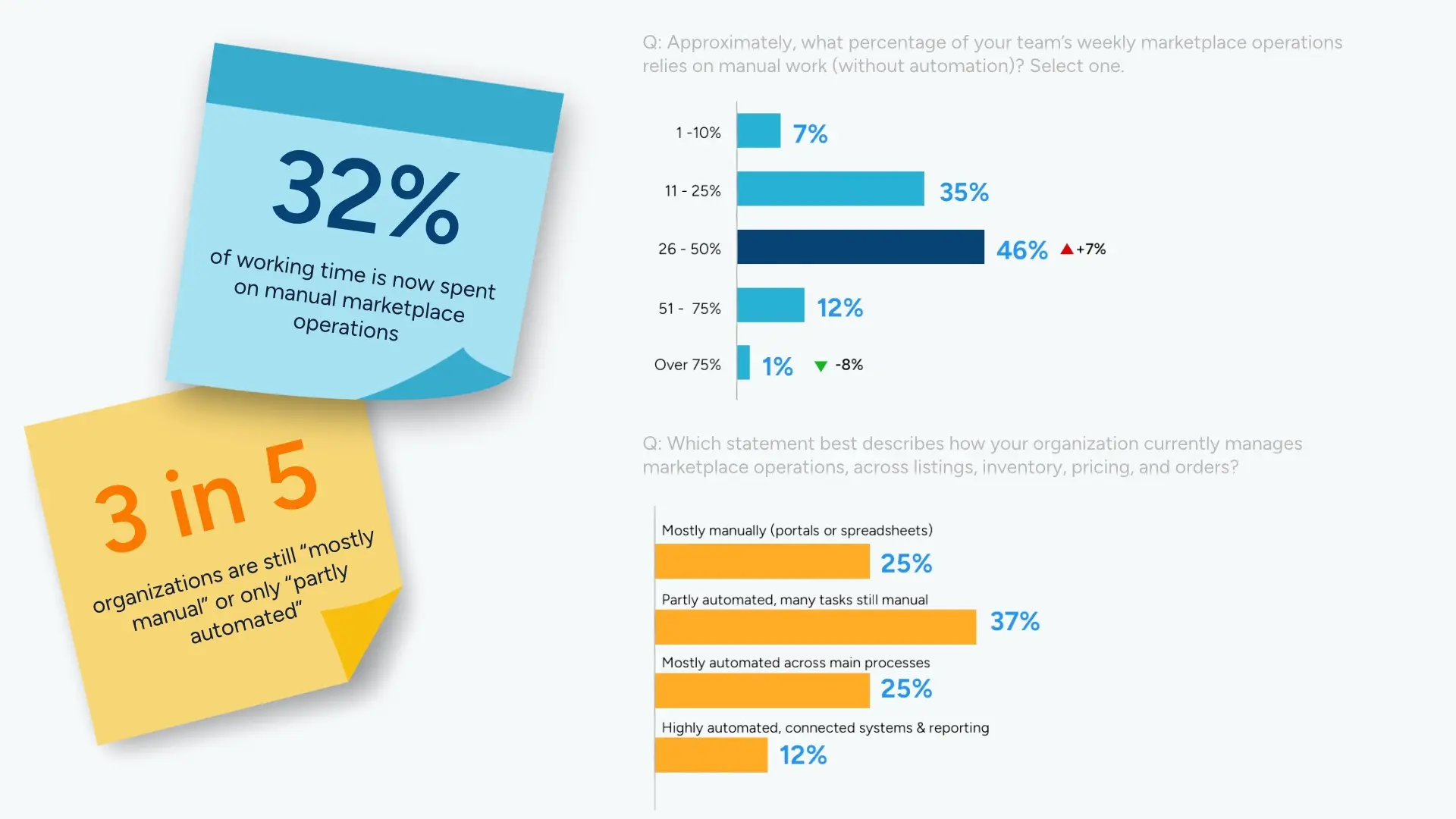
A year ago, our marketplace seller trends research found that manual tasks accounted for 36% of the average marketplace team's working week. In 2026, that figure has fallen to 32%. That's progress, but it doesn't tell the whole story.

AI is moving rapidly into marketplace operations. Automation is high on the priority list. Businesses are using technology across content, pricing, inventory, reporting, advertising, forecasting, and more.

Yet ChannelEngine’s Marketplace Sellers Research 2026 shows a significant gap between that ambition and operational reality. Only 12% of organizations describe their marketplace operations as highly automated, with connected systems, workflows, and reporting. Another 25% say their main marketplace processes are mostly automated. But 37% remain only partly automated, with many tasks still requiring manual work, while 25% describe their operations as mostly manual.
Automation gap

The automation gap remains, even as adoption accelerates. For marketplace sellers, the next step is turning individual automated processes into connected operations that can handle increasing marketplace complexity without adding the same level of manual work.


Technology adoption is only part of the automation picture


With manual work still taking up a significant share of marketplace operations, sellers are looking to technology to make those operations more efficient.

That shows up clearly in their priorities for the year ahead. When we asked sellers about their top priorities for marketplace success over the next 12 months, implementing AI to improve marketplace operations ranked first, at 26%. Increasing automation was also a priority for 20% of respondents.

And this isn't just future ambition. 39% of organizations describe themselves as early adopters, actively integrating AI into their workflows, while another 43% are fast followers adopting tools as they become proven. Only 2% say they are not currently planning to adopt AI in marketplace operations.

Yet the extent of AI adoption sits in contrast with the maturity of marketplace automation overall. AI can support individual activities without removing the manual work that connects them.

A business might use AI to optimize product content while still making manual updates in marketplace portals. Inventory may synchronize automatically while returns require intervention. Pricing, orders, and reporting may each be supported by different tools, while teams still need to step in between systems.

Individual processes may be becoming smarter and more automated, but that doesn't necessarily add up to a highly automated marketplace operation.

Partial automation still leaves plenty of manual work


If we look underneath the headline automation figures, the remaining friction becomes clearer. Product content and pricing are a good example. More than half of organizations, 52%, use product feeds to manage content and pricing updates. Yet 45% still use manual updates through marketplace portals, and 43% use internal tools or spreadsheets.

Similar uneven adoption also shows up across day-to-day marketplace operations. Nearly half of organizations, 47%, frequently encounter manual effort when launching new products on marketplaces. Complex return handling is frequently experienced by 46%, while 45% frequently encounter product listing errors or outdated information and inconsistent product content across multiple marketplaces.

These findings show how manual work remains embedded across marketplace operations, with teams still stepping in between systems, processes, and marketplaces to keep workflows moving.

 📋 Download the Marketplace Seller Report 2026


The Marketplace Sellers Research 2026 surveyed 550 ecommerce marketplace decision-makers across the US, UK, France, Germany, and the Netherlands.

Learn more about marketplace expansion, profitability pressures, operational challenges, automation, AI adoption, and the priorities shaping marketplace strategy in 2026. 

👉 [Download the full report here]

Manual work has a measurable business cost


Fragmented operations do more than consume time. They have measurable consequences for cost, growth, and performance.

Among organizations that rely on manual marketplace processes, 37% report higher operational costs, making it the most commonly cited impact. Another 34% say manual processes slow expansion into new marketplaces, while 33% report more listing, pricing, or inventory errors. Nearly a third (30%) point to missed sales opportunities.

There is also a significant opportunity cost. 32% say manual processes leave them with less time to optimize marketplace performance, while 28% have less time for advertising and promotional planning.

The trade-off is clear: time spent keeping marketplace operations running is time that cannot be spent improving performance. That means less capacity to analyze results, refine pricing, improve product content, or pursue new growth opportunities.

As profitability becomes a bigger priority for marketplace sellers, that trade-off matters even more. Automation can create capacity for teams to focus less on maintaining operations and more on the decisions that improve marketplace performance.

The automation gap naturally becomes more visible at scale


Organizations managing more than 10 marketplaces are significantly more likely to spend a larger share of their week on manual marketplace operations. Among businesses spending more than half their time on manual work, 23% operate across 10 or more marketplaces. That compares with just 6% among those spending 25% or less of their time on manual work.

The research suggests that operational complexity can grow faster than automation as businesses expand across marketplaces. Each additional channel brings its own requirements around listings, pricing, inventory, orders, returns, and reporting.

Processes that are manageable across a handful of channels can become harder to sustain when they need to be repeated or adapted across a growing marketplace portfolio.

For sellers with growth ambitions, this raises an important question: can the operating model absorb additional marketplaces without manual work growing at the same rate?

Closing the gap requires more than adding tools


One temptation is to solve this by continuing to add tools. But marketplace technology stacks are already crowded.

Sellers are using a broad mix of technology across marketplace operations, including AI tools, ecommerce platforms, pricing tools, analytics platforms, ERP systems, inventory solutions, and listing automation. On average, organizations use three different types of tools to support their marketplace business. 

The challenge is making those tools work together. When different parts of the operation are automated separately, teams can still end up manually moving information, resolving exceptions, or coordinating processes between systems.

Closing the automation gap therefore means looking at how work moves across the entire operation and identifying where those handoffs remain.

  • Does a product update flow through to every relevant marketplace? 
  • Do inventory and pricing changes stay synchronized across channels? 
  • Can orders move into fulfillment without another manual handoff?
  • Can teams see performance across marketplaces without bringing data together themselves?

The aim is for automation to carry through the workflow, rather than stopping at individual tasks.

➡️Reduce marketplace-by-marketplace management


Some of the biggest opportunities come from work that has to be repeated across channels.

45% of organizations still use manual marketplace portal updates for product content and pricing. The research also finds that organizations already using marketplace integrators are more likely to manage product content through multichannel software.

Centralizing those operations can reduce the need to treat every marketplace as a separate system. Product information, inventory, pricing, and orders can be managed from a common foundation while still accounting for the requirements of individual channels.

This becomes increasingly valuable as the number of marketplaces grows, because one improvement can remove repeated work across the wider portfolio.

➡️Prioritize automation that creates capacity


The number of automated tasks isn't necessarily the best measure of progress. A more useful question is what that automation gives the team back.

The research already shows where manual processes are taking capacity away: performance optimization, advertising and promotional planning, marketplace expansion, and other activities tied to growth.

Automation should reverse that equation.

If teams gain more time to analyze performance, improve profitability, optimize content and pricing, launch products faster, or expand into new channels, automation is doing more than making individual tasks faster.

Ultimately, the measure of successful automation isn't how many tasks are automated. It's how much easier the business becomes to operate as it grows.

See where marketplace automation is heading in 2026

Download the full Marketplace Sellers Research 2026
to benchmark your marketplace operations and see how sellers are approaching automation at scale.
Published on 15 October 2026
Nishkarsha Kotian
Nishkarsha Kotian is the Senior Content & SEO Manager at ChannelEngine. With a background in IT engineering and marketing, she brings a unique blend of technical expertise and creative strategy to her work. She knows what good code looks like, but also understands that great copy is what truly connects with audiences. Off the clock, she’s all about travel, good food, memes, and movies.
Nishkarsha Kotian
arrow_upward