Building the perfect marketplace management team: How the best brands do it

Learn how leading brands scale marketplace operations with lean teams, cross-functional execution, automation, and the right technology to drive sustainable growth.
Featured image for this blog post
Building the perfect marketplace management team: How the best brands do it
25:57

Marketplace growth isn’t just about being present on more channels. It’s about building a system that can scale without breaking. Many brands expand quickly, only to hit the same bottlenecks: manual processes, misaligned teams, and tooling that can’t keep up. The result? More effort, higher costs, and slower growth.

The brands that win do things differently. They build tight-knit, cross-functional teams, align their entire organization around marketplaces, and use technology to scale without adding complexity. This guide breaks down how they do it and what your team needs to replicate that success.

5 Pillars of a high-performing marketplace team


Brands succeed on marketplaces when they have a core marketplace team that can scale fast with minimum effort - one that goes far beyond rigid roles and titles, operates effectively, reduces manual processes to the bare minimum, and makes standardized workflows the norm.

Manual processes should be reduced to the bare minimum, and standardized workflows must become the norm. Successful brands all have one thing in common – they all rely on the following 5 pillars of a strong marketplace team to keep a tight focus and best sales.
Pillar 1: Clear strategy and vision


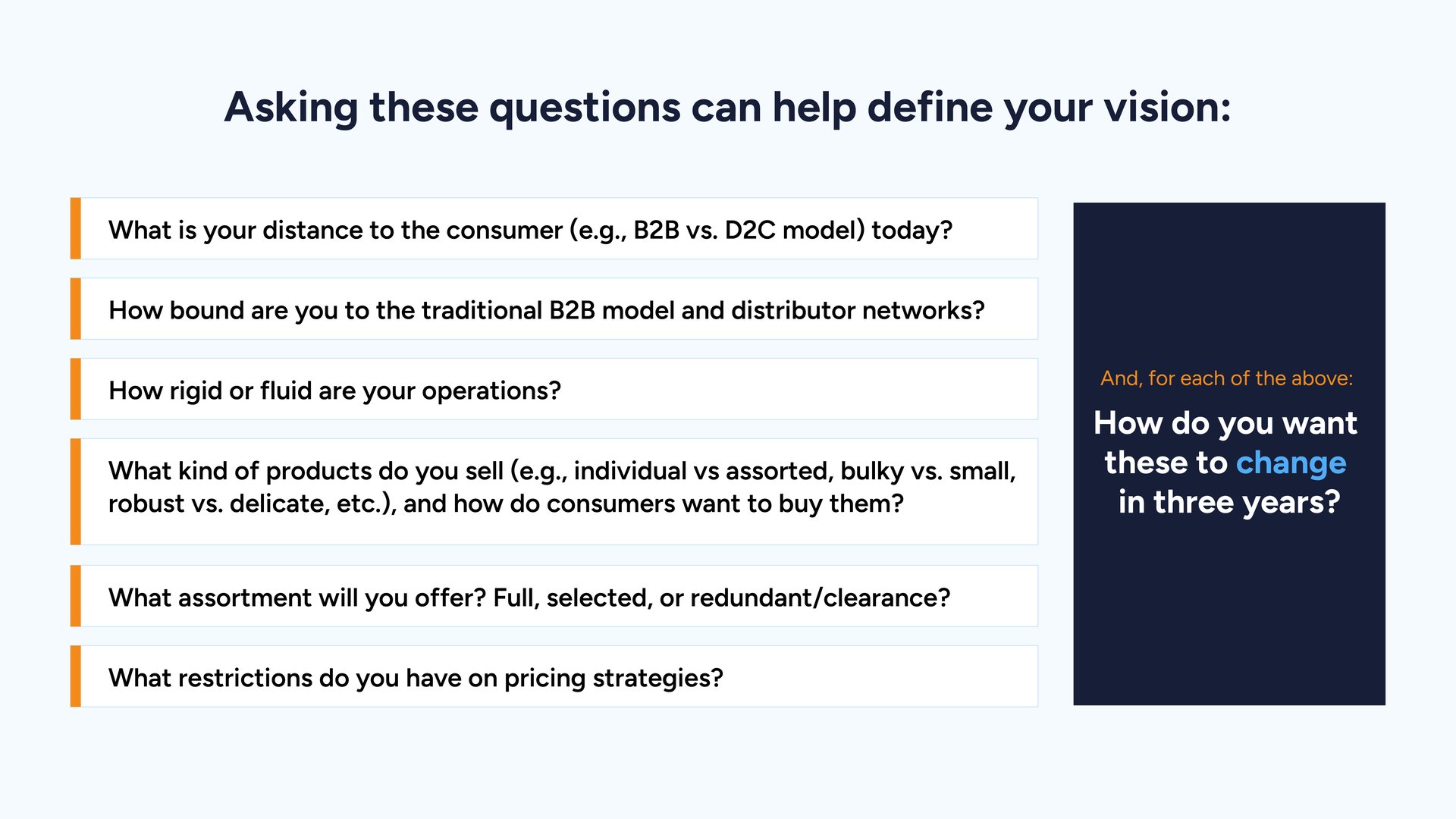
Your strategy must be crafted to match your operations and the specific products you want to sell. Brands need to map out important features of their existing operational landscape as the first step, before deciding how to proceed.

Questions can help define your vision-jpg

“After helping numerous brands scale successfully on marketplaces, I can say with confidence that having a clear vision of the current business is the foundation of any marketplace strategy.
 
“Once you really understand the current business situation, I recommend that brands determine their strategic direction with a 3-year roadmap and marketplace playbook.
 
“These are best created during the analysis and research phase, by a bare-bones project team that works closely with business leadership.
 
“The marketplace playbook should define the most important features of your operations, including selection criteria for where to sell, and enablers (tools, partners) that can help you win.”
 
Headshots - quote boxDavid Jan van den Burg
Managing Director/Executive Commercial Advisor at Consultrade

Pillar 2: Organizational alignment and ownership


Without organizational alignment, it is easy for sales to simply shift from one business area to another – without adding real revenue. This can easily happen if your 3P sales directly compete with 1P sales on the same platform.

Poor organizational alignment and silos create conflicts with marketing objectives, budgets, stock availability, and customer experience. All these will reduce your ability to win.

“There's no single role that drives marketplace success. Early momentum came from establishing a dedicated Center of Excellence - serving as a cross-functional hub across the different domains in business, supply chain, and technology, with the focus and advocacy to build this capability from scratch.

"When marketplaces represent only 10–15% of total sales, they simply won't get sufficient attention from the wider organization without that dedicated structure. That center of excellence was critical in embedding marketplace thinking across the business.

"Today we've moved past the transition phase: embedded ownership for more than 30 channels is fully integrated into the broader ecommerce setup, with D2C managers globally overseeing all relevant channels - marketplaces alongside brand.com and app.”
 
Alex BrauerAlexander Brauer
Global Platform Lead at Versuni

How brands achieve shared objectives and incentives

 
By making marketplaces an integral part of your D2C strategy, with a shared vision of ‘success’, it is easier to orient decision-making around shared goals. This relies on addressing:

Responsibility for P&L and decision-making: This must be clear for everyone. For example, is responsibility defined by category or regional market?

KPIs and incentives: Performance indicators and incentives must align with business (not departmental) objectives.

“In a mature e-commerce setup, marketplace and retail teams share the same P&L logic. The risk of siloed incentives is a left pocket-right pocket dynamic — shifting revenue between channels without creating net value. The better framing is shared customer success: One commercial outcome, regardless of which channel delivers it."
 
Alex BrauerAlexander Brauer
Global Platform Lead at Versuni

Current business: Strategy must encompass if/how to maintain the current business. Do you continue your B2B/wholesale model? How do you address current distributors? Will channel conflict emerge?

Buy Box and resellers: You don’t want to erode margins or fuel a ‘race to the bottom’ with self-competition. Well-defined roles are needed for your own webshop, resellers, and how these intersect with marketplaces and your ‘Buy Box’ strategy.

Besides being part of the company’s strategic vision, true success can only be realized when everyone walks the talk, starting with visible sponsorship from Senior Management and the MT. In addition, an adjusted bonus scheme that benefits everyone should reduce unproductive noise within the operation.

Pillar 3: Cross-functional execution


The best approach is to have a lean, core marketplace team that works closely with cross-functional teams organized around specific topics.

While you do need qualified people to handle marketplace management, it is essential that your overall strategy treats all platforms as an integral part of your business and its D2C strategy. A single marketplace manager cannot do everything on their own.

You’ll need to draw on expertise across marketing, sales, technology/IT, finance, legal, and supply chain.

Pillar 4: Data and performance culture


This pillar ensures you have reliable real-time data and metrics to drive continuous improvement.
  • Marketplace KPIs must be visible to everyone, with a good understanding of what they mean.

  • Specific and detailed KPIs (e.g. ROAS, CVR, seller rating, touchless order ratio, NPS, delivery performance) show how effective operations are and which ‘levers’ need to be pulled.

  • Transparency and accountability mean everyone can see what’s happening and take action to remediate it.


Pillar 5: Enablement layer

 
High-performing teams don't scale with headcount; they do it with efficient tooling. The tooling and infrastructure you choose will have a massive effect on your ability to run a tight team today and scale rapidly tomorrow.

With the right enablement layer, each new marketplace is easy to launch, and adding new products is efficient and mostly automated. Your enablement layer should also reinforce your performance culture with a single view over all channels and their performance.

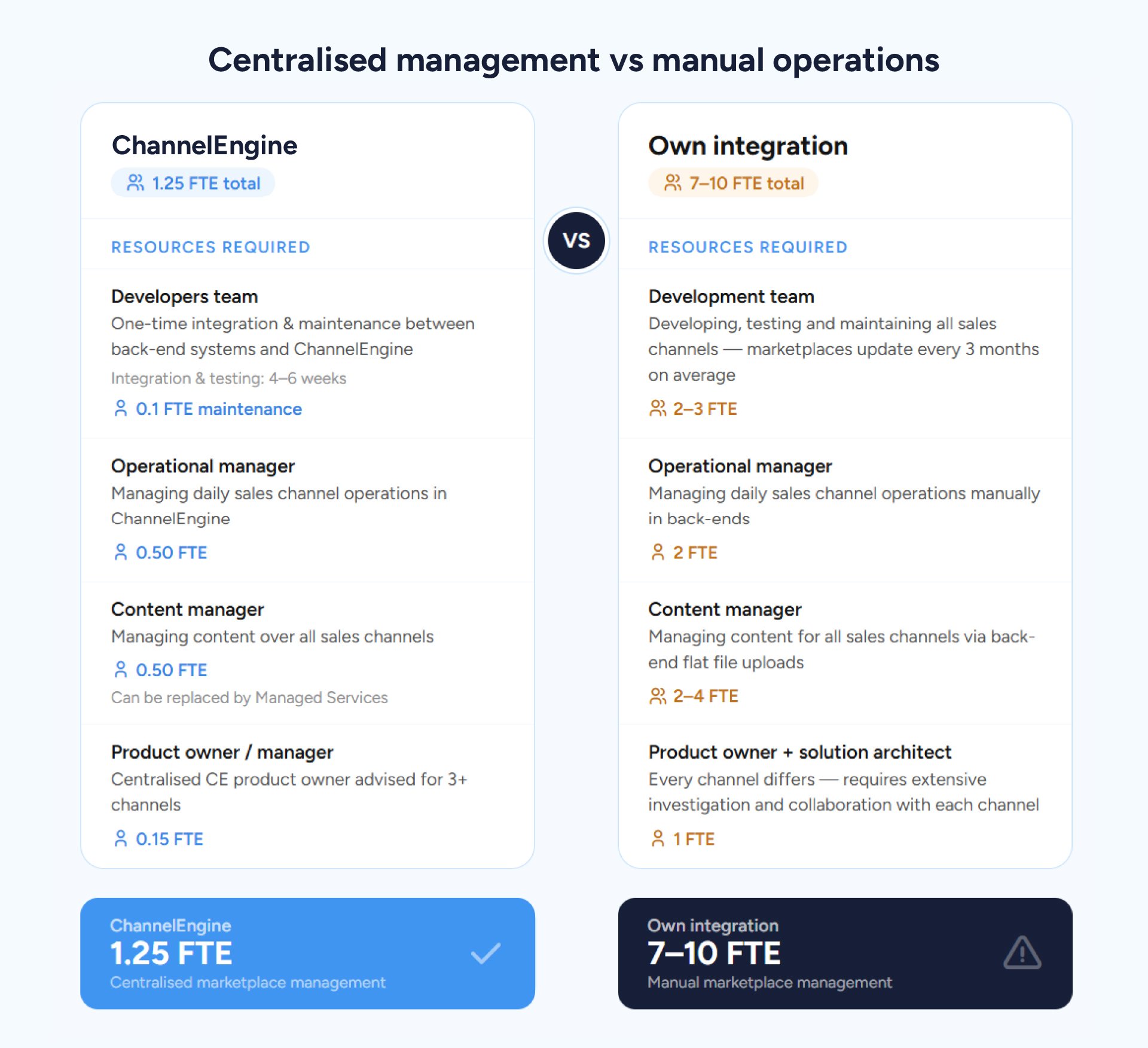
ChannelEngine vs Own integration-jpg

DIY enablement layer vs. centralized platform


Self-assembled enablement layer

 
Maintaining your own integrations and tools only becomes more complex and costly as you add more channels and regions into the mix.

Capability gaps are inevitable because your team cannot expect to assemble and maintain a toolkit that offers the same functionality as an enterprise-grade platform.

This is clear the moment you try to scale. Compared to a centralized platform, a self-managed approach requires more FTEs to manage the same number of channels.
 
This makes it harder to expand into new channels, as resources are already stretched.

Centralized platform


By using a centralized platform like ChannelEngine, all team members gain real-time visibility across all marketplaces.

Standardized workflows mean you can manage multiple marketplaces without increasing workload. This translates to significant cost savings and far greater scalability.

While you can expect to need 7-10 FTEs to run your own integrations and tooling, a centralized platform will only require 1.25 FTE.

You can achieve better results and more scalability with this approach. Because your tooling acts as a force multiplier (instead of a burden), you can run a more efficient team and scale more readily.

Team roles and responsibilities


Your team structure influences your ability to unlock economies of scale and channel expansion.
 
Roles and responsibilities are important, but you must be wary of creating an excessively rigid team structure. This makes it harder to respond quickly, and you need a lot of agility to deal with the fast-moving world of marketplaces.
 
Instead of managing and executing everything, the role of Marketplace Manager should link the business with marketplace customers by orchestrating their vision and coordinating the whole team.
 
Consultrade’s David Jan van den Burg has seen excellent results when brands adopt an efficiency-first approach to team structure. This means creating a robust and agile initial setup, with the ability to scale fast and stay lean.

“The first investment you make should be the integration or project lead, followed by the core team. This team should be lean and capable of filling multiple roles if needed. Once this is in place, you can add a scaling structure.” 
 
Headshots - quote boxDavid Jan van den Burg
Managing Director/Executive Commercial Advisor at Consultrade

Core streamlined team (initial setup)

 
Requiring just 3-4 FTEs this team can initially manage 1-3 marketplaces in one country.

  • Marketplace Manager (1 FTE): Orchestrates and directs team members (not doing everything themselves). Responsible for forecasting, merchandising, and campaign management.

  • Tech/Integration lead (0.5-1 FTE): Works with technology partners to ensure smooth integration with internal processes. Tests the offer feed (in a sandbox environment) and educates the team on new tech features.

  • Marketing/Content (0.5 FTE): Responsible for managing product content and coordinating marketing activities.

  • Pricing analyst (0.2 FTE): Sets pricing rules, manages pricing tools and re-pricing engines.

  • Operations/Supply chain (0.5 FTE): Coordinates downstream operations, including fulfilment, replenishment, returns, order flow, procurement, and supply chain partners.

  • Customer support (0.5 FTE): Takes care of customer service, using automations to minimize manual processes, and  safeguards seller ratings.

  • Finance support (0.2 FTE): Ensures budget availability and cash flow. Invoices 1P sellers, issues refunds, and makes claims.


When you’re ready to expand into more channels and regions, the next step is to start creating your scaling structure.

Top Tip 💡


The team should be English speaking, and a second language is a plus. This broadens your options for expansion. Also, choosing a central location for Tech and Marketplace managers helps to reduce idle time during integration, maintenance, and issue resolution.

Scaling structure


Scaling is how brands win on marketplaces. However, scalability relies on reducing friction wherever possible.

We’ve already seen how tooling can make a massive difference by making it easier to handle new channels with a centralized platform and standardized internal processes. This next stage is about simplifying your business model and using specialist expertise to gain the maximum benefit.

  • Marketplace Director: A weekly huddle with the Director and peers maintains clarity as operations expand.

  • Team Leads: One per 3-5 marketplace managers.

  • Business Development: This can initially be the Director (above)

  • Customer Success / Launch roles: Act as project lead in partnering with new marketplaces, coordinating with internal stakeholders. Once the store is live and the revenue threshold is attained, the channel is handed over to the marketplace manager.

  • Legal / compliance support (part-time) (0.5 FTE): These can be essential when expanding into new jurisdictions.

"With this recommended team structure, a Marketplace Manager should be able to scale operations to manage between 6 to 8 channels. However, this relies on the right tooling in the enablement layer.
 
In this context, platforms like ChannelEngine are essential for running a lean marketplace team.  Without a capable enablement layer, you will need more FTEs to manage the same workload."
 
Headshots - quote boxDavid Jan van den Burg
Managing Director/Executive Commercial Advisor at Consultrade

✏️ Case study
 
One of Europe’s leading Home and Garden e-commerce brands successfully scaled its marketplace operations by leveraging a clear strategy, roadmap, playbook, and tooling to manage 100+ channels across 20+ countries with just 30 FTEs.
 
This is a tenfold increase in efficiency, compared to the initial setup scenario, due to the economies of scale generated by efficient tooling and standardized processes.
 
They reduced complexity by avoiding channels that add extra work (e.g., special image formats or packing instructions), and prioritized countries adjacent to current markets or where existing channels were also present. They also leveraged local ‘hero’ marketplaces and channels based on Mirakl.  

Top Tip 💡


Make sure you pressure test the return, refund, and claim flows. These are easily overlooked, but have the biggest impact on customer experience, ratings and reviews, as well as relations with the marketplace.

Operating models that shape teams

 
A nimble, agile team structure means you can adjust it to fit your business model.  This is an important feature, because 1P and 3P require very different levels of effort in various areas.
 

1P 


This requires the least effort, but also provides very little control.
 
The marketplace is the first-party seller. To start, you need to agree on the purchase price, sign the contract, deliver the content, and ship stock. Then, you just need to backfill stock, process returns, and provide marketing support when needed.
 
However, with no control over how your products are sold, your brand is exposed to risk. You cannot control customer experience or pricing. Plus, if using consignment delivery, you still have the risk of inventory.
 

3P (direct) 


This asks for much more effort, but gives brands a lot of control. The brand handles all selling tasks, determines your own pricing, can manage content directly, and handles fulfillment and shipping to the consumer. Brands also need to handle returns, refunds, customer service, promotions, and marketing.

You’re in the driver’s seat with this model. So, your brand can offer a full assortment and has access to data and analytics. This control means you can manage your risk through operational excellence.

3P (indirect) 


This involves more effort than 1P, but less effort and less control than direct 3P.

Your brand handles all the backend marketplace processes, but leaves warehousing and fulfillment to a 3P partner.

Your risk exposure depends on your partners. There may be conflicts of interest if the partner also handles a competing brand, and when inventory is owned by a 3P partner, you cannot control pricing. Likewise, the marketplace connection and data are owned by the partner. Without clear legal arrangements in advance, it can be hard to get out of these relationships.

"Outsourcing was never a strategic option for us – we learned that the hard way. Our past reliance on distributors cost us visibility, inventory flexibility, and ultimately margin. Agencies still play a role in specialized areas like media buying, but core marketplace expertise needs to sit in-house. Rebuilding that capability was the only way to stay in control and scale effectively.”
 
Alex BrauerAlexander Brauer
Global Platform Lead at Versuni

Hybrid


The hybrid model is high-effort and high-reward. It combines 1P with the direct 3P model. This is a ‘dream scenario’ where you can gain the best of both, but it is also complex to manage without suitable tools. While your most in-demand items are handled by 1P, you’re free to offer your full assortment directly to the consumer via 3P. This can create a very steady revenue stream while balancing your risk.

To avoid legal issues, 1P and 3P will need to be managed by separate teams or have a clear ethical policy (a.k.a. ‘firewall’) where certain information (e.g., pricing) is not discussed. Making this model work also depends a lot on sufficiently sophisticated marketplace tooling.

Ways of working

 
The way your team collaborates makes a huge difference to how effective it can be. When Versuni (formerly Phillips Domestic Appliances) launched their products on marketplaces, they quickly found that their team could be more agile and responsive by operating in a ‘squad-like model’.
 

👉 A proven collaboration model

 
Instead of fixed teams, specialist roles across multiple functions are brought together to tackle each topic. Roles like D2C fulfilment specialists focus on achieving the most efficient delivery, while media specialists and planning experts focus on their roles.
 
When a topic is identified, relevant specialists form a ‘squad’ and use their own skills to address needs quickly.
 

👉 Breaking silos

 
According to Versuni, integrating marketplace and retail teams can help ensure marketplace strategy is treated as part of the broader business, not as a separate side project.
 
To break down silos, you should use common incentives, KPIs, and goals that help maintain this alignment. This prevents friction. For example, without an integrated vision, it may not be clear if a brand awareness campaign has priority over conversion-driven events like Prime Day. Or logistics can struggle because of poor planning and forecasting.

Top Tip 💡


An intelligent ‘traffic light’ system can signal operational burden to upstream and downstream team members. If customer service is already overloaded, the sales and marketing team can take steps to avoid putting even more pressure on (e.g. pricing promotion).

👉 Automation as a force multiplier

 
Instead of requiring exponentially more effort and creating bewildering complexity, each new marketplace or region should be easy to manage. The only way to do this is to use automation as a force multiplier.

This simple principle has a huge impact on your growth on marketplaces. It allows a small, agile team to handle many more channels. You can use the same standardized processes to manage different marketplaces, even when their requirements are different.

Versuni discovered these benefits for cross-border scaling.  When launching 3P Amazon in France, the team could simply copy the same strategy they had already perfected for 3P Amazon in Germany.

Only one interface is needed to manage all marketplaces around the globe, and all the necessary resources, tools, and workflows are at their fingertips. Furthermore, AI-powered automations can save time on the most repetitive processes, including content creation, customer service, and listing management.

“Automation and tooling are what made the shift real. By standardizing and harmonizing workflows globally, a lean team can manage multiple marketplaces at once — with full visibility across every channel. For us, that platform is ChannelEngine."
 
Alex BrauerAlexander Brauer
Global Platform Lead at Versuni

👉 What breaks without automation

 
Automation isn’t just needed for efficient scaling. It also helps to prevent cascading failures in the face of growing operational complexity. This is all too clear when automation fails.

Let’s imagine your integration for shipping notifications and order updates breaks due to an outdated API. It seems small, but the knock-on effects can be catastrophic. 

  • First, customers don’t receive their shipping notification or tracking info
  • That means a higher burden on customer service.
  • Before long, your contact center is overwhelmed with unhappy customers, and your seller rating will suffer.
  • But that’s not the worst part. Because the order updates aren’t being synced with Amazon, the marketplace thinks you haven’t shipped the items at all.
  • Then, all those orders you’ve already sent to customers are cancelled by the marketplace, and refunds are issued.

This further impacts your seller performance and creates a difficult situation where you need to accept the loss or get customers to return items. Without a workflow for processing these returns or issuing return labels (for orders that were ‘never sent’), you’re left with a huge mess.
 
A cascading failure can happen very easily when a small part of your automation breaks. In peak periods, this can be even worse. So, this is another strong argument for using a centralized platform that is continuously maintained and updated on your behalf.

💀 A nightmare scenario


During 11-11 in Southeast Asia, a major brand seemed not to be receiving any orders.

Anticipating a surge in overnight orders, the fulfillment team was unable to do anything. To reduce overheads, the team was sent home.

In reality, the orders were just delayed due to a downed server. When the server came back online, thousands of orders appeared within seconds. 

The morning shift arrived at the fulfillment center to find those missing 20,000+ orders that had been in limbo overnight.

Meeting service expectations wasn’t just hard – it was impossible. Seller performance and customer satisfaction were seriously affected, and all due to a breakdown in automation.

The lesson: reduce risk and complexity, and use a single provider you can trust for all automation.

👉 Why centralized automation makes all the difference

 
A centralized marketplace integration platform like ChannelEngine greatly reduces your operational complexity. As well as needing a single interface for all marketplaces, you only need to manage a single integration instead of maintaining dozens of APIs and tools.

Standardization is also a significant benefit for your marketplace team. You create workflows that can be used across multiple marketplaces and regions. Order management becomes a single process, and content management can be centrally managed.

With a single view across all platforms, you also have a clear view of seller performance. You can continuously monitor performance and quickly take action when issues arise.

Alerts and notifications mean you can always keep tabs and prevent cascading failures from getting out of control by taking prompt action upstream.

Lessons from mid-sized brands

 
Compared to enterprises that have established teams and ‘limitless’ resources, mid-sized brands can easily feel that they are at a disadvantage.

But the truth is more nuanced than that. In many cases, mid-sized brands actually have the edge over larger organizations. A smaller team makes it easier to gain clarity over priorities and form a single vision.

Also, instead of trying to support marketplaces as an ‘add-on’ to the existing business, a mid-sized brand is more agile. They are often better able to integrate roles and can adapt more easily when needed.

The key to marketplace success isn’t the availability of resources or the size of your organization; it’s the ability to execute effectively by using the fewest resources to produce the greatest impact.

This is why lean teams with clear leadership are always the most successful, regardless of the size of the organization. Provided they have the right technology in their enablement layer, they can move fast, make rapid decisions, and grow quickly when they need to.

❌ What goes wrong What works instead
Treating marketplaces as a side project, with unclear priorities and ownership Make marketplaces a core part of your strategy, with clear ownership, defined P&L responsibility, and shared KPIs across teams
Hiring a single “do-it-all” manager and expecting them to own everything Build a cross-functional team where a Marketplace Manager orchestrates expertise across functions
Letting teams work in silos with misaligned incentives Align teams around common goals, ensuring collaboration between commercial, operations, and marketing
Relying on manual processes and patching together fragmented tools Invest early in integrated systems and automation to create a single, scalable source of truth
Delaying building the right infrastructure, as it will be slow and error-prone Standardize processes and implement the right tooling early so each new channel adds minimal complexity
Operating with limited data visibility and weak analytics Build strong analytics and performance tracking so you can proactively optimize and react quickly to changes
Scaling without structure or clear governance Introduce clear roles, governance, and a scalable model where managers can efficiently handle multiple channels
Outsourcing marketplace capabilities too early and losing internal know-how Build internal expertise in key areas like pricing, content, and merchandising, while selectively using external support


Want to assess how scalable your current marketplace setup really is?

Book a free consultation call to discuss your marketplace strategy, team structure, operational challenges, and growth opportunities with our experts.
Published on 27 May 2026
Courtney Samok
Courtney Samok is the Regional Marketing Manager for North America at ChannelEngine, where she leverages her expertise in marketing strategies and event planning to drive regional growth.
Courtney Samok
arrow_upward