AI is the new co-shopper, but shoppers still want to have final say

Nishkarsha Kotian
24 February 2026
In 2026, AI is shaping product discovery, but shoppers still rely on marketplaces for trust and final decisions. The Shopping Behavior Report reveals where AI influences and where confidence wins.
Featured image for this blog post
AI is the new co-shopper, but shoppers still want to have final say
7:38


Picture a shopper planning to buy a new pair of noise-cancelling headphones. Instead of opening three marketplace tabs and scrolling through endless listings, they open an AI assistant and type: “Compare the best noise-cancelling headphones under 300 euros for travel and remote work.”

Within seconds, they receive a clean summary. Key features compared. Battery life highlighted. Pros and cons outlined. A shortlist created without the usual overload of tabs and filters. This is how product discovery is evolving in 2026. AI is becoming the first stop for many shoppers, helping them narrow choices before they ever land on a product page.

But when it is time to commit, behavior shifts. Shoppers still return to marketplaces to read reviews, compare sellers, validate pricing, and confirm delivery details. The Marketplace Shopping Behavior Report 2026 shows a clear pattern: AI may shape the shortlist, but marketplaces remain where confidence is confirmed, and purchases are completed.

AI is already shaping product discovery


Our research finds that more than half of shoppers, 58%, have used AI tools to research products. ChatGPT leads usage, with 33% of consumers saying they have used it during their shopping journey. For many consumers, AI now plays an early role in the journey:

  • Comparing similar products
  • Summarizing specifications
  • Recommending alternatives
  • Highlighting perceived best value options

For some shoppers, AI replaces the first round of manual marketplace browsing. Instead of scanning multiple listings, they ask a single question and receive a condensed answer. This marks a real shift. Discovery is fragmenting. Marketplaces are no longer the only starting point. But influence does not equal transaction.

Shoppers prefer established purchase environments


When shoppers were asked whether they would purchase directly through an AI assistant rather than going to a marketplace or brand site, the response revealed hesitation

  • 17% would be comfortable purchasing this way
  • 32% would consider it for some products
  • 43% prefer to purchase via a marketplace or brand site

Nearly half are open to AI-led commerce. But almost as many explicitly prefer established platforms like a marketplace or a brand site. This is not a rejection of AI. It is a preference for environments that feel structured and secure.

The trust gap behind the hesitation


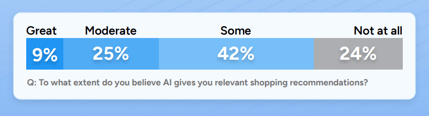
ChannelEngine’s research report goes deeper than willingness to transact. It also examines how relevant shoppers find AI recommendations, as shown below: 

AI relevant shopping recommendations - Marketplace Shopping Behavior Report 2026

  • 9% say AI gives great recommendations
  • 25% say moderate
  • 42% say some
  • 24% say not at all

The largest share of shoppers, 42%, say AI provides only some relevant recommendations. Nearly one in four say it does not provide relevant recommendations at all. This is the trust gap.

AI is clearly useful. It helps narrow options, summarize differences, and reduce early-stage overwhelm. But “some” relevance is not the same as confidence. It suggests that shoppers still feel the need to double-check what they are being shown.

Why marketplaces still anchor the final decision


The broader findings reinforce this behavior.

  • 60% of shoppers hesitate to buy products without reviews
  • 95% notice price differences across platforms
  • 53% compare the same product across multiple marketplaces before purchasing

Shoppers want to see star ratings, read reviews, compare sellers, and check delivery timelines. They want to confirm price consistency across platforms. That validation step is built into the marketplace experience.

AI tools can summarize options, but they do not yet provide the same depth of proof. They do not host review ecosystems. They do not show side-by-side seller comparisons. They do not standardize fulfillment expectations. So even if AI surfaces the product, shoppers return to marketplaces to verify it. That is the structural advantage marketplaces hold.

That is why marketplaces remain central. Marketplaces provide layered validation. Reviews, seller ratings, detailed product content, delivery timelines, and return policies all serve as reassurance mechanisms. They allow shoppers to confirm that the recommendation holds up under scrutiny. AI may influence what makes the shortlist. Marketplaces are still where that shortlist gets verified.

Until AI consistently delivers highly relevant, transparent, and explainable recommendations, shoppers will continue to use it as an assistant, not as a decision-maker.

Download the full Marketplace Shopping Behavior Report 2026


AI is only one part of the story. The Marketplace Shopping Behavior Report 2026 is based on a survey of 4,500 marketplace shoppers across the US, UK, France, Germany, and the Netherlands, and explores:
  • Why marketplaces remain central to validation, reviews, and final purchase decisions
  • What drives trust at checkout, from pricing consistency to seller transparency
  • How cross-border buying behavior continues to evolve

👉 [Download the full report here] to see how shopper expectations are changing in 2026, and what it means for your marketplace strategy.

The competitive shift: Visibility now depends on data quality


If AI is acting as a filtering layer before shoppers even reach a marketplace, the battleground changes. The question is no longer only “Can shoppers find your product?” It becomes “How accurately is your product represented across systems?”

AI tools summarize and recommend based on structured inputs. Marketplaces rank and display products based on completeness, consistency, and performance signals. In both cases, product data is the foundation. When content is inconsistent across channels, three things happen:

1. AI summaries become less precise
2. Price comparisons expose discrepancies
3. Trust erodes faster during validation

The report frames marketplace success as an information strategy. In an AI-assisted ecosystem, that insight becomes even more strategic. Brands are no longer optimizing for one interface. They are optimizing for multiple interpretive layers, including AI tools, marketplace algorithms, and comparison behaviors.

What this means for brands and retailers:


The rise of agentic commerce does not reduce the importance of marketplaces. It increases the importance of operational precision. Winning brands will:

  • Treat product data as a strategic asset rather than a feed requirement
  • Maintain pricing alignment across marketplaces to avoid credibility gaps
  • Prioritize review generation and authenticity signals
  • Standardize seller identity and fulfilment communication
  • Ensure product content is structured for both human and machine interpretation

In 2026, AI is embedded in the customer journey


Looking ahead, AI will become even more deeply integrated into the customer journey. It will continue to reduce friction, refine discovery, and surface options with increasing precision. But even as assistance grows more intelligent, the fundamentals of buying behavior will remain steady.

Shoppers will still seek validation. They will still compare alternatives. They will still expect control and transparency at the moment of purchase.

Selling on AI channels should not be treated as an isolated strategy. Instead, understand its role as an influence layer within a broader commerce ecosystem.

As the confidence economy evolves, meaning a market where trust matters more than access to information, the gap between assistance and assurance will define performance. When AI can surface endless options in seconds, confidence becomes the real differentiator. The brands that invest in clarity, consistency, and trust at every touchpoint will be the ones that turn AI-driven product discovery into measurable growth.

👉 Download the Marketplace Shopping Behavior Report 2026 to benchmark your marketplace approach against how shoppers really buy today, from discovery to comparison to the final click.
Published on 24 February 2026
Nishkarsha Kotian
Nishkarsha Kotian is the Senior Content & SEO Manager at ChannelEngine. With a background in IT engineering and marketing, she brings a unique blend of technical expertise and creative strategy to her work. She knows what good code looks like, but also understands that great copy is what truly connects with audiences. Off the clock, she’s all about travel, good food, memes, and movies.
Nishkarsha Kotian
arrow_upward