
Selling on marketplaces is one of the fastest ways for brands to expand reach, acquire new customers, and grow revenue. But growth alone is not enough. Increasing competition, rising costs, and more complex buying behavior mean that brands must focus on profitability just as much as volume.
The brands that succeed in 2026 will build growth on a disciplined profit foundation.
Why profitability is harder than ever
Marketplace selling has become more complex for 3 key reasons:
1. AI driven buying behavior is accelerating
According to the Marketplace Shopping Behavior Report 2026, marketplaces remain the primary starting point for online shopping, with 37% of consumers beginning their journey on a marketplace. But discovery is no longer limited to marketplaces alone.
Over 58% of shoppers have already used AI tools to research products, and 33% specifically use ChatGPT during their shopping journey. Nearly half of the shoppers we surveyed say they would either purchase or consider purchasing through an AI assistant.
AI-driven product discovery makes disciplined pricing and centralized data a profitability requirement, not just an operational nice-to-have.
2. Price sensitivity and comparison behavior are intensifying
Price remains the strongest purchase driver, with 48% of shoppers citing lower prices as their top decision factor, but it goes further.
A striking 95% of shoppers notice price differences across marketplaces, and 53% always or often compare the same product across multiple platforms before buying. On average, shoppers browse three marketplaces before making a purchase decision.
In this environment, inconsistent pricing immediately weakens trust. Margin discipline must coexist with competitive alignment across channels.
3. Cross-border expansion adds cost volatility
Cross-border commerce continues to grow, with 58% of shoppers having purchased from a marketplace outside their home country. At the same time, 46% avoid overseas marketplaces due to trust concerns, especially around returns and delivery reliability.
Expanding internationally creates opportunity, but also introduces tariff exposure, VAT complexity, currency considerations, and localized fulfillment costs. Static pricing cannot keep up with this volatility.
Increased comparison, AI discovery, and cross-border volatility all compress margins. To protect them, you first need clarity on where your profit is actually generated.
Understanding where your profit really comes from
Before optimizing pricing or scaling to new marketplaces, as a brand, you must understand your true cost structure. Marketplace profitability is influenced by more than commission rates. A complete view should include:
- Marketplace commission, often ranging between 5 and 25 percent
- Payment processing or platform-specific fees
- Middleware or integration costs
- Pick and pack costs per item
- Packaging and outbound shipping
- Return handling and return postage
- Advertising spend
- Storage and inbound logistics
Looking only at top-line revenue or GMV hides the real picture. Profitability must be calculated at the SKU level and per channel. Contribution margin is what remains after marketplace commission, fulfillment, returns, and operational costs are deducted from revenue. This is the metric that determines whether a product truly generates profit.
A high GMV with thin margins can generate less net profit than a smaller but healthier portfolio.
Want the full profitability framework?
If you want a step-by-step breakdown of contribution margin logic, cost structures, and minimum price calculation, download:
(Instant access. No forms to fill.)
Choosing the right selling model:
Profitability on marketplaces depends on the selling model chosen. You can either act as a 3rd-party seller (Amazon Seller) or a 1st-party vendor (Amazon Vendor), each with different cost structures and profit potentials. Here's how they compare:
3rd-party seller (Amazon Seller):
This model allows brands to sell directly to customers on marketplaces like Amazon. It provides higher revenue potential since you can set your prices and control your margins. However, in this case, you are also responsible for fulfillment, customer service, and marketplace fees, which can impact profitability. With effective pricing strategies and cost management, sellers can achieve strong profit margins while maintaining competitive pricing.
1st-party vendor (Amazon Vendor):
In this model, you sell your products in bulk to Amazon, and the marketplace then resells your products to customers. While this approach offers stability and removes some operational burdens, it also has lower revenue potential because as a brand, you will have less control over pricing. The profit margins are typically lower, but the advantage is reduced selling expenses and operational complexity.
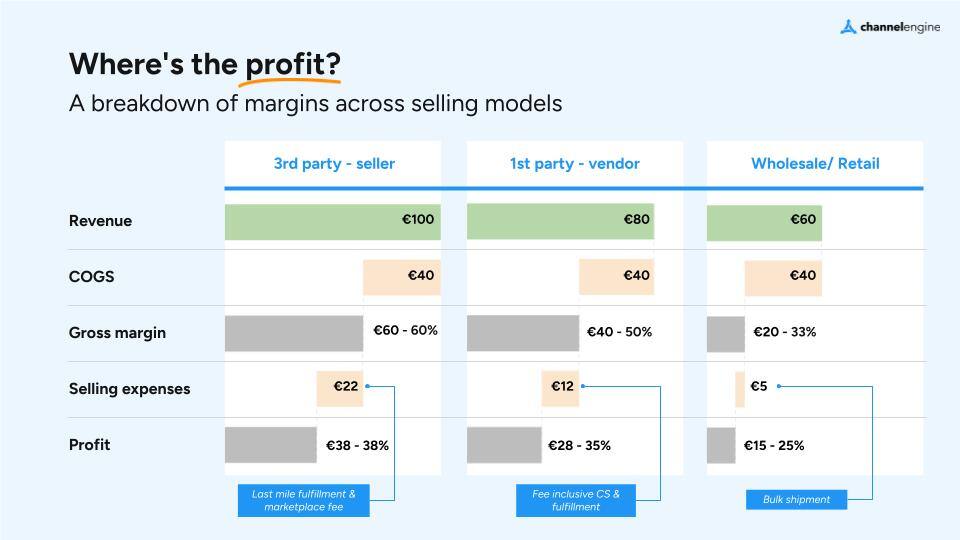
There is no universal best model. The right approach depends on your operational maturity, margin targets, and channel strategy. What matters most is aligning your selling model with clear profitability goals.
Profitability is also a channel strategy
Not all marketplaces operate the same way, and not all of them should play the same role in your growth strategy.
Large generalist marketplaces offer scale and visibility, but they often come with intense competition, aggressive pricing dynamics, and higher advertising pressure. While these platforms can drive significant volume, that volume does not automatically translate into higher net profit. In highly competitive environments, margins are frequently compressed, and advertising costs can erode contribution margin quickly.
Smaller or more curated marketplaces may generate lower volume, but they often provide stronger margins and more stable pricing environments. With less direct price competition and a more focused audience, brands may rely less on discounting and paid visibility to drive sales.
The key is not to choose one over the other, but to define the role each channel plays in your portfolio. Some marketplaces may be optimized for volume and brand visibility. Others may be optimized for margin contribution. Growth should come from deliberate portfolio design, not reactive price reductions.
Turning unprofitable products into cash cows
One of the most effective ways to improve profitability is through product bundling. Instead of selling low-margin products individually, bundling allows brands to increase per-order value while reducing fulfillment costs.
For example, selling a single low-priced item may not leave much room for profit after deducting commission fees, packaging and shipping expenses. Because shipping and pick and pack costs are largely fixed per parcel, increasing order value directly improves contribution margin. The higher the revenue per shipment, the more efficiently those fixed costs are absorbed.
However, when similar items are bundled together and sold as a multipack, brands can increase their overall margin per transaction. This strategy reduces per-unit costs and improves profitability by making each sale more valuable.
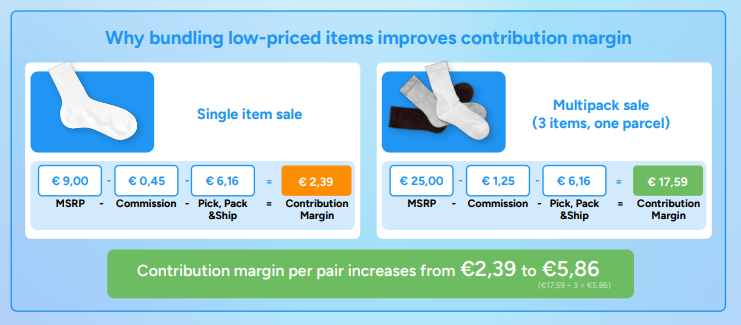
By bundling products into multipacks or virtual bundles, as a brand you can:
- Increase average order value
- Spread fixed shipping costs across higher revenue
- Improve perceived consumer value
- Protect margins without raising unit prices
Not every product is suitable for bundling. However, when applied strategically, bundling can transform low margin SKUs into consistent profit drivers.
The role of smart repricing in marketplace success
Pricing is a critical factor in winning the Buy Box and maintaining profitability. By leveraging repricing strategies and automation, brands can dynamically adjust pricing to remain competitive without sacrificing margins.
But automation without guardrails can destroy margins at scale. Successful brands use repricing strategically by:
- Setting minimum price floors per SKU and per channel
- Incorporating marketplace fees, VAT, and shipping into price calculations
- Defining clear upper and lower price boundaries
- Monitoring competitor behavior without blindly following price drops
The goal is not to be the cheapest. The goal is to be competitive while maintaining contribution margin. Minimum price should not be a guess. It should be calculated per SKU and per channel based on your full cost structure, including commission, fulfillment, VAT, and expected returns
ChannelEngine's price management solution
Maximizing profitability on marketplaces requires a data-driven pricing approach. ChannelEngine’s new Price Management solution provides intelligent tools to automate pricing decisions, ensuring you never sell at a loss.
- Ideal price point: Find and maintain the optimal price for each product, balancing competitiveness and profitability.
- Price boundaries: Set minimum, normal, and maximum price limits to ensure pricing covers costs while maximizing revenue.
- Minimum price calculation: Automatically define a minimum price that factors in all expenses and protects margins.
- Marketplace fees: Seamlessly incorporate marketplace fees, VAT, and shipping costs into pricing strategies to guarantee profitability.
- Profitability reporting: Gain detailed insights into profit margins for every product and order, helping brands optimize their pricing strategies effectively.
By leveraging our marketplace integration platform, you can automate cost calculations, prevent losses, refine your pricing models, and do much more smartly to drive long-term marketplace success.
How we helped EQOM achieve profitable growth on marketplaces
The EQOM Group (known for EasyToys) aimed to enhance profitability and expand their product portfolio by refining their marketplace strategy. With ChannelEngine as their marketplace integration partner, they were able to achieve this through strategic repricing and intelligent cost management, ultimately transforming their approach to marketplace selling.
Marketplace Specialist, EQOM Group

- BuyBox success: Optimized repricing strategies helped secure the BuyBox without sacrificing profitability.
- Higher margins: A 4.3% increase in bottom-line margins within just two months.
- Expanded portfolio: A 72% reduction in overpriced products, enabling hundreds of new listings and increased GMV.
By leveraging our price management solution, the EQOM Group successfully achieved a balance between competitiveness and profitability, ensuring sustainable growth on marketplaces.
Concluding thoughts
Profitable growth on marketplaces is not about selling more at any cost. It is about building discipline into every decision. Brands that succeed take the time to understand their full cost structures, calculate contribution margin at SKU level, choose the right selling model for their goals, and design a balanced channel portfolio. They use bundling strategically to increase order value and automate pricing with clear margin guardrails in place.
Marketplaces remain one of the most powerful growth engines available to brands. However, only those who combine scale with financial discipline will achieve sustainable, long-term success.