.jpg?width=960&height=540&name=Webinar%20LP%20Featured%20image%20(1).jpg)
In this webinar, Twan Rutten of ChannelEngine joined Jorrit ten Brummeler of Azerty and Emile Valkestijn of 10XCREW to unpack one of the hardest questions in ecommerce today: how to grow across marketplaces, social commerce, and emerging AI-driven discovery channels without losing control of profitability.
The session focused on practical tactics for enterprise brands and ecommerce leaders navigating margin pressure, rising channel complexity, and new growth opportunities in 2026.
Quick takeaway
The discussion revealed that scaling across marketplaces, social commerce, and AI-driven product discovery is more accessible than ever - but profitability is harder to protect. Most margin loss doesn't happen at the strategy level. It happens in daily execution: inconsistent pricing logic, untracked cost components, and a failure to treat each channel as its own P&L.
🎥 Missed the live session?
Here's the recording:
What we heard from the audience:
Before the session kicked off, attendees answered two polls that set the stage perfectly.
When asked about their marketplace strategy, the results were split almost evenly: 33% prioritise profit, 33% prioritise market share and volume, 20% focus on brand awareness, and 13% are looking at international expansion. In other words, there's no single "right" strategy, but there is a right foundation.
On social commerce, 72% of attendees said they're not yet selling but are actively considering it. Only 17% were currently live and optimising. This tells us the market is at an inflection point - and the first movers have a real window right now.
Top 5 takeaways
- More channels does not automatically mean more profit: Scaling is easier than ever. Staying profitable is harder. As you add channels, you also add pricing complexity, operational risk, and margin exposure, and if your cost logic isn't keeping up, revenue growth can mask a profitability problem
- Your P&L should drive your pricing, not the other way around: Azerty's transformation began when they stopped pricing based on their webshop price and started pricing from their actual cost components: purchase price, commission per channel, shipping per destination, handling, returns, and desired margin. The P&L came first; the pricing followed.
- TikTok is a demand engine: TikTok influences purchasing decisions across all your channels, not just within the app itself. Brands that understand the "halo effect" — where TikTok activity drives branded search and sales on Amazon, bol, and your own webshop — will get far more ROI from their investment than those treating it as a standalone channel.
- AI is becoming the new product discovery layer: Over half of shoppers (58%) now use AI tools to research products. AI instantly detects price gaps, inconsistencies in product data, and availability differences across platforms. If your content and pricing aren't consistent across channels, AI will expose it — and that affects your rankings and conversions.
- Start somewhere. Then make it better: Both Jorrit and Emile closed with the same advice: don't wait for the perfect setup. Start with your purchase price and commission, estimate the rest, and refine as you grow. A good-enough pricing model you actually implement will outperform a perfect one that's still in a spreadsheet.
Best practices and key learnings
Marketplace Profitability: The Azerty Case Study
Azerty is a leading IT hardware retailer based in the Netherlands, selling everything from keyboards to 49-inch monitors and their own branded gaming PCs (Xenith). They've been active on marketplaces since 2014, but by 2024, despite healthy GMV, their net margins weren't where they needed to be.
"We saw that the margins we had, the profit that was left, were not good enough based on our standards. So we knew we had to step up our game."
 Jorrit ten Brummeler,
Marketplace Specialist at Azerty
The issue was a lack of the right structure. Here's what they changed:
-
They built a structured minimum price logic. Instead of defaulting to their webshop price with a flat commission uplift, they started calculating a floor price per product per marketplace - built from purchase price, actual SKU-level commission, shipping cost per destination, and handling fees.
-
They made costs dynamic and data-driven. A small mouse and a 49-inch monitor have very different logistics costs. ChannelEngine's pricing tool lets them feed in dynamic cost data per item, replacing one-size-fits-all rates.
-
They applied brand-specific and category-specific margin rules. Accessories carry higher margins than laptops. Some A-brands carry pricing restrictions. These nuances are now baked into the logic rather than managed manually.
-
They used ChannelEngine's maximum bound pricing features. On bol, Azerty configured the system around bol's "2-star rule" to keep offers visible without breaching their minimum price. On Amazon, the same logic applies to the competitive price threshold, fetched and applied automatically.
-
They connected pricing to advertising. With clear margin visibility per SKU, they could confidently increase ad spend on high-margin products, keeping the flywheel profitable.
-
They cut the unprofitable products entirely. Some brands generated too many returns, lost-in-mail claims, and fraud incidents to justify marketplace listings. Azerty removed them.
"We knew this would happen because we needed to step up our game. But it increased our bottom margin once all costs were included."
Jorrit ten Brummeler,Marketplace Specialist at Azerty
The key lesson, as Twan Rutten reinforced, is to make sure every order that comes in actually contributes to the business.
Understanding your marketplace P&L
"Start with your P&L, take all the components out, and ask: is this order profitable for us - yes or no?"
 Twan Rutten,
 Strategic Business Growth Lead at ChannelEngine
Every marketplace order carries variable costs - primarily commission (which varies by SKU on platforms like bol, which share actual rates via API) and any middleware fees. Then there are fixed costs at the article level: pick and pack, outbound shipping, return handling, and return postage. Plus overall fixed costs: storage, inbound logistics, and monthly platform fees.
The critical insight: returns are not neutral. Most marketplaces will credit your GMV and commission, but your cost of goods sold isn't fully recovered, and the return shipment is an additional cost. Lost-in-mail claims are another hidden drain. These need to be priced in, not averaged out. The session also walked through the P&L comparison across selling models:
- 3P (third-party seller): Higher gross margin, higher selling expenses. Net profit ~38%.
- 1P (vendor/first-party): Lower gross margin, lower selling expenses. Net profit ~28–35%.
- Wholesale/retail: Lowest gross margin, lowest selling expenses. Net profit ~15–25%.
Where you sit in this structure shapes how aggressively you can price and how much you can invest in advertising.
Social commerce strategy: Making TikTok work for your brand
Emile Valkestijn has spent 20 years in e-commerce, including a decade at bol, and his take on TikTok Shop is clear: this isn't a trend to monitor. It's a channel to enter now. Social commerce currently accounts for less than 5% of total ecommerce, but projections put it at 15–25% by the end of the decade.
Here's what most B2B decision-makers miss: When someone scrolls TikTok, they're not in buying mode, but they can be moved into it. 83% of users say the platform influences their purchasing decisions. 71% have bought something after seeing it on TikTok. 70% use it to discover new brands.
The Stanley Cup story makes this concrete. When Stanley went viral on TikTok, branded searches on Amazon spiked globally. On bol, Stanley overtook Dopper, the long-established Dutch water bottle category leader, in branded search volume. TikTok created demand that converted everywhere. This is what Emile calls the halo effect, and research puts it at a 33% marketplace sales uplift across brands.
"You can't manage that (the halo effect) with a siloed strategy. You really need to approach this with a holistic view."
 Emile Valkestijn,
 Chief Commercial Officer at 10XCREW
The maturity model for getting started. 10XCREW recommends a phased approach:
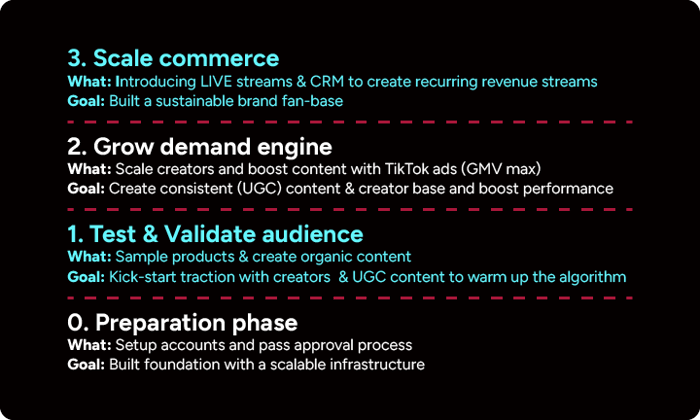
This is a 6–9 month commitment minimum. But the first-mover window in the Netherlands and Belgium, where TikTok Shop is launching imminently, is open right now.
Understanding the investment. Foundation costs run upward of €10K. Platform fees are 10–15% of GMV. Creator partnerships account for 15–30%. Paid advertising adds another 10–25%. The key is not to evaluate TikTok on direct revenue alone; the ROI calculation must include the halo effect on marketplaces and your webshop, plus the media value of creator content (100,000 views at a €5–€10 CPM equals €20,000 in equivalent reach).
That's why your TikTok Shop strategy can't sit only with the e-commerce team. Marketing, brand, and commercial leads all need a seat at the table — because it only works as a shared P&L.
AI-driven visibility: What it means for your pricing and content
AI is increasingly becoming the first stop in product discovery. ChatGPT now accounts for 33% of AI-assisted product searches. Google AI, Gemini, and marketplace-native tools like Amazon's Rufus and Perplexity account for much of the rest.
The implication for sellers is significant. AI tools aggregate product data across platforms instantly, and they expose inconsistencies. If your product description says one thing on Amazon and something different on bol, or if your pricing varies inexplicably between channels, AI will surface those gaps. That inconsistency can erode trust, affect recommendation rankings, and ultimately reduce conversion.
The session's guidance on winning visibility without triggering margin pressure: maintain strong, consistent product data across all channels, ensure channel alignment in pricing and attributes, and use smart automation to respond to market changes quickly rather than manually.
AI systems reward clarity and penalise conflicting signals. ChannelEngine is running a dedicated webinar on AI-driven commerce on April 21 - worth checking out if you want to go deeper on this topic.
🎥 Register for the webinar hereFinal thoughts
If there's one thread running through everything discussed in this masterclass, it's this: the opportunity in multichannel commerce has never been bigger, but the margin for error has never been smaller. More channels mean more revenue potential and more ways for profitability to quietly leak away.
The brands that will win in 2026 and beyond are those who treat their P&L as the foundation of everything else: their pricing logic, their channel selection, their advertising investment, and their social commerce strategy. They're not reacting to commission changes or competitor repricing after the fact. They've built systems and the right platform infrastructure that keep them ahead of it.
As Jorrit summed it up: "Just start somewhere. Just start with the purchase price and the commission and then add up some money for the rest of the cost you think you make. Try to make some estimations and then, when you are growing, try to make it more specific."
For B2B ecommerce leaders and marketplace managers, the priority is clear. Build a scalable foundation, maintain consistent product information across channels, and stay agile enough to adapt as new discovery and commerce platforms emerge.
Book a personalized consultation with our team →