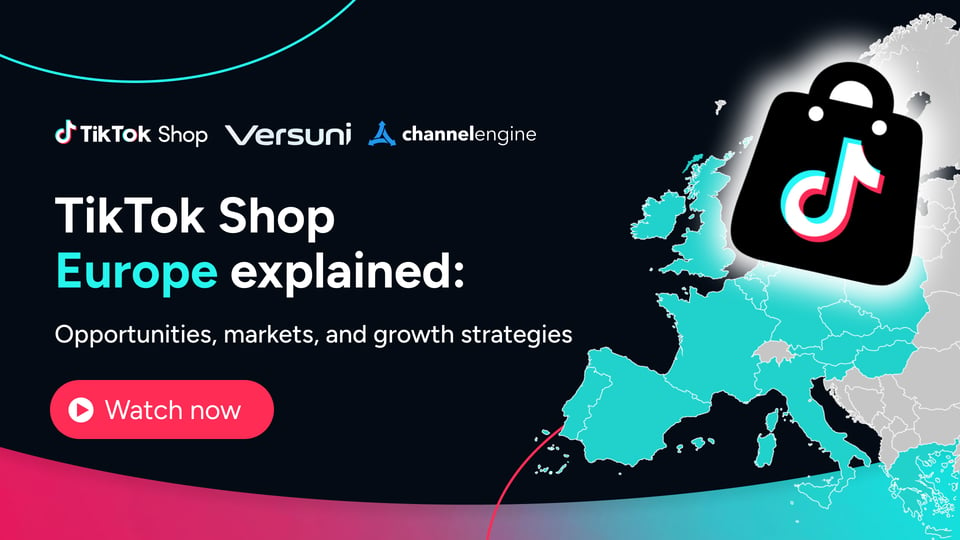
Opportunities, markets, and growth strategies on TikTok Shop Europe explained
TikTok Shop is now live in 13 European markets and has grown to become Germany's 15th-largest retailer in under a year. Here are the key takeaways from our webinar held on July 9, 2026, on how to choose your markets, set up cross-border operations, and scale social commerce across Europe.
🎥 Missed the live session? Watch the recording here:
🎙️ Prefer reading? Jump to the full webinar transcript.
Top 5 takeaways
1. The early-mover window is genuinely open - TikTok Shop only launched in the Netherlands, Belgium, Austria, and Poland in June 2025. Several countries went live just weeks before this webinar.
2. One setup, 13 markets - TikTok Shop's "Sell Across EU" feature lets brands list products centrally and push them to all active European markets, with auto-translation and shared reviews included.
3. Creators are the growth engine - organic reach is limited. The brands winning on TikTok Shop are building creator networks, running affiliate campaigns, and investing in live selling.
4. Logistics is solved - between Fulfilled by TikTok (FBT) and the 4PL carrier model, brands can sell across all 13 countries without building their own pan-EU fulfilment infrastructure.
5. Start small, start now - the platform is different enough that you need to learn it from the inside. Waiting for certainty means handing first-mover advantage to someone else.
Why Europe, and why now
If you've been watching TikTok Shop's trajectory, the European expansion isn't a surprise. What might be a surprise is the pace. In Germany alone, TikTok Shop launched just over a year ago and already ranks among the country's top 15 retailers. Ningxin Wu, who led the Germany launch before moving on to the Netherlands, Belgium, and Poland, puts the opportunity plainly: three-digit growth across the five initial EU markets in a single year.
For Alexander Brauer at Versuni, the decision to enter wasn't a question of "if"; it was a question of "when." Versuni already operates TikTok Shop as one of its most important channels in Southeast Asia and China, so the team understood the model. Europe, with around 200 to 250 million monthly active TikTok users, was the obvious next step.
What makes TikTok Shop different from a traditional marketplace isn't just the audience size. It's the direction of discovery.
TikTok has now closed that loop by embedding commerce directly into the content experience. A viewer watching a live demo doesn't need to click out to a web shop anymore; they purchase in-app.
How selling across Europe actually works
One of the more practical additions to TikTok Shop's infrastructure is the "Sell Across EU" feature, which launched alongside the recent market expansion.
Here's how it works: you register once and choose a home country, which becomes your umbrella shop. You then activate sub-shops for any of the 13 available markets from the same seller centre, with three options for how to handle listings.
The first is one-click sync, where you push listings from your umbrella shop across all active markets. The second is auto-translation, where TikTok localises your product content automatically. The third is a centralised view of orders, stock, returns, and reviews, where shared sales data and ratings flow across all market shops for the same product.
For brands already managing localised content, like Versuni, the approach is more nuanced. Alexander describes it as "making the best out of two worlds": using TikTok's central umbrella structure, but feeding it with pre-validated local content and market-specific pricing rather than relying on auto-translation. The key point, as he noted, is that this is not an either/or choice. You can use the pan-EU feature as the foundation and layer country-specific pricing or content on top of it.
ChannelEngine supports both approaches. Whether you're pushing the same catalogue across all markets or managing country-level content and pricing separately, you can connect it all through a single integration, with no manual uploads and no duplicate processes.
Choosing where to start
If you're entering TikTok Shop in Europe for the first time, market selection matters. A few useful frameworks from the session:
👉 Start where your brand is already strong. Versuni launched in the Netherlands and Germany first, Philips' home territory and Central Europe, where brand recognition was already high and social traction existed to build on.
👉 Weigh maturity against competition. The UK is TikTok Shop's most developed European market, with the highest adoption rates and the longest runway of creator ecosystem development. It's also the most competitive. Newer markets like the Netherlands or Poland offer more greenfield opportunity: less competition, more room to shape your position early, and more room to grow alongside user adoption.
👉 Don't overlook Poland. It's the fastest-growing ecommerce market in Europe right now, and some of the larger European marketplace players are less dominant there. That combination is worth paying attention to.
👉 Germany sits in the middle. Large, strategically important, and launching about a year ago, but still in earlier stages of social commerce adoption compared to the UK. Growing with the market has its advantages.
Building the content and creator engine
This is where TikTok Shop diverges most sharply from traditional marketplaces, and where brands often underestimate the investment required. There are four main ways to sell on TikTok Shop: shoppable video (creator-led or brand-led), live selling, the shop tab, and the brand storefront. The most effective strategies use all of them, but live and affiliate-driven content do the heaviest lifting.
Alexander echoes this from experience. Versuni's approach centres on live selling, which suits their product range well. High-ticket items, like air fryers and compact steamers, benefit from demonstration. Live formats let the brand show the product in real use, answer questions in real time, and build consumer trust through genuine interaction.
On the affiliate side, TikTok actively helps brands by recommending creators with strong track records. The advice here is to move quickly and be less precious about selection, since TikTok's recommended creators have vetted sales and fulfilment history. More affiliate content, published faster, compounds reach.
One operational detail worth flagging before launch: creator samples. To activate the affiliate ecosystem, brands send products to creators at no charge. These land as orders in your system, technically zero-value orders, and not every ERP handles them cleanly. Some flag them as pricing errors.
Alexander's advice is to check and resolve this before going live, since it's an essential mechanic on TikTok Shop and worth confirming in your tech stack before it becomes a blocker.
Logistics: what you actually need to set up
TikTok Shop offers two managed fulfilment models for cross-border selling in Europe.
The first is Fulfilled by TikTok (FBT), a full-service model covering warehousing, pick and pack, and last-mile delivery. TikTok currently operates warehouses in Germany and Spain, so sellers inbounding stock can choose locations to reduce average shipping distances and costs. Note that FBT requires inbounding to specific warehouses - TikTok doesn't currently redistribute stock between centres.
The second is the 4PL model, where sellers keep inventory in their own warehouse and TikTok's carrier partners (GLS, DPD, Asendia, and others) collect and ship across all 13 markets. For brands with established warehousing who don't want to split their stock, this removes the need to build a separate pan-EU fulfilment operation from scratch.
Returns are also handled. Consumers can initiate a return in-app, receive a label, and drop off at a parcel point. The return goes to either the FBT warehouse or the seller's own warehouse, depending on the model in use. Sellers who want to use their own carriers for returns can also do that via API integration.
Final thoughts
The conversation between Ningxin and Alexander kept returning to one theme: TikTok Shop is different enough from other marketplaces that you genuinely need to learn it by doing. The mechanics, the creator relationships, the content formats, the live selling cadence: none of it translates directly from Amazon or Zalando experience.
The good news is that the infrastructure is now in place to make that learning scalable. One registration, 13 markets, managed fulfilment, auto-localisation, and an active creator ecosystem. The window where you can build that experience before the space gets crowded won't stay open indefinitely.
ChannelEngine connects your product catalogue, pricing, and inventory to TikTok Shop across all 13 European markets through a single integration that works alongside your existing marketplace operations. Book a consultation with our team to map out your market strategy and what your setup would look like in practice.
Book a free consultation call →
Read the full webinar transcript 👇
Speaker introductions and agenda
00:00:03 Mitchell Dröge: Good morning, everybody, and welcome to this webinar with ChannelEngine, TikTok Shop, and Versuni. TikTok Shop, Europe Explained. We're going to look at opportunities, markets, and growth strategies for TikTok Shop in Europe.
00:00:33 Mitchell Dröge: For everybody who joined our webinar on the 25th of June, our other TikTok Shop focused webinar — that webinar focused a little bit more high level on how TikTok Shop works. And this is more of a deep dive looking into TikTok Shop specifically in Europe, what the opportunity's like, and some tips and tricks from an actual seller that has launched on TikTok Shop. You can find the recording of that previous webinar on our website if you would like a more high-level view.
00:02:54 Mitchell Dröge: I'll be your host today. My name is Mitchell, Alliance Manager at ChannelEngine, responsible for our key partnerships globally, and TikTok Shop being one of the key ones. I've been involved with our TikTok Shop partnership since the get-go — ever since TikTok Shop launched in Southeast Asia, the first to move out of its home base from China into the wider world, we were already connected. Then the expansion into Europe through UK, the US as well, and now over the last years with their expansion into the EU. And very recently, the new markets, the EU8, which we'll talk about in a minute.
00:03:45 Mitchell Dröge: Very exciting to see this, to see the growth for our clients across the globe on TikTok Shop. That's why we're so excited today to have a speaker from ByteDance, from TikTok Shop with us, which is Ningxin Wu, Industry Lead at TikTok Shop in Europe.
00:04:06 Ningxin Wu: So last year I was in the launch team in Germany, and then after we launched and stabilized the business, I moved over to lead the launch in the Netherlands, Belgium, and also Poland — from the merchant side.
00:04:45 Mitchell Dröge: We also have Alexander Brauer from Versuni, Philips Domestic Appliances — key clients of ChannelEngine for many years. Alexander, what do you do at Versuni and what are you sharing today?
00:05:14 Alexander Brauer: My name is Alexander, working at Versuni. Maybe not the most familiar name for some of you, but I trust that everyone knows the brand behind Versuni, and that is Philips Domestic Appliances. The previous home division company of Philips moved to this new company, Versuni. I'm responsible for global marketplaces — overseeing marketplaces from Asia and Southeast Asia, where TikTok is a very dominant player, to Europe and the Middle East, where we have legacy players like Amazon, to the Americas, where we have Walmart and Mercado Libre. Overseeing that platform commerce, as we call it, consumer marketplace commerce for Versuni.
00:06:12 Mitchell Dröge: We're a global integrator, but with our seller base being very Europe and US focused. Very cool to have you guys on board, because you're so involved with TikTok Shop in other markets. And I think you've also witnessed what's happened over there — TikTok Shop actually kicking one of the top marketplaces off the number one spot over the last years. Very impressive what's been happening there.
00:06:59 Mitchell Dröge: Quickly, for those of you who don't know ChannelEngine — we're a marketplace integrator. We connect with more than 1,300 channels, sales channels globally, and we've built that network over the last 10-plus years. We started off in the Netherlands many years ago and have expanded to Germany, US, Canada, Singapore, and Dubai with offices. We cover basically most of the world. TikTok Shop is a key channel that we support in Europe, North America, Southeast Asia, and pretty soon also in Latin America. We make it easy for you to list your products on all those channels and to retrieve orders, do offer management, price management, et cetera.
00:08:15 Mitchell Dröge: I think there's a great combination here — a great triangle. We have this global partnership that now supports social commerce growth in Europe, where TikTok Shop connects brands with shoppers through content creators, live, and in-app shopping. Versuni brings products closer to shoppers through discovery-led commerce. And ChannelEngine helps make TikTok Shop manageable at scale alongside existing marketplace operations. Together this partnership really shows how you can, in a scalable way, serve consumers in this new era of shopping — discovery shopping.
00:08:57 Mitchell Dröge: What are we going to cover today? We're going to look at why TikTok Shop Europe matters, explain how you can sell across Europe through one setup, Versuni will share what steps they had to take first, how to launch, and what your team needs to know before going live.
Why TikTok Shop Europe matters
00:10:46 Mitchell Dröge: Why TikTok Shop Europe? There are so many options out there. But TikTok Shop has moved quite quickly in Europe, and many brands are now asking whether this is the right time to explore the channel and what role TikTok Shop could play in their e-commerce strategy. Ningxin, what does this mean for brands, that TikTok Shop has expanded so rapidly across Europe? What markets have you expanded to, and why should they pay attention now?
00:11:26 Ningxin Wu: We're available now in 13 countries across Europe. Last year we opened Germany, Italy, France, Spain, and also Ireland. And this year we added the Netherlands, Belgium, Poland, Austria, Hungary, Czech Republic, Greece, and Portugal onto the list as well. So that means if a brand decides to open a TikTok Shop, the brand will be able to sell across the EU and cover most of the western, central, and also southern part of Europe.
00:11:57 Ningxin Wu: I think it's a really great opportunity for brands because TikTok Shop has this new kind of e-commerce, which is social commerce. In traditional e-commerce, traffic is very expensive to acquire. But with social commerce, you are more in control of the traffic — you can play a more active role in acquiring it. And if you have the right strategy in place via content and affiliates, you can really create your own virality on TikTok. That's why it's a very strong growth platform, especially for new brands or brands that sell solely online via their website. TikTok Shop is really a native platform for them to grow and scale. And the whole performance on TikTok Shop is trackable, scalable, and analyzable — you can always read the data, read the traffic efficiency, and immediately react and change your strategy. All the effort you put into TikTok Shop, you always see return.
00:13:11 Mitchell Dröge: Absolutely. Instead of the consumer looking at shoppable content or a live stream and clicking out to the web shop, they actually purchase the product within TikTok Shop. That's very exciting. Alexander, why did TikTok Shop become relevant for Versuni in the first place? What made it worth exploring?
00:13:48 Alexander Brauer: We've been watching the evolution of TikTok for quite a while already, because TikTok is one of our most important sales channels in Southeast Asia and China. Given the penetration that the TikTok platform has in Europe — around 200 to 250 million active users on a monthly basis — it wasn't really a question of if, but when to start.
00:14:19 Alexander Brauer: What makes TikTok particularly interesting for us is that it very much reflects the way consumers behave today. Discovery doesn't start with a search anymore, especially for a younger audience — it starts with content, it starts with creators, which feel native for you as a user. People go to these social platforms to get inspired, to get entertained, and TikTok is simply closing that loop now by embedding the commerce journey into that experience.
00:15:04 Alexander Brauer: And we believe it's still early for Europe. Some of these countries only launched three or four weeks ago. That makes it very interesting because there is a window where brands can build learnings but also claim market share. What we see in those TikTok countries that are a bit more mature — Germany is live for a year, UK even longer — is that brands get share and get traction on these platforms. There are a lot of challenger brands, and we as a legacy brand want to be present there as well. It's a very nice environment to also build a brand. And you must be present there.
00:15:53 Mitchell Dröge: So it's a combination of brand building, which can have a halo effect, and actual driving of sales through different types of content strategies.
00:16:46 Ningxin Wu: Either for new brands or for legacy brands — on traditional e-commerce, it's always about the user searching for the product. But on TikTok Shop, via the affiliates and via the content, the product actually finds the consumer. It's completely the other way around, and it opens up a lot of opportunities.
Selling across Europe: the pan-EU feature
00:17:39 Mitchell Dröge: Within Europe, selling across platforms in the EU can still be challenging. Now, if we look at the sell across Europe feature that TikTok Shop has launched in tandem with this EU8 expansion, it's a key question — you have that opportunity, but how do you actually scalably list across all these countries? Ningxin, can you walk us through this sell across Europe feature? How does it work?
00:18:29 Ningxin Wu: The sell across EU feature means that on TikTok Shop, the only place for sellers to operate is the Seller Center. In the Seller Center, we have enabled for each country to have a sub-page. For example, if I open a shop in the Netherlands, that's going to be my home country — the umbrella shop. But then I can choose to also activate sub-shops in Germany, France, Italy, and all the other countries where it's available. You'll be able to list in the umbrella shop and then send all the listings to other countries. Or you can choose to list locally for each country, depending on your merchandising strategy.
00:19:11 Ningxin Wu: The important things about the umbrella shop and the listing are: first, we offer one-click sync. Second, we offer auto-translation and localization for the listings. Third, we merge all the sales records and reviews, so that shops across all EU for the same merchandise will have the same reviews and the same number of sales. And fourth, you can manage orders, fulfillment, and stock centrally. Countries can have flexibility, but if livestock management, merchandise management, and finance are all done centrally, they can all be controlled in the umbrella shop.
00:20:02 Mitchell Dröge: That's a fantastic feature. Irina is asking — she's already selling in Germany on TikTok Shop and wants to know if she needs to open a new TikTok account to sell in Austria. Ningxin?
00:20:30 Ningxin Wu: Irina, you can just simply send your listing from Germany to Austria and then start selling there.
00:20:39 Mitchell Dröge: And on the ChannelEngine side — if you're using ChannelEngine to push your content into TikTok Shop, we also support this pan-EU or sell across EU feature. So if that is the route you choose, you can activate that in ChannelEngine as well, saving time. Alexander, how are you thinking about the market setup and expansion in Europe, especially in the context of this sell across Europe opportunity?
00:21:18 Alexander Brauer: These new functionalities are a great growth lever, because it's quite painful to register in every single country with your entity. This new approach from TikTok is very helpful to scale fast. We are utilizing that — we registered once, we sell across multiple countries, and we benefit from that structure of duplicating listings. We do it a bit more nuanced, and we use some capabilities in ChannelEngine as well. For example, we have localized content already in our engine, so there's no real benefit for us to duplicate that automatically. And we have market-specific pricing strategies. So we're basically making the best out of two worlds — we use the central platform of TikTok, the umbrella accounts, and we feed this structure with local content so that all the content is streamlined, with validated translations and localized pricing.
00:23:01 Mitchell Dröge: So if you want to do some country-specific tailoring — regarding pricing or content — through ChannelEngine, you can also use that country-by-country setup, in hybrid with the sell across EU functionality. You don't need to set up an account separately for each country.
00:23:33 Alexander Brauer: That's important — it's not either/or.
00:23:40 Ningxin Wu: Just to add one more thing — infrastructure-wise, besides the listing possibility, we also provide Fulfilled by TikTok. If the seller doesn't want to build up the whole fulfillment infrastructure across the EU, Fulfilled by TikTok is a one-stop solution — from warehousing to last-mile fulfillment. We also have the Fulfilled by Platform model, which means the seller can still have their own warehouse, but our carriers will go to the warehouse and pick up and ship for the seller across all EU countries. So if a brand wants to sell across the EU starting from tomorrow, it's definitely possible.
Local market considerations
00:24:30 Mitchell Dröge: For brands interested in selling across multiple EU markets, what do they need to understand about operating locally in each market through TikTok Shop? Each market has its intricacies. What do they need to keep in mind?
00:25:00 Ningxin Wu: First of all, compliance is super important. In the EU, when you sell online, there are different compliance requirements to keep in mind. For example, EPR — especially if you're selling electronics, you need to make sure that in every country you've registered for the WEEE and also the battery EPR if the product contains a battery. If you're selling cosmetics or food, you also need to have labels in local languages and be registered at the local authorities to ensure your product is compliant with local regulations. GDSR is also something super important, and we require safety warnings to be uploaded into TikTok Shop in order to sell.
00:25:55 Ningxin Wu: The second thing is localization — not only the listing has to have good quality localization, but also the content. It's not that you use English and sell across the EU, because each country has their own language, their own culture, and their own way they like products to be presented. If you have the ability to produce content locally, that's great. But if you don't, definitely work with local affiliates and let them localize the product and the brand message for you.
00:26:32 Mitchell Dröge: On the compliance and certification side, I don't think it's any different from any other marketplace — very much in line with how other marketplaces function in Europe. When it comes to localizing content, there are translation tools you can use, provided by TikTok and also in the ChannelEngine interface. But naturally, you need to consider having local capabilities to really check that content — it's not just a matter of machine translating and letting it go.
00:27:19 Mitchell Dröge: Alex, how did you choose where to start? What influenced your market prioritization when looking at country specifics in Europe?
00:27:42 Alexander Brauer: We focused on countries where we are already strong. The home turf of Philips is the Netherlands, we are very strong in Central Europe, so Germany was a natural choice, France was a natural choice. We operate as a single billing entity, which helps — we have one entity holding all those registrations, which makes the TikTok setup very scalable when Ningxin and her team approach new geographies.
00:28:21 Alexander Brauer: The primary variables we looked at are: where are we strong as a brand, and where do we have a social footprint? There is no one-size-fits-all answer, but I can offer some perspective. If you want to scale quickly and access the biggest TikTok market available in Europe, you can go for the UK — it's already very competitive, and there are some Brexit regulations. On the other hand, newer markets like the Netherlands offer more of a greenfield opportunity, with less competition and more room to shape your position.
00:29:47 Alexander Brauer: I find Poland particularly interesting — it's a super strong e-commerce market, I think the fastest growing in Europe at the moment, and some key marketplace players are a bit less dominant there. And then there's Germany, which launched about a year ago, with very impressive growth figures — it's by far the largest e-commerce country in Europe. Strategically important for a lot of brands. But compared to other TikTok regions, adoption is still a bit lower than in the UK, simply because the UK has been live much longer. People are still adapting to the new concepts of social selling in Germany, and that's quite nice because you can grow with the adoption of the users.
Logistics and fulfillment options
00:31:10 Mitchell Dröge: Let's go into a little bit more detail on logistics. Ningxin, what are the logistics realities for cross-border on TikTok Shop? How do shipping, returns, and customer service come into play when you're selling into markets where you don't have a physical presence?
00:31:32 Ningxin Wu: Our goal is always to help sellers grow across the EU, so we want to take away as much hindrance as possible. In terms of logistics, we have the FBT model — Fulfilled by TikTok — which provides a real one-stop solution from warehousing to shipping. We have warehouses in Germany and also in Spain, so sellers can use different warehouse locations to reduce shipping costs.
00:32:08 Ningxin Wu: The second option is the Fulfilled by Platform model. For more mature sellers who already have their own warehousing and find it difficult to separate stock, the 4PL model allows them to store products in their own warehouse while we pick up and ship across the EU to all 13 countries. We work with carriers such as GLS, DPD, and FedEx, and we allocate orders according to carrier capacity to ensure on-time fulfillment. By choosing either fulfillment method, sellers don't need to worry about their logistics performance score — that's handled by us.
00:33:16 Ningxin Wu: For returns, we have intra-EU returns, which means sellers don't need to organize returns themselves. Users can simply click return in the app, get a label, and drop off the package at a parcel store, which is then returned to the seller's warehouse or to the FBT warehouse if the seller chooses FBT returns. If a seller wants to handle returns completely on their own, that's also possible — we have an API solution for sellers to connect so that when a user generates a return label in the app, it comes from the seller's own return label.
00:34:06 Mitchell Dröge: A question here: if selling by FBT, does the vendor ship to one central FBT center, or do they have to inbound to different centers based on where they're selling?
00:34:41 Ningxin Wu: It needs to be inbound to different centers. At the moment, sellers need to choose the destination warehouse and inbound there.
00:34:54 Mitchell Dröge: And on shipping costs — obviously if you're shipping further, costs will be higher. But having your products nearer to the market in an FBT center positively influences shipping costs, so you can play around with that as a seller.
What it takes to succeed on TikTok Shop
00:35:32 Mitchell Dröge: Let's look at what's needed to be successful on TikTok Shop. Before we answer that, we need to understand how TikTok Shop works — what kind of sales avenues are there. Ningxin, what are the main ways that sellers and brands can sell on TikTok Shop?
00:35:51 Ningxin Wu: There are different content formats. First, video selling — the most stable way of selling. The video can be the seller's own video or an affiliate video. Second, live selling, which is mainly for when you want to create peak moments during campaigns or brand days. Lives can be done by the seller or by affiliate creators. Third, the Shop Tab — just like a normal e-commerce aggregated page within the TikTok app. And fourth, sellers also have their own showcase, like a storefront, where users can browse and purchase products directly from the store.
00:36:47 Ningxin Wu: To be successful on TikTok Shop, first of all, definitely lean into creators — the content needs to be really authentic, not like an advertisement. In terms of scaling up quickly, I would always suggest working with affiliates first. We recommend a lot of affiliates to brands — brands can be a bit more open regarding the creators we recommend, because they all have good sales and fulfillment records, so the brands can scale up the number of affiliate content pieces as fast as possible. The second thing is to lean into live selling if possible. We also have a lot of partners that have live studios, so brands don't need to build the infrastructure themselves — they can rely on a partner to handle the live selling part for them.
00:37:53 Mitchell Dröge: So it's not just a matter of pushing your products, product information, and stock levels into TikTok Shop through ChannelEngine. You need to do that first, but then there are a lot of different options to work on — from creating content for shoppable videos to actually working with affiliates. Alex, what are you doing on the content side?
00:38:20 Alexander Brauer: Organic traction in TikTok is quite difficult to achieve. We are prioritizing the two formats Ningxin just mentioned — lives and the affiliate-driven creator content ecosystem. Live is a focus for us, especially given the type of products we sell, which can be above average price and may require some explanation. Live allows us to demonstrate functionalities, explain the benefits, and interact with consumers. You can really engage with potential consumers, and it's not just about selling but about building understanding and trust through storytelling — real people standing in front of an air fryer cooking something for you. We do this for hours, sometimes ironing for hours, showcasing why it's worth having a compact steamer you can put in your luggage for your next business trip or vacation.
00:40:00 Alexander Brauer: And then there are the affiliate and creator partnerships, which are very critical to scale. TikTok is inherently creator-driven and built on that ecosystem. A big part of our approach is building the right creator network. TikTok helps with that — they have a shortlisted set of creators that might be a fit. People who can help translate products into content that feels native — Ningxin said authentic, and that is super, super important because then you're credible to your audience. Overall, our recommendation for any brand is: don't just push your high-production brand content as the first logical step. It's more about activating this ecosystem of creators who will create content for you, and driving deeper engagement through lives and events to build reach and relevance.
Working with creators and samples
00:41:28 Mitchell Dröge: You need to send creators samples, right? If you're working with creators, you need to send them product samples?
00:41:35 Alexander Brauer: That's correct. That's one of the core mechanics. TikTok works with some mechanics that are not that common in other marketplaces. You typically sample your creator base — send them free-of-charge items. Then there's a lead time of about two to three weeks, and you get shoppable videos in return. Those videos then drive traffic to your shop where people explore the product and eventually make a purchase. That's the ecosystem TikTok offers.
00:42:15 Mitchell Dröge: And you need to make sure your systems are set up to process those free products you're sending out?
00:42:27 Alexander Brauer: Yes. From a systems perspective, these orders land as any other orders — you don't need manual flows or relying on local agencies to send out samples. TikTok supplies you with that offer, but it's technically a free-of-charge order. It is something I advise checking before you start, because it's very essential in TikTok and not every ERP handles free-of-charge scenarios well — some ERPs flag it as suspicious, like a pricing issue. That's worth checking before you start, definitely.
00:43:10 Mitchell Dröge: And you set that up in your backend systems and connected it through ChannelEngine so it's processed correctly?
00:43:18 Alexander Brauer: Exactly, yes.
Going live on TikTok Shop: final considerations and Q&A
00:43:33 Mitchell Dröge: Looking from interest to launch on TikTok Shop — as on any marketplace, there are things to consider. It all starts with making sure your infrastructure as a brand — where your products are stored, where your product information is stored, your pricing — is connected to TikTok Shop in a scalable manner. And TikTok Shop isn't the only marketplace you're selling on, so you're doing this for many different channels. That's where ChannelEngine can come in and do this in a scalable way. You need accurate product data, localized content, and accurate pricing — all of that can be managed in ChannelEngine, pulling directly from your backend systems so it's always up to date. No manual processes anymore to list your products on TikTok Shop, either using the pan-EU solution or country by country.
00:44:50 Mitchell Dröge: Then there are many nuances in how TikTok Shop works — creators, affiliates, shoppable content. That's where TikTok Shop can help a lot. They have the network of affiliates, the strong understanding of social commerce. They basically own it. So that's really where they come in to help you thrive.
00:45:14 Mitchell Dröge: Ningxin, one last message for the audience — why should brands start exploring the opportunity now on TikTok Shop?
00:45:29 Ningxin Wu: We just opened so many new markets, and interest in local markets is high. Last year we saw three-digit growth across the five EU countries. In just one year, we became the 15th biggest retailer in Germany. We have a lot of room to grow. If brands become first movers, competition is not yet super tight. And you can combine selling and marketing all in one place, and really utilize the effect we observe from TikTok and TikTok Shop together. You'll find a very strong new channel to scale your brand and generate more sales.
00:46:13 Mitchell Dröge: Fantastic. Jumping on board with TikTok is jumping on board with a platform that's growing extremely fast in key markets in Europe — for direct sales on the platform, and with a halo effect that can have great knock-on effects on your web shop or retail destinations. Alexander, any last practical lessons or advice from your own experience?
00:46:49 Alexander Brauer: For those brands who are not yet live, my recommendation is to start small — eventually in one of these new countries — but start now. One of the biggest learnings we've made is that TikTok is a very different environment, a very different marketplace. You won't figure that out from the outside. So get your hands on this new platform, test content, work with creators, see what works and what doesn't, and make these learnings — because I believe discovery commerce and social commerce is here to stay. We see how people behave. If you sit in the metro tonight, people are in front of their phones watching TikToks. The TikTok Shop component is just a natural evolution. So get yourself ready for that.
00:48:10 Mitchell Dröge: Absolutely. Now's the moment. If anybody would like to deep dive on this, we're happy to do a consultation with you. On some of the chat questions: Dale, you're asking if you can set pricing by locale in ChannelEngine — absolutely, that's also what Versuni is doing. Per market, you can have tailored pricing set up for your products for the consumers in those markets.
00:48:49 Mitchell Dröge: You can connect Shopify to ChannelEngine, and we're completely optimized for listing onto TikTok Shop. So you don't need to make a direct TikTok–Shopify connection, even though it is possible. But Shopify is not primarily built for marketplace sales, as great an e-commerce platform as it is.
00:49:16 Mitchell Dröge: Ian, you're asking which market has more potential besides the UK — Germany is the biggest e-commerce market in the EU, so in terms of TikTok users it's a big opportunity. We can deep dive on that during one of the consultations. And on the question about selling into a different country from where your warehouse is — Ningxin, you already touched on that. It is possible to ship, for example, from a warehouse in Belgium to consumers in Germany. And on the return side, the seller would return to the original warehouse, unless they use FBT returns.
00:50:36 Ningxin Wu: There are two ways to handle it: you can either choose return by FBT, or return to your own warehouse — whichever works better. And we don't by default ask sellers to ship to all our FBT warehouses across Europe. We understand it's a cost and stock management consideration, so sellers can freely choose to store all products in one location if they prefer.
00:51:36 Mitchell Dröge: On the question about which price points sell best on TikTok — that's hard to answer because it will differ per category. The seller with us today, Versuni, has products priced over €100, including some great high-quality electronics.
00:51:57 Alexander Brauer: Most of them, actually. And I'd caution against Googling that, because the averages you may find online are very misleading — there are brands who sell a lot of volume at very low price points, but that doesn't mean higher price points don't work.
00:52:21 Mitchell Dröge: Okay, I think that wraps it up. Thanks a lot, Alexander and Ningxin, for joining us today. Really appreciate it. And to the audience, thanks for joining — we will send over a recap of the session to you. Have a great day.
00:52:42 Ningxin Wu: Thank you for inviting us.
.png?width=1920&height=1080&name=TikTok%20Shop%20EU%20webinar%20-%20Jul%202026%20(1).png)