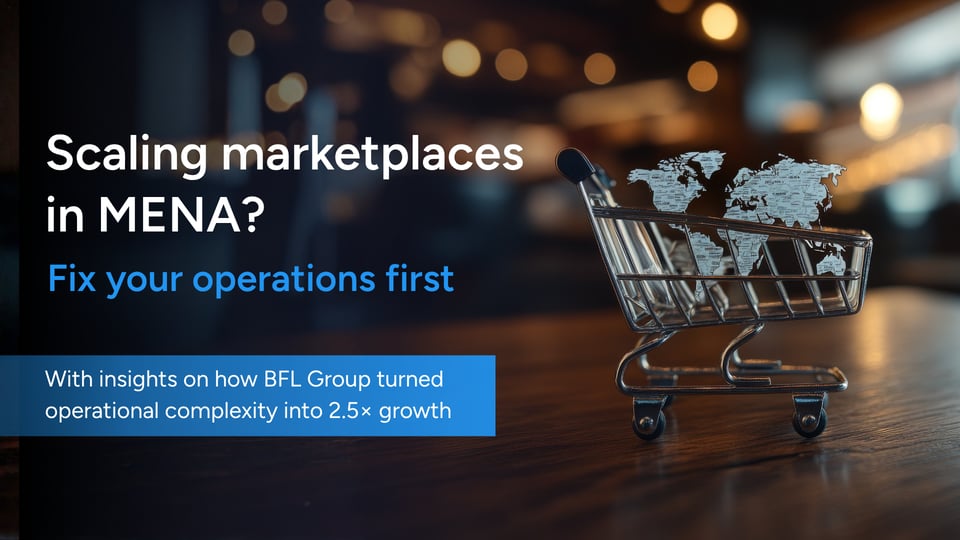
Why operational readiness is the real competitive edge in MENA

Most brands focus on channel access when expanding in MENA. BFL Group focused on operational readiness first and scaled 70,000+ SKUs with 2.5x revenue growth as a result.
Featured image for this blog post
Why operational readiness is the real competitive edge in MENA
7:43

For brands expanding across the Middle East, marketplaces like Amazon, Noon, Trendyol, Namshi, Vogacloset, and Shein offer significant growth potential. But connecting to new sales channels is the easy part. Scaling them profitably, without operational breakdowns, is where most brands struggle.

The breaking points are usually the same: inventory that doesn’t reflect reality, fulfillment that can’t keep pace, and manual processes that make sense at lower volume but collapse under scale. In MENA, fragmented logistics networks make these problems harder to absorb and slower to recover from.

BFL Group, a leading off-price retailer in the region, faced this exact challenge. With a catalog of over 170,000 products and a constantly rotating inventory, scaling marketplaces required more than just frontend automation.

What sets BFL apart is their ability to connect backend operations with marketplace execution into one end-to-end system. What they built and what their results reflect is what happens when both sides of that equation are solved together.


Why marketplace growth often fails without operational readiness


Most marketplace strategies in MENA don't fail because of weak demand. They fail because the operational foundation underneath them isn't built to scale.

For fast-moving retailers, marketplace growth introduces two interconnected challenges that cannot be solved in isolation. On one side, teams focus on expanding across marketplaces, managing listings, pricing, and channel performance. On the other hand, operations must ensure accurate stock levels, efficient fulfillment, and reliable delivery.

When these two layers are not aligned, marketplace growth quickly becomes unstable.

What makes this particularly difficult in MENA is that the margin for error is smaller. Logistics networks are more fragmented, operational maturity varies across markets, and customer expectations on platforms like Amazon and Noon are high. A fulfillment miss isn't just an operational problem; it's a visibility and ranking problem too.

BFL Group experienced these limitations firsthand. Their existing processes made it difficult to grow across marketplaces while maintaining control and efficiency. The fix wasn't to choose between operations and commerce. It was to align them.

Connecting operations with commerce


BFL's approach was to tackle both layers simultaneously - strengthening the backend operations while building out marketplace automation on the frontend.

➡️Strengthening backend operations with Increff


Increff introduced structure and efficiency into BFL’s warehouse operations. By improving inventory visibility and streamlining fulfillment processes, they created a more reliable operational foundation.

The focus was on making inventory data reliable in real time, reducing the gap between what the system showed and what was physically on the shelf, and streamlining how orders moved from pick to dispatch.

➡️Scaling marketplaces with ChannelEngine


With warehouse operations running reliably, BFL used ChannelEngine to scale their marketplace presence. Product listings were automated across channels, stock levels synchronized in real time, and order and pricing management were centralized - removing the manual workload that would otherwise grow in proportion to the number of channels.

The integrations covered Amazon, Noon, Namshi, and Trendyol. But more important than the channel count was the fact that adding a new marketplace didn't mean adding complexity. The system absorbed it.

From complexity to scalable growth


The results BFL achieved weren't the product of a single tool or a single decision. They came from building a system where operations and commerce reinforced each other, and then scaling it.

Marketplace impact:
  • 70,000+ SKUs launched in just a few months
  • Active sales in the UAE and Saudi Arabia
  • Connected to Amazon, Noon, Namshi, and Trendyol
  • 2.5× revenue growth since launch


These results were driven not by discounting or promotions, but by the ability to execute consistently across channels.

Operational impact:
  • 99.9% fulfillment accuracy
  • 25% faster and more consistent dispatch cycles
  • 59% reduction in manual supervision 
  • Improved inventory reliability across channels


This meant fewer cancellations, fewer customer service escalations, and a marketplace performance record that held up during the periods that matter most, Ramadan, Eid Al Fitr, Back-to-School, when volume spikes and operational cracks tend to show.

Perhaps the most telling result was what didn't happen. BFL scaled to four marketplaces across two markets without expanding their team. That's the kind of leverage that's only possible when the underlying system is built to handle growth, not just react to it.

What BFL Group’s experience means for brands in MENA


The instinct when entering a new market is to focus on access - getting listed, getting visible, getting sales. That's understandable. But in MENA, where logistics complexity is high, and marketplace algorithms reward consistent performance, access without operational readiness tends to create problems faster than it creates revenue.

BFL’s experience shows that the constraint isn’t usually demand; it is execution. And execution at scale requires you to align both sides of the business:

  • Backend operations (inventory, warehouse, fulfillment)
  • Frontend execution (marketplaces, listings, pricing)


That's a harder problem to solve than plugging into a new channel, but it's also a more durable one. Brands that get this right don't just perform better on their first marketplace. They expand to the next one faster, absorb peak periods more cleanly, and grow without the operational drag that tends to cap ambition at a certain point.

A practical framework for scaling marketplaces


If you're planning to expand across marketplaces in the region, these are the fundamentals worth getting right before you scale:

1. Get inventory accuracy right first
Overselling and cancellations are the fastest way to damage marketplace performance. Focus on having real-time visibility across warehouses and channels.

2. Automate where complexity compounds
Reduce the amount of manual intervention needed with product listings, stock updates, and order management, as these low-volume processes can become a bottleneck at scale.

3. Scale gradually and with control
Adding a new marketplace should be a structured decision, not a reaction to opportunity. Expand assortment and channels only when operations can support it.

4. Treat peak periods as a stress test.
Ramadan, Eid, and Back-to-School expose operational weaknesses that normal trading volume conceals. Build for those moments, not just the average week.

5. Align operations and commerce as one system
The brands that scale efficiently in MENA aren't running two parallel functions. They're running one connected system where each side supports the other.

Ready to scale marketplaces with confidence?


If you are looking to expand across marketplaces in MENA, the right combination of automation and operational control makes the difference.

Book a consultation to explore how ChannelEngine can support your marketplace growth.
Published on 12 June 2026
Stephen Meade
Stephen Meade is the Regional Marketing Manager for EMEA, where he tailors marketing strategies to the unique needs of the region and has a strong emphasis on driving growth.
Stephen Meade
arrow_upward