
Marketplaces continue to grow, competition intensifies, and automation becomes more sophisticated every year. Yet for many sellers, one question remains unanswered:
Where is the profit actually coming from, and where is it leaking?
Too often, success on marketplaces is measured in GMV, order volume, or Buy Box wins. But revenue growth does not automatically translate into sustainable profitability. Margin erosion can happen silently through fees, returns, advertising costs, price wars, and cross-border complexity.
Profitable marketplace growth does not happen by accident. It must be designed. This article breaks down a practical framework for controlling margin at scale, from financial foundations to tactical execution.
👉 You'll also find exclusive expert insights from Shauna Pannone, who shares practical tips on profit guardrails and how to avoid the pitfalls of chasing every Buy Box.
Key Takeaways 💡
- Marketplace growth does not guarantee profitability. Contribution margin, not GMV, determines sustainable growth.
- Profit must be calculated at the SKU and channel level because marketplace fees, returns, and fulfillment costs vary widely.
- Margin control depends on 3 pillars: strong financial modeling, centralized data, and automation with clear guardrails.
- Tactical levers such as bundling and premium product variations can significantly improve contribution margin.
- Profit guardrails and minimum price rules prevent automation and repricing tools from eroding margins at scale.
Why margin matters more than volume
In the cutthroat world of online marketplaces, success is not measured solely by sales volume. What truly matters is what remains after every cost has been accounted for. Contribution margin represents the revenue left after deducting marketplace commissions, fulfillment expenses, returns, advertising spend, and operational costs. This is the metric that ultimately determines whether a product is genuinely profitable.
Many sellers operate under the assumption that volume will compensate for thin margins. In reality, high GMV with weak contribution margin often results in stalled growth, limited reinvestment capacity, and fragile business models.
Profitability must be calculated at the SKU level and per channel. A product that performs well on one marketplace may be marginal or even loss-making on another due to different commission structures, return behavior, fulfillment costs, or advertising pressure. Before optimizing listings or chasing the Buy Box, sellers must first understand their cost structure.
The three stages of marketplace margin control
Sustainable marketplace profitability rests on 3 things:
1. A solid financial foundation
2. Centralized and consistent data
3. Automation with clear guardrails
-Feb-23-2026-10-53-06-9146-AM.png?width=532&height=500&name=image%20(1)-Feb-23-2026-10-53-06-9146-AM.png)
Automation sits at the top, but it only works if it is built on reliable data and disciplined financial logic. Without that structure, scaling simply amplifies losses. Let's break this down.
Stage 1: Build a solid financial foundation
Margin control starts with cost clarity. Marketplace profitability is influenced by more than commission rates. A complete cost structure should include:
- Marketplace commission, often between 5 and 25 percent
- Payment processing fees
- Middleware or integration costs
- Pick and pack costs per item
- Packaging and outbound shipping
- Return handling and return postage
- Storage and inbound logistics
- Advertising spend
Each of these components affects contribution margin. Ignoring even one can distort profitability calculations. Cross-border ecommerce adds further complexity. Tariffs, VAT differences, currency fluctuations, and localized fulfillment costs mean that a SKU profitable in one region may be unviable in another.
This is where minimum price discipline becomes critical. Minimum price should not be a guess. It should be calculated per SKU and per channel based on your full cost structure, including commission, fulfillment, VAT, and expected returns. Without a properly calculated profit floor, dynamic pricing and automation can quickly turn small margin errors into large-scale losses.
Want practical tools to calculate marketplace profitability?
Download our Profit-First Marketplace Toolkit. It includes:
- A step-by-step guide to building profitable marketplace growth
- A ready-to-use P&L template to calculate true contribution margin per SKU and marketplace
No forms required. Instant access.
Stage 2: Centralize data to prevent margin leakage
Even with strong financial modeling, profitability on marketplaces is fragile if your data is fragmented. Inconsistent pricing across marketplaces can erode trust and trigger unnecessary price competition. When shoppers compare platforms and detect price differences, it weakens perceived brand value and increases pressure to discount.
Centralized, consistent data enables you to:
- Align pricing logic across channels
- Apply channel-specific cost calculations
- Monitor performance at the SKU level
- Identify unprofitable listings quickly
- Adjust strategy based on real margin data
Without centralized control, manual spreadsheets and disconnected tools create blind spots. Margin leakage often happens not because of strategy, but because of inconsistent execution. Clean data is an operational requirement and a safeguard for profitability.
Stage 3: Execute with margin-focused tactics
Once financial clarity and centralized data are in place, tactical levers can significantly improve contribution margin.
Product bundling: Absorb fixed costs and increase order value
Product bundling has long been a retail strategy, but its margin impact on marketplaces is substantial. Because shipping and pick and pack costs are largely fixed per parcel, increasing order value directly improves contribution margin. The higher the revenue per shipment, the more efficiently those fixed costs are absorbed.
Example: When a single pair of socks is sold, the fixed fulfillment costs (pick, pack, and shipping) consume a large share of the selling price, leaving a contribution margin of €2.39.
But when 3 pairs are sold together in a single parcel, those same fulfillment costs are spread across multiple items. Even after a higher commission, the total contribution margin increases to €17.59, or €5.86 per pair.
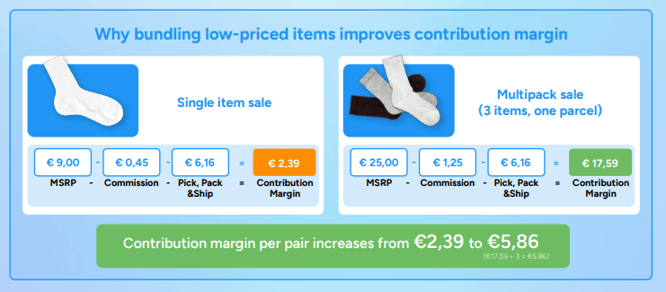
Bundling increases order value while spreading fixed fulfillment costs across multiple items. The result is stronger contribution margin per unit and more efficient logistics economics.
Beyond the margin benefit, bundling also strengthens marketplace performance. Offering complementary products together increases perceived value and raises average order value without relying on discounting. For sellers offering free shipping, this can make fulfillment costs significantly more sustainable.
Bundling is not just a merchandising tactic. It is a structural way to improve marketplace profitability.
Variations: Introduce premium anchors
Product variations such as size, color, or upgraded models can also influence margin. Consolidated listings combine reviews and sales history, strengthening ranking and perceived reliability. This shared social proof supports higher pricing power.
Introducing higher-priced variants with added features or materials can create a pricing anchor. Customers compare within the listing, and the premium option reframes perceived value. This often increases the average selling price without discounting the core product. Variations allow you to expand the margin without entering a price war.
Expert insight: Profit guardrails in action
Shauna Pannone, PreSales Engineer at ChannlEngine, explains that many sellers mistakenly believe profitability comes from winning the Buy Box at all costs. In reality, chasing it 100% of the time often triggers a race to the bottom on pricing.To avoid eroding margins, she recommends setting profit guardrails that safeguard both profitability and brand value:
- Profit floor – Cover all baseline costs, marketplace fees, fulfillment surcharges, and returns. This ensures you never sell below true profitability.
- Commercial minimum – Protect your brand by preventing resellers from undercutting MSRP and damaging customer trust.
- Dynamic margin sweet spot – Instead of trying to win every Buy Box, strike a balance between sales volume and healthy margins.
As she puts it: “The goal isn’t more wins, it’s the right wins.”
▶️ Watch a 4-minute video from Shaunna for more tips on protecting profitability.
For a deeper dive into practical growth levers such as repricing, channel mix optimization, and portfolio strategy, explore our guide on key strategies for driving profitable growth on marketplaces.
Where profit typically gets lost
Even with strong sales performance, margin erosion often hides in predictable places. Low-priced SKUs with high return rates can quietly undermine profitability, especially when reverse logistics and handling costs are underestimated. Advertising spend frequently creeps up over time, reducing contribution margin without clear visibility. Cross-border expansion can introduce VAT miscalculations, tariff exposure, and unexpected fulfillment surcharges that distort pricing assumptions.
Excessive Buy Box chasing may trigger unnecessary price reductions, compressing margins in competitive environments. Shipping costs that are not fully integrated into pricing logic can steadily erode profit, particularly when free delivery is expected. In many cases, unprofitable products remain active simply because they generate volume, even though they dilute overall portfolio performance.
Regular SKU-level performance reviews are essential. Growth should not be driven by emotion or market pressure, but by contribution margin data.
Final thoughts: Design profit into your system
Marketplaces offer immense opportunities, but scale alone does not guarantee sustainable growth. Profitable marketplace businesses share a common approach:
- They define full cost structures.
- They calculate contribution margin per SKU and per channel.
- They set minimum price safeguards.
- They centralize data.
- They automate within clear financial guardrails.
Margin is not improved by accident. It is controlled through structure. This is where marketplace integrators play a critical role. By centralizing product data, pricing logic, and marketplace operations in one environment, integrators make it possible to apply consistent margin rules across channels.
Instead of managing fragmented tools and spreadsheets, sellers gain the operational control needed to scale without losing visibility over profitability. By building a profit-first marketplace model, sellers can move beyond reactive pricing and tactical experimentation. Instead, they create a system where every decision supports sustainable profitability.