How to launch and grow on Macy’s marketplace

Macy's has 41.2M active shoppers, and its centennial year in 2026 is driving record cultural visibility. Roee Fung from Macy's and Alyssa Kaldahl from RG Barry joined ChannelEngine on July 14, 2026, to share how brands outside fashion can launch, activate, and grow on Macy's Marketplace.

Featured image for this blog post
How to launch and grow on Macy’s marketplace
10:33

The misconception that's costing brands a real opportunity


Ask most ecommerce leaders what Macy's sells, and they'll say fashion, maybe home goods. Ask them whether it belongs in their channel mix alongside Amazon, Walmart, and DTC, and you'll usually get a shrug.

That assumption is worth examining, because Macy's Marketplace has quietly evolved into something different: a lifestyle destination with 41.2 million active shoppers, over six million daily visits to macys.com, and a customer base that shops across categories from beauty to wellness to consumer electronics. And 2026 is a uniquely significant moment to be on it, as Macy's marks 100 years of the Thanksgiving Day Parade.

In this live session, Damian Speck, Head of Channel Partnerships at ChannelEngine, sat down with Roee Fung, Senior Manager of Business Development at Macy's, and Alyssa Kaldahl, Director of Marketplaces at RG Barry, to pull back the curtain on what it actually takes to launch and grow on Macy's Marketplace.

In a nutshell


The conversation surfaced a consistent theme: The brands that win on Macy's are the ones that treat it as a strategic retail partnership, not just another feed to push products through. From assortment strategy to promotional participation to the onboarding process itself, success on the Macy's marketplace is earned through collaboration and planning, not speed.
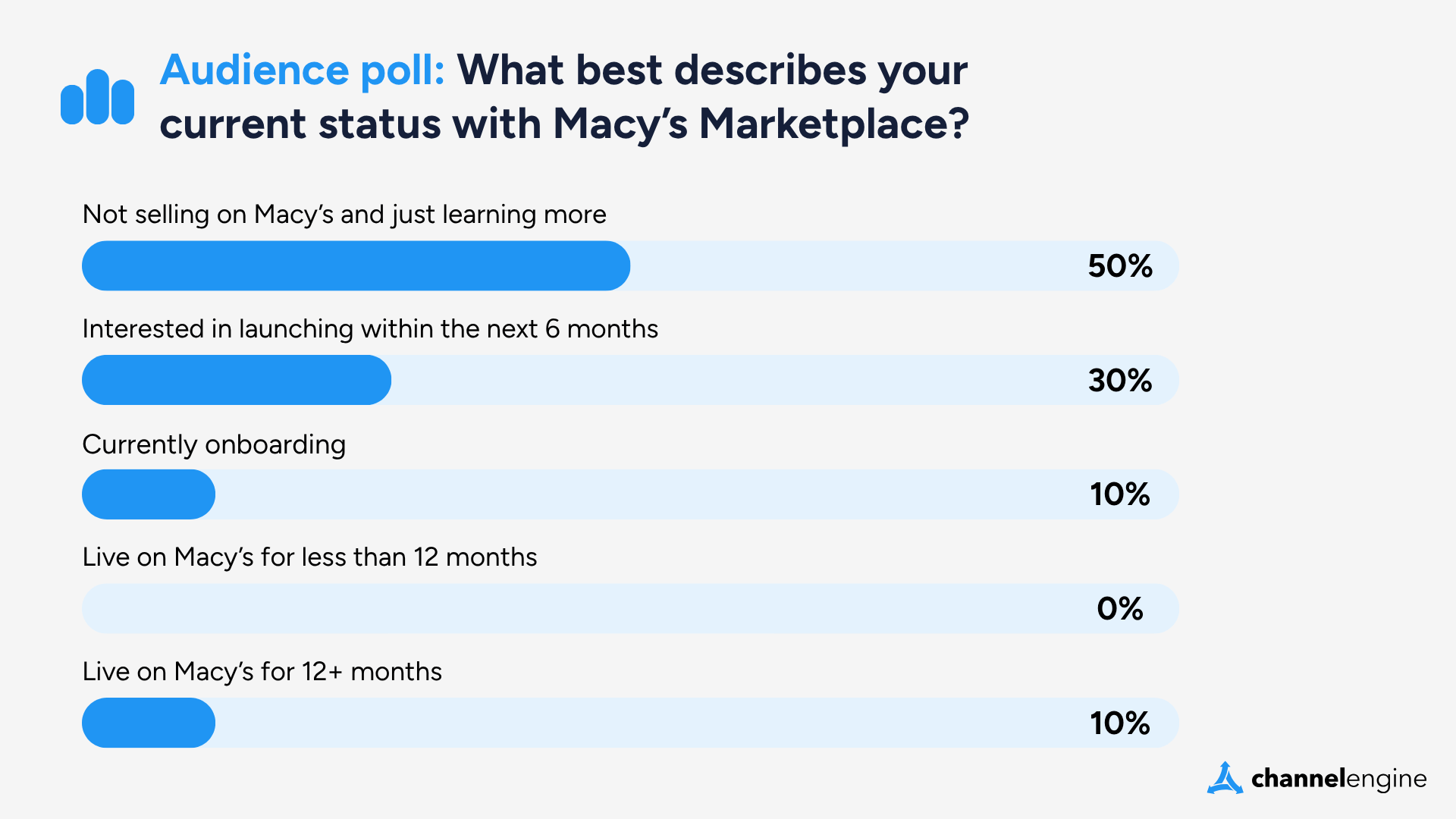
Audience poll - What best describes your current status with Macy's marketplace

Missed the webinar? Watch the recording here 👇


Watch the full webinar recording here.


🎙️ Prefer reading? Jump to the full webinar transcript.

 Top 6 takeaways


1. The Macy's shopper is loyal, cross-category, and shopping for the whole household.
They're not hunting for the lowest price. They arrive with a moment in mind and regularly buy across apparel, home, beauty, and wellness in a single session.

2. Non-apparel brands are finding some of their strongest growth on Macy's. Home, wellness, consumer electronics, outdoor, and pets are all growing, and the curated model means less competition than an open marketplace.

3. Macy's curated model means you're not competing with endless products. Unlike open marketplaces, brands on Macy's aren't buried under thousands of similar listings, which changes the visibility dynamic entirely.

4. Promotional participation is the single biggest lever for visibility and growth. Being live isn't enough. Brands that lean into Macy's promotional calendar get found. Brands that don't stay invisible, regardless of how good their products are.

5. Onboarding takes longer than a month; brands that come prepared move fastest. Assortment alignment, contracting, catalogue prep, and validation all happen before go-live. Arriving with your content, pricing, and strategy ready is the single biggest accelerator.

6. Macy's operates a curated, collaborative model, which means it expects its partners to show up that way too. You won't get a login and a "good luck." But you will need to bring a long-term mindset, a considered assortment, and a willingness to optimise continuously.

Best practices and key learnings


➡️Beyond apparel: which categories are actually growing


The biggest misconception about Macy's, as Roee Fung put it plainly, is that it's purely an apparel destination. Fashion remains core to the business, but it's far from the only story.

"Our customers don't shop in a silo per se, but instead they think of a specific moment in mind," Roee explained, using the example of a shopper who arrives looking for a dress for a destination wedding, then buys the wedding gift and a new pair of headphones in the same session.

That moment-led shopping behaviour is exactly why the marketplace program has expanded so aggressively into home, beauty, consumer electronics, outdoor and fitness, and pets. These categories aren't afterthoughts; they're now central to Macy's growth strategy.

For brands outside fashion, the pitch is straightforward: you're entering an environment where customers are already in a discovery mindset, shopping with trust, and spending across their lifestyle, not just their wardrobe.

➡️Who's shopping on Macy's


The Macy's customer is loyal in a way that's worth pausing on. They're not hunting for the lowest price. They come with a retailer they already trust and a moment in mind, whether that's furnishing a first apartment, preparing for the holidays, or shopping for the whole household.

That last point surprised many of the brands Roee works with. Macy's shoppers often buy across multiple categories in a single session, apparel alongside home alongside wellness, which is why multi-category brands consistently outperform on the platform. They're entering a broader lifestyle ecosystem, not competing for a single product search.

For a comfort-driven brand like Dearfoams, that loyalty profile is particularly relevant.

"There's a strong loyalty component, and for a comfort-driven brand like Dearfoams, that matters. These customers understand the brand, they come back to the brand, they often shop Macy's with a specific level of trust in the product and the partner."

Alyssa KaldahlAlyssa Kaldahl
Director of Marketplaces
RGB logo

➡️Why 2026 is a particularly good moment to launch


Macy's is celebrating its 100th Thanksgiving Day Parade this year, alongside its 50th Fourth of July fireworks event, which coincided with America's 250th anniversary. These aren't just milestones; they're cultural moments that drive sustained attention to the Macy's brand throughout the year.

For brands launching in 2026, that heightened visibility translates into more customer engagement and a stronger halo effect on the products they discover. As Roee put it, the bigger message is that partnering with Macy's means aligning with one of the most recognised retail brands in the country at a moment when cultural attention is especially high.

➡️Visibility and activation: how brands get found


Search is only part of the discovery story on Macy's. The platform also surfaces products through curated collections, seasonal shops, editorial content, personalised recommendations, and a robust promotional calendar that its customer base already knows and responds to.

That promotional calendar is where Alyssa and the Dearfoams team found their biggest turning point. When they first launched on Macy's Marketplace, they were live but largely invisible. Sales weren't where they expected them to be.

"When we first launched Macy's Marketplace, we were not leaning into the Macy's promotional calendar. We were live, but we were not really seeing the visibility or the sales volume that we believed the brand could have on the platform."

Alyssa KaldahlAlyssa Kaldahl
Director of Marketplaces
RGB logo
The shift came when they started participating in promotional events toward the end of 2024. What they discovered quickly was that promotions weren't just about discounting; they were about showing up where customers were already looking, and creating a halo effect across the broader assortment.

For a brand with a MAP policy, that required real strategic thinking. Dearfoams couldn't simply discount everything. Instead, the team used discontinued styles, off-MAP products, and event-appropriate items to participate without undermining their pricing strategy across the rest of the catalogue. On average, their team now spends four to five hours per month planning and submitting promotional pricing through Macy's system, Miracle. The investment has paid off: Macy's has become a top growth channel within their marketplace portfolio.

One practical note for brands managing that complexity: ChannelEngine's pricing engine lets you schedule promotional price changes in advance, set margin floors so you're never selling at a loss, and manage the whole process without manually updating each SKU at campaign time.

➡️Onboarding: what the process looks like


Realistic expectations matter here. Onboarding on Macy's is comprehensive, involving assortment alignment, contracting, integration, catalogue preparation, and validation before products go live. Expect the process to take more than a month. Brands that move fastest are the ones that arrive prepared, with their launch assortment decided, content ready, and a willingness to collaborate with the Macy's team from day one.

Alyssa's onboarding experience was somewhat unconventional because Dearfoams was already a drop-ship partner with Macy's before transitioning to the marketplace model. Even so, what surprised her most was the level of strategic planning involved.

"It wasn't just load items and go live. We had to think through on our side the assortment, the timing, content, product migration, and operational impact of moving the business over."

Alyssa KaldahlAlyssa Kaldahl
Director of Marketplaces
RGB logo

After running both models in parallel for about a year, the team decided to migrate the full business to the marketplace side. That migration required careful planning around timing, blackout periods, and the mechanics of transitioning products properly. The team moved to ChannelEngine during this period, and the transition was smooth. 

"Our ChannelEngine onboarding specialist was extremely helpful in coordinating the timing of the migration and guiding us through all aspects of the process, from setup to testing, to making sure we're aligned operationally before the transition happens."

Roee reinforced the collaborative nature of Macy's approach:

"We are not giving you a login and saying good luck to it. We really want to work alongside our partners to build a really strong customer experience and then ultimately helping our partners position themselves for sustainable growth."

Roee FungRoee Fung
Senior Manager, Business Development
macys_logo_standard

Final thoughts


The clearest message from both Roee and Alyssa was the same: treat the launch as a starting point, not a finish line. The brands that perform best on Macy's are the ones that continuously optimise their content, participate in promotional moments, stay close to performance data, and engage with the Macy's team as a genuine partner.

With key seasonal moments in the second half of 2026 approaching, including the 100th Thanksgiving Day Parade, there's a clear window right now for brands that are ready to move.

As Alyssa put it, "make sure you come in ready, know your assortment strategy, have your strong content, all your pricing, your operations buttoned up, and then just be willing to test and learn and utilise your partners through ChannelEngine and through Macy's."

Ready to explore Macy's Marketplace for your brand?

If you're evaluating Macy's as your next growth channel, or you're already live and looking to get more out of the partnership, ChannelEngine can help. From integration and onboarding to promotional pricing and catalogue management, we work alongside brands at every stage of the Macy's journey.

Book a consultation with our team to explore what selling on Macy's could look like for your brand →

Read the full webinar transcript 👇

Speaker introductions and agenda

00:02:09 Damian Speck: I am Damian. I'm hosting today on behalf of ChannelEngine. I'm based here in New York City. Technically, I'm in Florida today, but our office, our US headquarters is in New York City. But I lead our channel partnerships, acting as the bridge between our clients, our staff, and our numerous external channel partners, which includes a wonderful team over at Macy's.

00:02:34 Damian Speck: We know your time is incredibly valuable, so we're cramming as much as we can into a 30-minute call. It's all about growth. It's all about unlocking a new channel, specifically how you can scale on Macy's. There's tons of channels out there. Macy's is doing it really, really well. It's an iconic giant retailer that really has transformed into a digital powerhouse. So today we're peeling back that curtain of how your brand can leverage that massive loyal customer base.

00:03:08 Damian Speck: Before we proceed with the conversation, for those of you not too familiar with ChannelEngine, I'll make this very, very brief. We are a multi-channel management software, aka an integrator. We assist with channel introductions, activation of channels, and more importantly, the syndication of your products, content, pricing, and inventory — and remit order status in near real time to really 1,300-plus channels. Our goal is to help brands move away from managing their e-commerce business in a fragmented, messy, inefficient way, and do it through one login, one software, so you can manage an entire global sales operation. You plug in your Shopify, NetSuite, SAP, your PIM, WMS — basically any source of your products — into ChannelEngine, and in turn unlock those marketplaces.

00:04:11 Damian Speck: Moving on, I want to pass it on to our guests. We have two guests today. Roy, I will pass it to you for introduction.

00:04:26 Roee Fung: Yeah, absolutely. Great to be here. Really excited to chat about Macy's Marketplace today. I'm Roee Fung. I'm a senior manager on the business development team here at Macy's, and my focus is on the home categories. Generally speaking, I help identify, recruit, and launch brands across different categories within our home business. That normally includes our typical soft and hard home categories, but we also focus on what we call new and adjacent categories like consumer electronics, outdoor rec and fitness, as well as pets.

00:04:59 Roee Fung: A huge part of my role is to make sure that we're bringing on the right brands in the right categories for our customers, and then obviously helping these brand partners understand what it takes to launch and have long-term success with us. All of this is to really support our company's new bold chapter, which is our transformation strategy to make Macy's even more customer-centric and a complete destination for our customers.

00:05:26 Damian Speck: Alyssa, how about an introduction for RG Barry?

00:05:32 Alyssa Kaldahl: Hi everyone. I am Alyssa Kaldahl and I'm the director of marketplaces for RG Barry Brands. I oversee marketplace strategy across the brand portfolio with a focus on channel growth, partner relationships, assortment strategy, promotional planning, and operational readiness.

00:05:50 Alyssa Kaldahl: RG Barry is a heritage brand platform founded in Ohio in 1947, focused on customer-led, digital-first, comfort-driven lifestyle brands. Our portfolio includes Dearfoams, Baggallini, and Gola, alongside licensing like Clarks and Timberland, with a broader purpose of making life more comfortable through brands built around comfort, innovation, and sustainability.

00:06:16 Alyssa Kaldahl: For Dearfoams specifically, Macy's Marketplace has been a really important partner for us and for our marketplace business. Dearfoams is one of the most recognized name brands in slippers, with over a billion slippers sold, more than 30 million pairs sold annually, and consistent leadership as the number one slipper brand in unit market share across all genres. The brand has also been recognized three times by Oprah's Favorite Things, which speaks to the strength of Dearfoams as both a comfort and gifting brand.

00:06:48 Alyssa Kaldahl: As we look ahead to fall and winter 2026, Dearfoams is continuing to build on that foundation with a collection centered around comfort, innovation, seasonal gifting, family moments, holiday novelty, and premium construction like our Fireside Junior and Shearling styles. What I'm excited to talk to you about today is not just the launch itself, but how the partnership evolved over time with a lot of collaboration, testing, and learning.

00:07:21 Damian Speck: Awesome. So we have 30 minutes scheduled. We have the chat there — put any questions you have and we'll try to get them as they come in. If not, we'll try to get some at the end. The call will be recorded, so if you want to come back to it, you can. The content is basically all about how to grow on Macy's — what the process is when you're on with Macy's, and then how to do well. So let's get right into it.

Growth categories and the Macy's customer

00:07:56 Damian Speck: Roy, most people think of Macy's as an apparel destination. But what categories are actually driving growth on the marketplace today?

00:08:09 Roee Fung: I think being seen as purely an apparel destination is probably our biggest misconception. Fashion is definitely incredibly important for our business and always will be. But today, our customers shop across their entire lifestyle, not just for their wardrobe. On the marketplace side, we're seeing huge growth in core categories like apparel — we have a center core business that includes beauty, men's, and kids — and obviously your standard categories within home like furniture. All those are doing great, but we're also seeing industry-leading brands join us and be very successful in these new and adjacent categories.

00:08:49 Roee Fung: What makes this opportunity really unique is that our customers don't shop in a silo — instead they think of a specific moment in mind. An example I always like to use: think about a customer that might come to us looking for a dress for a destination wedding they have coming up. But then they also end up buying that wedding gift on Macy's, and then maybe a pair of new headphones to use on their trip over to that destination wedding. That's why the marketplace program is such a big part of our strategy — it allows us to expand our assortment for our customers while still maintaining that curated experience they expect from us.

00:09:31 Damian Speck: So then for a brand that sells something like home goods or pet accessories, how would you make the case for Macy's if they're evaluating different channels?

00:09:42 Roee Fung: The biggest thing I would point to is really customer trust. We spend a lot of time building relationships with our customers around some of their biggest moments in life — think about furnishing a new home, maybe their first apartment, preparing for the holidays, celebrating milestones. All those moments naturally extend just beyond apparel. Whether our partners sell home goods or wellness products, what you're doing is entering an environment where customers are really looking with a lifestyle moment in mind, rather than just a specific product. They're also not just searching for the lowest prices. They go to Macy's and tend to look for brands and products that are relevant to them, at a retailer they already trust.

00:10:37 Damian Speck: Can you paint a picture of that customer — who they are, who are they buying for?

00:10:56 Roee Fung: First and foremost, our customer is incredibly engaged and remarkably loyal. One thing that surprises a lot of our partners is that Macy's customers aren't just shopping for themselves — they're often shopping for the entire household. Whether it's for their children, outfitting their home for the holidays, celebrating a milestone, or just everyday living, that encourages a lot of cross-shopping between multiple categories. It's very common for a customer who comes to Macy's and buys in apparel to also shop in home, beauty, active, and wellness — and that happens throughout the year. That's one of the reasons why multi-category brands are often very successful with us, because they're entering a broader lifestyle ecosystem rather than just a single destination.

00:11:56 Damian Speck: So then for brands who are already mostly omnipresent — already on Amazon, Target, maybe Walmart, and their own Shopify site — what would be the incremental argument to launch on Macy's?

00:12:16 Roee Fung: I would always encourage brands and partners not to think of us as just another sales channel. We offer a really specialized and highly loyal customer base who also shop very differently than on other channels. We take a very curated approach, as opposed to an open marketplace concept. Brands aren't really competing with endless products. For many brands, it's more about adding a differentiated relationship instead of just adding another channel to their sales mix.

Why Dearfoams chose Macy's Marketplace

00:12:54 Damian Speck: Let's go to the brand side. Alyssa, you had several marketplace opportunities when you initially launched on Macy's. What made Macy's stand out? What were ultimately the factors that convinced you to start selling there?

00:13:13 Alyssa Kaldahl: What's interesting for us about Macy's is it wasn't really a new partnership. Dearfoams already had a longstanding relationship with Macy's through the wholesale and dropship side of the business. So there was already brand familiarity, customer overlap, and trust between the teams. What made the marketplace opportunity compelling was that it allowed us to think differently about the business. Our dropship assortment was really focused on our classic slipper business, but we also had other parts of the Dearfoams portfolio — like our Fireside, Drink, and Shearling product — where we wanted to have more control over catalog setup, pricing, and overall product experience. Macy's gave us an opportunity to test that.

00:13:56 Alyssa Kaldahl: Rather than moving everything over at once, we started with a strategic selection of products. This approach allowed us to compare the two models side by side, learn how customers responded, understand where we could create the best experience for the shopper, and then make a more informed decision with the Macy's team about how to evolve the partnership.

00:14:17 Alyssa Kaldahl: I do think the Macy's customer is also different from who we see on our other channels. There's a strong loyalty component, and for a comfort-driven brand like Dearfoams, that matters. These customers understand the brand, they come back to the brand, and they often shop Macy's with a specific level of trust in the product and the partner. Ultimately, Macy's stood out because it gave us the opportunity to grow with an existing strategic partner, reach a loyal and somewhat different customer base, and gain more control over how our brand shows up digitally.

00:14:53 Damian Speck: So it sounds like you didn't just launch everything on there and set it and forget it. You came at it in a very tactical way — you launched, you measured, you adjusted, and then iterated. And that's such a key to success. We often see brands that just launch on a channel, maybe don't have success because they didn't put the best content out there, didn't adjust pricing, didn't play with the listing. So it's good to see that you did that and had success.

Macy's milestones and brand awareness

00:15:21 Damian Speck: Moving on — Macy's has been around for quite some time. Given the milestone, Roy, what should brands know when it comes to being a part of the Macy's 100th Thanksgiving Day Parade celebration?

00:15:51 Roee Fung: It's our 100th Thanksgiving Day Parade that we're going to be hosting, and I think it is really special for us because it represents much more than just another anniversary. Macy's has been ingrained in American culture for generations. When you think about iconic retail moments, events like our Thanksgiving Day Parade and our 4th of July fireworks are usually right near the top of that list. This year was even more meaningful because our 50th 4th of July fireworks event coincided with America's 250th anniversary. And of course, we'll be hosting our 100th Thanksgiving Parade later this year.

00:16:45 Roee Fung: In terms of what this means for brands — it creates a lot of awareness and engagement. Storytelling is there throughout the year for our customers and for our partners. Customers will pay more attention to the Macy's brand in general, and that naturally creates opportunities for the brands. The bigger message I want to transfer to brands is that when they partner with us, they're aligning themselves to one of the most recognized retail brands in the country.

Product discoverability and merchandising

00:17:24 Damian Speck: You mentioned brand awareness and visibility. Often when we're talking with brands and evaluating channels, the challenge is: will my product be found, or will my product be relevant given the marketplace? In the case of Macy's, brands that don't sell apparel might wonder if their product will be buried. Beyond just a standard product search, walk us through what other means are available for consumers to find products — editorial pages, landing pages, personalization — what can brands leverage?

00:18:10 Roee Fung: Discovery on Macy's definitely goes beyond just search. Searchability is there, and it can happen through navigation. But we also have created collections, seasonal shops, editorial content, and personalized recommendations. We also have many promotional campaigns throughout the year, and all of this together helps our customers find all the amazing products that we have.

00:18:42 Roee Fung: One thing that is very unique with Macy's is that we merchandise around the customer's needs for that specific lifestyle moment, instead of just giving them an endless amount of products to search through. That's why great storytelling matters so much with our partners. Having strong imagery, compelling content, competitive pricing, and inventory availability — all of that plays a major role in helping products get discovered on site.

00:19:16 Damian Speck: Alyssa, what activation or merchandising opportunities or promotional moments helped you gain brand traction on Macy's, and what did you learn from it?

00:19:29 Alyssa Kaldahl: The biggest turning point for us has been promotional participation. When we first launched on Macy's Marketplace, we were not leaning into the Macy's promotional calendar. We were live, but we were not really seeing the visibility or the sales traction that we believed the brand could have on the platform. Towards the end of 2024, we decided to start participating in some Macy's promotional events. That was a meaningful shift for us. We started to see that promotional participation was not only about discounting a specific product — it was also about gaining visibility, showing up where the customer was already shopping, and creating a halo effect across the broader assortment.

00:20:13 Alyssa Kaldahl: That was especially important for us because Dearfoams has a MAP policy, so we have to be really thoughtful. We cannot simply promote everything all the time. What we did learn was that we could use our discontinued or off-MAP styles, or even select event-appropriate items, to participate strategically while still protecting the broader brand and pricing strategy.

00:20:34 Alyssa Kaldahl: The process does take some planning. On average, our team spends about four to five hours per month setting up campaigns for the upcoming month. At a high level, we review all available promotions in Miracle, identify the discount and category requirements, and then evaluate our SKU-level pricing, margin, inventory, and MAP status — and then from there submit the final promotional pricing and selected styles through the Macy's template in Miracle.

00:21:04 Alyssa Kaldahl: The effort has been worth it in the long run, and the test-and-learn approach ended up being one of the biggest drivers of Macy's becoming a top growth channel for the Dearfoams marketplace business that I oversee. The key learning was that marketplace success is not just about getting products live. You need an activation strategy. You need to understand how the retailer's customer shops, what moments matter on that platform, and how to participate in a way that supports both growth and brand integrity.

00:21:36 Roee Fung: I definitely want to jump in as well. From our perspective, the brands that are the most visible are usually the brands that execute the fundamentals the best. Participating in key promotional moments is very important for our customer engagement. We do have several promotions for our customers that are really well recognized by our customer base — they already know to come and look for these products at particular times. We always encourage our brands to think about major retail moments like back to school, holiday gift-giving season, and wellness-focused events, because those are the events where we often see the biggest engagement from our customer base.

00:22:29 Damian Speck: Alyssa brought up a good point — to win, you often do have to take advantage of promotions. You have to get that visibility, and there are ways to do it wherever you're selling. We know from what we do at ChannelEngine that pricing can take quite a bit of time. Matter of fact, I think Alyssa's first setup was actually with a competitor. Things are going smoother now with ChannelEngine — you can implement pricing changes ahead of time. It's one of the features I'm most proud of: our pricing engine. You can create these pricing rules ahead of time, knowing you're going to participate in different events. You can also key in profit targets, so if you have a margin to maintain, you can make sure the price does not go below it. Too often we find that brands take advantage of promotions and then discover they actually lost money on those sales. If pricing changes and promotions are something you deal with, it's something we can definitely help with.

Onboarding process and timeline

00:23:50 Damian Speck: So when it comes to, "all right, we're interested — what do we need to do?" — it's probably onboarding. How long is the onboarding going to take? What's that process? For a brand that is ready to move, what does that onboarding journey look like? What is a realistic timeline to go live?

00:24:12 Roee Fung: The process is very comprehensive. In a typical case, onboarding will start with pre-work and onboarding prep — that's going to include making sure we have alignment between the brand's assortment and our category strategy. From there, we move through contracting, integration, catalog preparation, assortment validation, and then obviously launching the products on site.

00:24:40 Roee Fung: That timeline can vary depending on how complex the integration process is with that particular seller. That's why having the support of a partner like ChannelEngine is really important — your team can help facilitate that technical integration piece. What I would generally say to brands is to expect that process to take more than a month. The brands that move the fastest are usually the ones that come prepared — having that launch assortment ready, having the required content ready to go, and being ready to collaborate with our onboarding team.

00:25:39 Roee Fung: I also want to touch on the point that we are a really hands-on type of marketplace. For our partners, what that means is that we are trying not to be the biggest marketplace, but to be the right marketplace. We operate on a very curated model, so there's a lot of collaboration that needs to happen upfront with our partners — usually around strategy, category fit, and optimization — all with an eye toward long-term growth opportunities. For brands, what that means is that we are not giving you a login and saying "good luck" — we really want to work alongside our partners to build a really strong customer experience and help our brand partners position themselves for sustainable growth.

00:26:38 Roee Fung: That's the biggest thing that separates us from other channels. We really want to build that common thread with our partners. The brands that perform the best treat the launch on site as a starting point, not the finish line. Our best partners continuously optimize their content, monitor their performance, participate in promotional opportunities, and constantly look to improve their customer experience. We really want collaboration, we encourage collaboration, and we're here to help our partners.

00:27:25 Damian Speck: Going back to the onboarding — Alyssa, thinking back to your launch date, what surprised you the most about the onboarding process?

00:27:47 Alyssa Kaldahl: Our onboarding experience was a little bit unconventional because, like I mentioned, we were already a dropship partner with Macy's. But what surprised me most was how much strategic planning went into the transition. Like Roy was saying, the team was very hands-on. It wasn't just "load items and go live." We had to think through the assortment, the timing, content, product migration, and the operational impact of moving the business over.

00:28:19 Alyssa Kaldahl: After we were running both models for about a year, we did partner with the Macy's team and ultimately decided to migrate our full business to the marketplace side. That also required a lot of planning around timing, blackout periods, and the amount of time it takes to transition products over properly. Another thing that stood out is just how collaborative the Macy's team is overall. Some marketplaces, the relationships can feel very self-serve. But with Macy's, we had guidance — we had conversations around what was working, what we needed to adjust, and how to better position the brand.

00:28:55 Alyssa Kaldahl: I would clarify that we didn't originally launch Macy's Marketplace through ChannelEngine, but we did migrate to ChannelEngine very recently, and that transition was seamless. Our ChannelEngine onboarding specialist was extremely helpful in coordinating the timing of the migration and guiding us through all aspects of the process — from setup to testing, to making sure we were aligned operationally before the transition happened. The biggest takeaway for me is that for both onboarding and migration, it's not just technical steps. There's a lot of coordination across content, pricing, inventory, operations, and customer experience, and having the right partner involved makes the biggest difference.

00:29:39 Damian Speck: For any brand that's on the call today or listening after the fact — if you're asking about migration, whether it's from a competitor to ChannelEngine, we are experts when it comes to migrating your business without any disruption. Happy to talk about that.

Keys to a successful launch

00:30:04 Damian Speck: Looking back, what's one thing that your team did that contributed to a really successful launch? Or what advice would you give to those on the call who are preparing to launch?

00:30:17 Alyssa Kaldahl: I think the biggest thing is treating Macy's like a strategic partner and not just another marketplace feed. This has been one of my biggest priorities since I started at RG Barry — making sure we have great partnerships with our marketplace partners. With Macy's, that's really allowed us to build strong relationships, stay close to the performance, talk through issues early, and identify new opportunities instead of only reacting when something was wrong.

00:30:57 Alyssa Kaldahl: We also make sure that we really utilize Macy's resources that are available for sellers — their self-help tools, support tickets, and seller help reps have all been very helpful, especially when we're working through things like PDP issues, content questions, or other operational needs. I also think Macy's does an excellent job of always working on updates that help sellers better manage their business. For example, they recently added a lot more seller metrics into the portal, which gives brands better visibility into performance and helps teams understand where they should focus.

00:31:27 Alyssa Kaldahl: The biggest advice would be: make sure you come in ready. Know your assortment strategy, have your strong content, pricing, and operations all buttoned up — and then be willing to test and learn, and utilize your partners through ChannelEngine and through Macy's. The brands that will do well are the ones that treat the launch as the beginning of the work, not the end.

00:31:51 Damian Speck: Excellent advice. Roy, to wrap this up — for brands listening and taking this seriously, what's one thing you'd want them to know before they reach out?

00:32:04 Roee Fung: I would encourage brands to think beyond just getting on site. The brands that are successful are the ones that understand how they fit into the broader Macy's lifestyle ecosystem and that they can create value for our customer. If you approach Macy's as a strategic retail partnership rather than just another channel, you'll get more out of the relationship.

00:32:29 Roee Fung: A lot of times, partnerships with channels can feel a bit transactional, and we definitely don't want our relationship with our partners to be that way. We want to be collaborative. As Alyssa mentioned, come prepared — come with a thoughtful assortment, be ready, have that long-term goal in mind. Those are usually the brands that achieve success with us. And with key seasonal moments just around the corner in the second half of the year, now is a great time to join and be part of this year's holiday season. Our team would love to connect with every single one of you.

00:33:08 Damian Speck: Perfect. Our contact details are on screen — you can get in touch with us via the QR code. We'd love to talk to you after this. I want to shout out to our guests Roy and Alyssa — thanks so much for attending. And to our attendees, thanks for listening. Chat soon. Cheers.

00:33:33 Roee Fung: Thank you very much. Bye.

arrow_upward