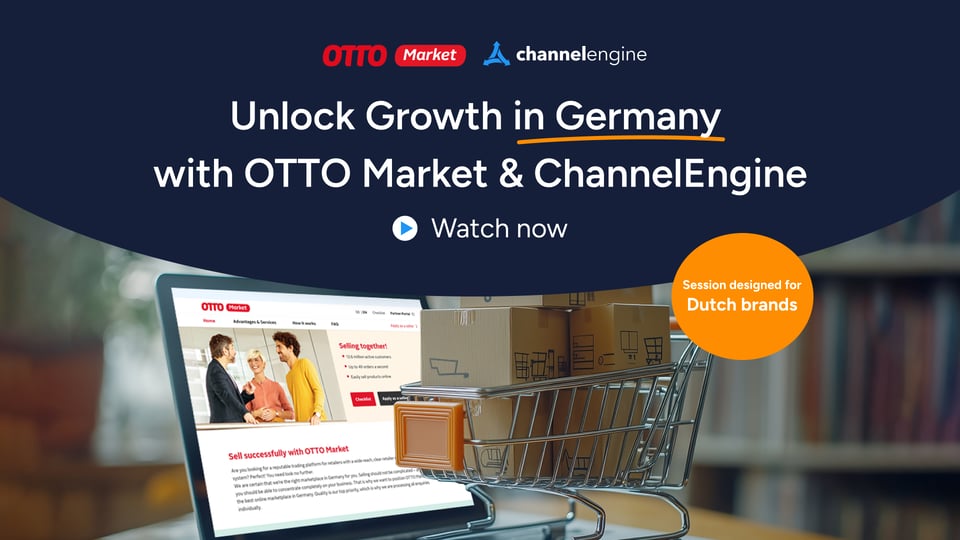
How Dutch sellers can tap into Otto, Germany's biggest marketplace
🎥 Watch the full webinar recording:
Top 6 takeaways
- Otto is Germany's #2 marketplace ranking behind only Amazon, ahead of eBay, with €7.5 billion in GMV last year.
- Dutch sellers now have direct access: The Netherlands is the first international market Otto is opening to, with Poland, Austria, France, Spain, and Denmark to follow within 2026.
- Otto is a closed marketplace: Sellers must apply and be approved, which means less competition and a higher-quality selling environment.
- ChannelEngine handles the technical heavy lifting, from AI-powered category mapping to automated product content translation and bundle creation.
- High-growth white-spot categories include pet food, plants, and supplements - high demand, low supply, real opportunity.
Everything you need to know about selling on Otto
Why Germany and why now?
Germany is the largest ecommerce market in continental Europe, and for Dutch sellers, it's arguably the most accessible. Many brands already have German content, ship to German consumers, and understand the market. The question has never really been whether to sell in Germany; it's been which channel gets you the most traction.
That answer is shifting. Otto recently closed its best business year with €7.5 billion in GMV and 6% year-over-year growth, above the market average, all while keeping its seller base intentionally small at just over 6,100 selected partners. For context, Amazon Germany hosts hundreds of thousands of sellers. On Otto, you're competing with a fraction of that number.
Daniel ZaleskiSenior Sales & Account Manager at Otto
That's a fundamentally different value proposition from Amazon, and for quality-focused Dutch brands, it could be the better fit.
What makes Otto different from other German marketplaces?
Otto isn't just another marketplace. It's a 77-year-old household name that started as a mail-order catalogue in 1949 and has since evolved through an online shop (launched in 1995), a mobile-first app (launched in 2018, now driving 90% of all traffic), and a full marketplace model (launched in 2019). That legacy translates into something harder to manufacture: deep consumer trust.
Otto is also part of the Otto Group, a network of more than 30 ecommerce and retail companies with a combined €15 billion in GMV, which includes Hermes, Germany's major parcel carrier. That means built-in logistics synergies and long-term stability as a platform partner.
On the demand side, Otto invests heavily in brand awareness. TV campaigns, billboards, influencer partnerships targeting younger audiences, co-branded product launches (including a well-received Adidas collaboration), and live shopping - Otto was an early mover in live commerce long before TikTok Shop made it mainstream.
Otto Market: closed, curated, and quality-first
In 2026, Otto made a deliberate strategic shift: moving from an open to a closed marketplace. This is the single most important thing to understand before you apply.
Sarah HußleinSales & Marketing Manager at Otto
What this means in practice is that every seller application is individually reviewed. The basic eligibility criteria (legal entity, VAT, logistics) get you through the door, but quality criteria determine whether you get an invitation. Otto looks at:
The requirements for Dutch sellers
Here's what you need to have in place before applying:
- Legal entity: BV, NV, or VOF (more legal forms will be added over time).
- VAT: A valid Dutch VAT ID is required. You must participate in the OSS (One Stop Shop) procedure using your Dutch VAT. A German VAT ID is not yet accepted, though that's on the roadmap.
- Logistics: A warehouse within the EU, and returns handled via DHL.
- Language: All product content must be in German. Customer service must be in German too, though the good news is that almost all communication happens in written form, which makes this far more manageable than it sounds.
If you're already selling in Germany through another channel (Amazon), you've likely already cleared most of these prerequisites.
How to get started: the onboarding journey
The process is more straightforward than it might initially seem:
- Already a ChannelEngine customer? Start selling on Otto directly here - your integration setup is just a few steps away.
- Not yet using ChannelEngine? Get in touch with us first, and we'll guide you through the full setup, from platform onboarding to your first Otto listing.
Once you're in, the steps are:
- Wait for review - applications are individually assessed; allow up to two weeks for a response, but you will always receive one
- Receive login details for Otto Partner Connect (OPC), Otto's partner portal
- Set up two-factor authentication and sign contracts
- Complete identity verification via Otto Payments (Otto's payment provider)
- Upload your company, logistics, and product information
- Go live - your products become visible to Otto's 12.6 million customers
Using ChannelEngine to automate your Otto sales
Getting approved is one thing. Running an efficient, scalable Otto operation is another. That's where ChannelEngine comes in.
As a marketplace integration software, ChannelEngine connects your backend systems. whether that's Shopify, an ERP, or a PIM, to Otto's API, handling all the critical flows: product listings, stock and pricing updates, order retrieval, shipment tracking, returns, and cancellations.
For clients already on ChannelEngine selling via Bol or Amazon, adding Otto is an extension of your existing setup, not a new project. Here are a few features of our platform that make selling on Otto easier from day one:
AI category mapping. One of the first steps when listing products on Otto is mapping them to the correct category. ChannelEngine's AI tool analyzes Otto's taxonomy and suggests the most accurate category for each product automatically, dramatically reducing what used to be a manual, time-consuming process.
Virtual bundles with AI-generated content. Want to list a phone case alongside a handset, or bundle socks with trainers? ChannelEngine lets you create virtual bundles without touching your backend systems. Better still, because bundles combine two separate product descriptions, ChannelEngine uses AI to generate unique bundle content automatically. Bundles also increase average order value and can make individually thin-margin products viable as a combined listing.
Content translation. If your listings are in Dutch or English and you need German versions, ChannelEngine integrates directly with Google Cloud Translate and DeepL. You can translate your full product catalog into properly formatted German listings in minutes. A human review pass is always recommended, but it's a fast, practical way to get live quickly.
ChannelEngine's own data from clients already selling on Otto shows aggregate GMV growth of close to 13% year-on-year, an average order value of €71, and strong performance across home & living, consumer electronics, garden, and fashion categories.
Answering the most common questions
👉 Can I win the buy box if Otto is also selling that product?
Yes. Otto's buy box logic works similarly to Amazon's - it is based on price, availability, and delivery speed. If your offer is more competitive than Otto's own listing on those metrics, you can and will win it. No seller gets automatic preference.
👉 What about advertising on Otto?
Otto has a full retail media offering through its agency, Otto Advertising. Options include sponsored product ads (SPA), sponsored display ads, newsletters, and live shopping. The SPA report is particularly useful; it shows where your products rank, how competitive the category is, your visibility, and potential return on investment if you activate paid placement.
👉 Does Otto offer fulfillment services?
Not yet for marketplace partners, but it's on the roadmap. In the meantime, Hermes (part of the Otto Group) offers a fulfillment solution called Fulfillment by Hermes (F2X) that sellers can access directly.
👉 What are the highest-opportunity categories right now?
Beyond the established strong categories (home & living, consumer electronics, garden, fashion), Daniel Zaleski flagged three fast-growing white-spot areas: pet food, plants, and supplements, with high demand, low seller supply, and strong growth momentum.
👉 Is there brand protection?
Otto maintains a list of brands in its terms and conditions that cannot be sold through the 3P marketplace model. Outside of that list, sellers are free to add and sell brands, including adding new brands to the Otto database.
Final thoughts
Otto's decision to open its marketplace to Dutch sellers first isn't just a milestone for the platform; it's a well-timed opportunity for brands and retailers already navigating the German market.
The combination of a curated, lower-competition environment, a loyal 12.6-million-strong customer base, and a straightforward onboarding path makes it one of the more compelling expansion plays available to Dutch ecommerce businesses right now.
The quality bar is high, as Otto isn't looking for every seller to join their platform; they are looking for the right sellers. If your brand has strong product content, a solid track record, and a relevant assortment for the German consumer, you have a genuine shot at building a meaningful revenue channel before the platform scales to more international markets later this year.
The Netherlands is first. That window won't stay exclusive for long.
Not using ChannelEngine yet? Schedule a free consultation call with us to see how we can connect your catalog to Otto and hundreds of other global marketplaces from a single platform.
Book a consultation call →