The marketplace seller's guide to peak season preparation in 2026

Maximize your ecommerce profits this Q4 with expert strategies from ChannelEngine and Target Plus, covering the tactics you need to outshine the competition and drive success.
Featured image for this blog post
The marketplace seller's guide to peak season preparation in 2026
37:38


Key Takeaways 💡

  • Peak season is no longer a clean two-month sprint. The commercial window runs from October through January, with Amazon's Prime Big Deal Days in October now acting as the starting gun for holiday shopping.
  • Global retail ecommerce sales hit $6.42 trillion in 2025, up 6.86% year-over-year. Cyber Monday alone generated $14.25 billion in online sales, the largest single digital shopping day in US history.
  • AI-driven traffic to retail sites surged 805% year-over-year during BFCM 2025, with AI agents generating nearly $3 billion in US online sales. Your product data is now being read by machines as much as by people.
  • Mobile accounted for 58.6% of all Cyber Week purchases in 2025. If your listings aren't optimized for a 6-inch screen, you're losing sales before shoppers even see your price.
  • Start preparing in Q1 or Q2. By October, you should be executing, not building.
  • Post-holiday is the biggest white space in most sellers' strategies. Returns, Q1 retention, and channel reactivation are where the real opportunity sits.


The peak season reality check


"Black Friday broke me" is a sentiment that shows up in seller forums every January. The PTSD from peak season is real. And it's getting more complicated, not less.

Here's what actually happened in 2025:
  • Peak season didn't arrive on Black Friday; it crept in through Prime Big Deal Days in October and "Black November" campaigns that ran for weeks before Thanksgiving.
  • It crested during Cyber Week, and trickled out through January returns.
  • Nearly six in 10 shoppers started their holiday season prep before the traditional BFCM window.
  • Sellers who planned for a single November sprint found themselves under-prepared when the real demand wave arried.

The good news is that this fragmentation creates opportunity. A longer peak season means more touchpoints, more time to win back abandoned carts, and more chances to reach shoppers who are still deciding. But it also means the margin for late preparation is gone.

This holiday season guide covers everything you need to plan, execute, and extend peak season successfully: Strategy, verticals, regional nuances, operations, and the post-peak tactics that most brands ignore. It's built on ChannelEngine's operational expertise alongside insights from Target Plus, our marketplace partner.

If you're reading this and thinking "I should have started sooner," you're probably right. But you're also not crazy for thinking about it now. Let's get into it.

How big is peak season?


Global picture: Global retail ecommerce sales reached $6.42 trillion in 2025, up 6.86% from 2024's $6.01 trillion. Online commerce now represents over 20% of all global retail sales, up from 17% in 2024.

US Cyber Week: US shoppers spent $44.2 billion online across Thanksgiving through Cyber Monday in 2025, up 7.7% year-over-year. Cyber Monday generated $14.25 billion in a single day, the highest in history. Black Friday followed at $11.8 billion, up 9.1% year-over-year. A record 202.9 million US consumers shopped during the five-day Cyber Weekend.

Singles' Day: China's Singles' Day remains the largest single-day ecommerce event globally, with Alibaba and JD.com generating a combined $156.6 billion in GMV in 2024. The event continues to grow in Western Europe and is increasingly relevant for cross-border sellers.

AI's arrival: AI-driven clicks to US retail sites jumped 805% year-over-year during Cyber Week 2025. AI shopping agents generated nearly $3 billion in online sales. For sellers, this means one thing: your product data is now interpreted by algorithms before it ever reaches a human buyer. Clean titles, accurate attributes, and structured content aren't just good practice; they're a competitive requirement.

Mobile: 58.6% of all Cyber Week purchases in 2025 came from mobile. Peak sales reached $5.1 million per minute on Black Friday at 12:01 pm EST, almost all of it from smartphones. If your listings, landing pages, or checkout experiences are not optimized for mobile, you are losing to sellers who are.

BNPL: Buy Now Pay Later transactions grew 30.85% during Cyber Week 2025. Cyber Monday alone saw $1.03 billion in BNPL purchases. Electronics, apparel, and furniture are leading categories. This matters for how you position pricing and perceived value.

Want a practical checklist instead?

Download your peak season checklist covering all three phases: before, during, and after. Grounded in 2025 data and built for the trends shaping 2026, including AI commerce, mobile-first shopping, and tighter margins.

[Download the checklist]

When should you start preparing for peak season?


The short answer: much earlier than you think. Peak season is a stress test for your entire business — from promotions and pricing to fulfillment and returns. Brands that only “switch on” in November risk margin erosion and missed sales.

A smarter approach is to reflect on the last peak season. What went smoothly? Where did operations break down? Whether it was misforecasted demand, campaign fatigue, or bottlenecks in returns processing, diagnosing those issues now gives you the best chance to fix them before the next holiday rush.

Here's a realistic planning framework


Q1-Q2 (January-June): Diagnose and plan. This is when to run the post-mortem on last Q4. What broke? Where did stockouts happen? Which channels underperformed? Which carriers let you down? The language sellers use in forums is diagnostic: "They said they were ready. They weren't." That's a supplier, 3PL, or carrier story. Lock in backup relationships now, not in September.

This is also when to analyze demand patterns: review your top 20% of SKUs, identify which ones drive 80% of revenue, and start building the data model for peak season demand forecasting.

Q2-Q3 (April-September): Build and test. Campaign calendars, promotional plans, content updates, and marketplace-specific applications (some marketplaces require promotion opt-in weeks or months in advance). Stress test your fulfillment infrastructure in September with simulated peak volumes, not in November when real orders are flowing.

Build your inventory model now. Scenario planning, buffer stock decisions, and secondary supplier contracts need to be in place before you're competing for warehouse space and carrier capacity at the height of peak season.

October: Final position. By October, you should be executing, not building. Finalize pricing and promotional strategies. Ensure marketplace listings are updated, content is localized, and all integrations are tested. The October Prime Day event (now a consistent fixture in the retail calendar) is your first real stress test.

November-December: Execute and monitor velocity per SKU from early November promotions. Reallocate inventory to best-performing channels before Black Friday. React, don't redesign. Peak season is not the time to switch carriers, launch new channels, or experiment with campaigns. Save pilots for Q1.

January: Returns and retention. Post-peak is not a wind-down. It's a different kind of peak: returns processing, loyalty activation, and Q1 remarketing. Most sellers under-invest here. This guide covers it in detail below.

Peak season strategies: A ChannelEngine x Target Plus Guide


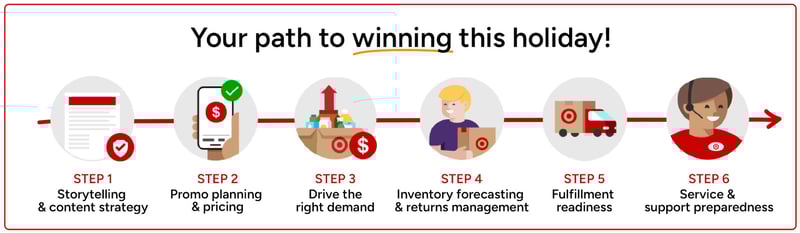
We’ve built this guide side by side with our partners at Target Plus, combining ChannelEngine’s operational expertise with Target’s marketplace perspective. Here’s a quick snapshot from Target Plus’s Path to Winning This Holiday framework:

1. Storytelling & content strategy

Target Plus insight: The holidays are the prime opportunity to maximize sales during the busiest shopping period of the year. Optimized data attributes, product content, and festive storytelling help products get found and chosen.

Content is one of the most powerful levers for peak season performance, and increasingly the most technically demanding. With AI agents now interpreting product listings on behalf of shoppers, your content needs to communicate value to both algorithms and humans simultaneously.

Practically, this means well-structured attributes, relevant keywords, compelling visuals, and festive product copy on product listings. AI-assisted shopping tools prioritize listings with complete, machine-readable data. Gaps in your product feed are gaps in AI discoverability.

Start with your top 20% of SKUs. Refreshing every product in your catalog before peak season is not realistic, so focus first on the products that drive 80% of revenue, update their content for seasonal relevance, and localize where you're selling across multiple markets.

Then look beyond your bestsellers. AI agents reason about shopper situations rather than matching keywords, which means long-tail products with strong audience context, clear use cases, and occasion fit can surface in ways traditional search never allowed. A niche kitchen tool described as "a gift for someone who cooks on weekends" can win a recommendation that a bestseller with thinner attributes loses. 

👉 Read Niels Floors' take on how AI agents change which products get found during peak season

Mobile-first optimization applies to both. With over 58% of peak season traffic arriving from smartphones, titles need to land in the first 60 characters, visuals need to be striking at thumbnail size, and bullet points need to communicate value in a glance.

2. Promo planning & pricing


Promo execution is more complex on marketplaces than in D2C, and the 2025 BFCM season confirmed a shift in shopper behavior: consumers are increasingly price-savvy, using AI tools and comparison engines to track prices over time before committing. The average discount depth during BFCM 2025 was 28%, flat compared to 2024, but the expectation from buyers has not softened.

Target Plus insight: Value matters most to our guests. Competitive pricing builds trust, boosts conversion, and drives confident purchases. Ensure your items are priced competitively and updated promptly to stay ahead of the competition.

Instead of blanket discounting, focus on products with elastic demand (where a modest cut drives disproportionate volume) and safeguard inelastic SKUs with automation. Using a dynamic repricer, you can automate adjustments based on competitor moves, marketplace rules, and margin floors.

Marketplace-initiated promotions, like Target-run holiday campaigns, amplify reach and conversion. Opt in early. Some programs require confirmation weeks ahead of the event.

3. Drive the right demand

Target Plus insight: Opting in to Target-initiated promotions can help your brand reach further and boost conversion. Stay up to date on upcoming promotions to plan inventory, pricing, and media in advance to capitalize on peak holiday moments.

Driving demand during Q4 requires more than listing products; you need to be present where shoppers are already looking. Strategic media planning, campaign calendars, and retail media investments ensure your products stay visible at the right time. Focus your budget on proven channels and top-selling SKUs, and layer in sponsored placements and retargeting to capture high-intent shoppers.

One of the clearest insights from 2025: peak season demand is more fragmented than ever. Multiple sellers on Reddit confirmed that October Prime Day and early Black Friday deals pulled spending forward, making December softer than expected. Your media planning needs to account for this fragmentation, not assume a single November peak.

What this means in practice: start promotional activity earlier (late October at the latest), sustain it across multiple events, and calibrate spend to where your category peaks, not where the retail calendar says it should.

4. Inventory forecasting & returns management


Forecasting requires more than reviewing last year’s numbers. Brands need to layer in external signals such as competitor sell-through, campaign calendars, and broader market trends to make accurate demand projections. Holiday returns are inevitable due to gifting, wrong sizing, and impulse buying. The key is to track patterns early and respond in ways that protect both customer satisfaction and profit margins.

Target Plus insight: Inventory readiness fuels the guest experience. Keep assortments up to date, replenish stock quickly, and remove outdated items to capture highly engaged, fast-moving shoppers.
  • Scenario planning: Build best/worst/expected case demand models and assign buffer stock.
  • Shared inventory pools: Dynamically allocate stock between channels, minimizing overselling.
  • Supplier diversification: Q4 exposes fragile supply chains—set contracts with secondary suppliers early.
  • Monitor velocity per SKU during early November promotions and reallocate inventory dynamically to best-performing channels before Black Friday.
  • Plan for returns: Extend return windows, track reasons, and automate low-value returns to ease service load.
  • Reduce preventable returns: Use clear product content, post-purchase guides, and sizing tips to set the right expectations.


By combining accurate forecasting with smart returns management, brands can keep stock moving efficiently, protect margins, and maintain customer trust during the holiday rush.

5. Fulfillment readiness

Target Plus insight: On-time delivery makes the holiday magic! Align shipping settings with delivery promises and ensure accuracy from order to fulfillment, so every guest gets their order when promised.

Customers expect accuracy and reliability during the holidays, and marketplaces enforce strict performance standards. A late shipment rate that spikes during Cyber Week can take months to recover from in marketplace visibility.

Practical readiness steps:
  • Diversify carriers before Q4. Brands relying on a single carrier in 2024 experienced 27% more bottlenecks during peak. Two or more last-mile partners provide meaningful resilience.
  • Map delivery lead times by region. Customers in remote or rural areas require earlier cutoff dates and may need express shipping as a default option during December.
  • Set clear order cutoff dates for guaranteed Christmas delivery and communicate them prominently in your listings and post-purchase communications.
  • Use order routing to automatically direct orders to the warehouse or 3PL best positioned to fulfill quickly and cost-effectively. During peak, the difference between optimal and suboptimal routing compounds with every order.

Consider marketplace fulfillment programs for your fastest-moving SKUs. The trust signal and delivery speed they provide can meaningfully improve conversion during Q4.

6. Service & support preparedness


Even the best-prepared brands can face unexpected challenges during peak season. Building resilience into your operations ensures you can respond quickly without losing focus on sales and service.

Leverage marketplace support teams and fulfillment partners to troubleshoot issues such as order delays, listing errors, or sudden inventory gaps. Tap into your technology providers’ expertise to fine-tune automations and reporting when volumes spike. Clear communication lines with partners keep operations running smoothly, even under pressure.

Stress testing is essential: run simulations in October with doubled order volumes to identify weak spots in fulfillment, service, and support processes before Q4 begins.

Target Plus insight: Internal readiness matters too. Brief your teams on escalation protocols, align customer service with return/refund policies, and ensure backup resources are available during high-volume days. And remember, you don’t have to do it alone - Target’s team of experts is here to help you stay festive, stay focused, and get the most out of the holiday season.

Top 5 verticals for marketplace sellers during peak season


Peak season doesn't look the same across every product category, and within each vertical, every brand's experience will differ based on their assortment, markets, and margin structure. What follows is a general picture of the dynamics that tend to define each category during peak season.

1. Fashion and apparel


What makes Q4 different: Apparel is the single largest ecommerce category during BFCM, accounting for $47.6 billion in seasonal spend in 2025. But it also carries the highest return rates, typically 25-35% in Q1, driven by gifting mismatches, sizing issues, and impulse purchases that don't survive buyer's remorse.

Q4 is also when fast fashion competitors and marketplace resellers flood listings with discounted alternatives. Protecting margin while remaining price-competitive requires precise dynamic pricing and a content strategy that differentiates on quality, fit detail, and brand story.

Key marketplaces: Zalando, ASOS Marketplace, Amazon Fashion, Bol.com (Netherlands and Belgium), La Redoute (France), ABOUT YOU (DACH region).

💡 Tactical tips:
  • Size guides, fit notes, and model measurements in your listing copy reduce return rates meaningfully. Treat them as margin protection, not just customer service.
  • Run early-access promotions for newsletter subscribers before Black Friday. It builds urgency without participating in the discount race, and allows you to learn which SKUs are resonating before you commit inventory.

2. Consumer electronics


What makes Q4 different: Electronics drive the highest average order values of any Q4 category and see the most concentrated purchasing during the BFCM weekend itself. Shoppers do weeks of research, track prices via AI tools and browser extensions, and convert when the discount hits their threshold. The competition on price is intense, and margins are thin.

The BNPL trend is most pronounced in electronics. Adobe data shows it as one of the top three categories for Buy Now Pay Later usage during Cyber Week 2025, which affects how you should frame pricing and payment messaging.

Key marketplaces: Amazon, MediaMarkt, Fnac-Darty (France and Belgium), Coolblue (Netherlands and Belgium), Currys (UK), Kaufland (DACH), OTTO (Germany).

💡 Tactical tips:
  • Bundle accessories with hero products to protect margin. A standalone speaker at a competitive price loses to a bundle with a carry case and cable at a slightly higher price but better margin.
  • List specifications in full. AI agents evaluating products for shoppers will deprioritize listings with incomplete technical attributes. The structured data layer is now a ranking factor, not just good housekeeping.

3. Home and living


What makes Q4 different: Home and living peaks slightly earlier than apparel and electronics, with gifting demand building from October. Large-item categories (furniture, appliances) have long consideration cycles and are disproportionately driven by deals rather than impulse. Conversion rates tend to be higher for sellers with clear delivery date promises and installation or assembly support content.

Returns in this category are expensive to process. A returned sofa or wardrobe is a significant reverse logistics cost. Prevention through accurate product content, realistic photography, and detailed dimension information is worth more here than in almost any other vertical.

Key marketplaces: Wayfair (US, UK, Germany), OTTO (Germany), Bol, Amazon, IKEA marketplace, Manomano (home improvement, Western Europe).

💡 Tactical tips:
  • Delivery date certainty is a conversion driver in home and living. Shoppers buying gifts or planning for Christmas need to know the item will arrive before December 25. Make your cutoff dates visible in your listing.
  • Room-context imagery (showing a product in a styled room rather than on a white background) significantly improves conversion in this category. Invest in seasonal photography if your current imagery is purely product-on-white.

4. Beauty and personal care


What makes Q4 different: Beauty is a gifting category, which means purchase decisions are made by someone other than the end user. This changes the content challenge: you need to communicate value to a gift-buyer who may not know the brand, not just to a loyal customer who already does. Gift sets, curated bundles, and gift-ready packaging become major conversion levers.

The category is also one of the fastest-growing areas for AI-assisted discovery. Shoppers using AI tools to find gifts ask questions like "best skincare gift set under €50" and the AI interprets your product data to match or exclude you from results.

Key marketplaces: Lookfantastic, Cult Beauty, Amazon Beauty, Douglas (DACH, France, Italy, Poland), Nocibe (France), Flaconi (Germany), Bol.com.

💡 Tactical tips:
  • Update listings to reflect gifting occasion language for peak season. "For her," "gift set," "limited edition," and "festive packaging" in titles and bullet points improve discoverability for seasonal gift search queries.
  • If you use subscription or replenishment mechanics, suppress them during holiday season gift campaigns. Shoppers looking for a one-time gift don't want to be pushed toward subscribe-and-save.

5. Sports and outdoor


What makes Q4 different: Sports and outdoor splits into two peaks. New Year's fitness resolutions drive a January surge (often ignored in peak season planning). But Q4 itself is meaningful for gifting, with mid-range items (equipment, apparel, accessories) performing well at the premium price points that hold better margin.

This is also one of the categories most affected by the earlier-start trend. Many sports and outdoor sellers see demand building from October, particularly for outdoor gear ahead of winter.

Key marketplaces: Decathlon marketplace, Amazon, Bol.com, Zalando Sport, JD Sports marketplace (UK, France, Germany), Intersport digital (Europe).

💡 Tactical tips:
  • Plan for the January fitness spike now, not in December. Stock the right SKUs, build the Q1 campaign calendar, and prepare retention flows for peak season buyers. ROAS tanks in January, not because demand disappears but because most sellers stop spending.
  • Focus gifting campaigns on the €40-€100 price range. It's the sweet spot for sports gifts where purchase confidence is high, and the margin is defensible.

Regional differences during peak season


Peak season is not uniform across markets. The dates differ, the events differ, the consumer behavior differs, and the marketplaces that matter differ significantly by region.

United States


The US remains the most concentrated single-market peak season event. Cyber Week (Thanksgiving through Cyber Monday) is the dominant moment, and most sellers are already planning for it. What changed in 2025: shopping fragmentation across more days, consumer price sensitivity increasing, and AI-driven comparison shopping becoming standard behavior.

BNPL adoption is high and growing. Amazon, Walmart Marketplace, and Target Plus are the core platforms. Walmart Marketplace in particular is growing share and is increasingly relevant for mid-market and value-positioned brands.

Key dates: Halloween (October, an increasingly significant ecommerce moment), Black Friday and Cyber Monday (November), Christmas cutoff dates (typically December 18-20 for standard shipping), New Year's fitness/self-improvement spike (January).

United Kingdom


The UK has the most consolidated BFCM culture outside the US. Black Friday spending grows over 7% year-on-year, and the event is now mainstream across most retail categories. British consumers are mobile-first, deal-sensitive, and expect free returns. The post-Christmas sale (December 26 onwards) remains a significant commercial moment.

Key marketplace relevance: Amazon UK, Marks and Spencer marketplace, ASOS, Next marketplace, OnBuy (growing), and Currys for electronics. Zalando is relevant for fashion.

Key dates: Black Friday, Cyber Monday, Boxing Day (December 26), January sales (running through the first two weeks of January).

Germany


Germany is Europe's largest ecommerce market and has specific characteristics that matter for marketplace sellers. German consumers are highly privacy-conscious, have strong product liability expectations, and favor payment methods like KLARNA and direct bank transfer (Sofort, SEPA) over card payments. Return behavior is among the highest in Europe by category.

Black Friday has become mainstream, but Singles' Day (November 11) is growing. The Christmas market culture means home decor, food, and gift categories peak in late November rather than mid-December.

Key marketplace relevance: Amazon.de, OTTO, Zalando, Kaufland (ChannelEngine's #1 technology partner there), ABOUT YOU, and MediaMarkt for electronics.

Key dates: Singles' Day (November 11), Black Friday and Cyber Monday, Christmas shipping cutoffs (typically December 19-21), winter sales (January).

France


French consumers favor local retailers and are generally more skeptical of cross-border sellers than UK or German shoppers. Trust signals matter more: clear French-language descriptions, French customer service contact information, and local return addresses significantly improve conversion. Payment by Carte Bancaire is the dominant method and needs to be supported.

Black Friday is now significant in France. Singles' Day has limited traction but is growing. The January soldes (legally regulated sales period) is a meaningful commercial moment unique to  France.

Key marketplace relevance: Amazon.fr, Fnac-Darty, La Redoute, Cdiscount, Veepee (flash sales), ManoMano (home), Leroy Merlin (home improvement).

Key dates: Black Friday, Cyber Monday, Christmas, Soldes d'hiver (typically starting early January, exact dates regulated by government).

Netherlands and Belgium


Benelux has a unique calendar event that has no equivalent elsewhere: Sinterklaas (December 5 in the Netherlands, December 6 in Belgium). It is a major gifting occasion, comparable in commercial volume to Christmas for Dutch and Belgian consumers. Sellers who miss the November 25-December 4 window for Sinterklaas miss a significant portion of Benelux peak season revenue.

Bol.com dominates ecommerce in the Netherlands and Belgium. ChannelEngine is a certified Bol Gold Partner. Amazon is present but secondary. Dutch consumers expect fast, free delivery and have very high return tolerance (they will buy multiple variants and return the rest).

Key dates: Sinterklaas (December 5/6), Black Friday, Cyber Monday, Christmas.

Southern Europe (Italy, Spain)


Southern European markets are growing faster than their coverage suggests. Italy and Spain are among Europe's fastest-growing ecommerce markets, but product localization, local payment methods, and local marketplace presence are essential requirements, not optional enhancements.

The community observation is accurate: sellers targeting France, Germany, Italy, and Spain get almost no market-specific guidance. Generic advice (countdown timers, BOGO offers) doesn't account for local payment preferences, local consumer behavior, or local marketplace hierarchy. This is a meaningful competitive gap for sellers who do the localization work.

Key marketplace relevance: Amazon.it and Amazon.es, El Corte Ingles marketplace (Spain), MediaWorld (Italy), PcComponentes (Spain, electronics), Privalia (Italy and Spain, flash sales), eBay (significant in both markets).

Key dates: Black Friday, Cyber Monday, Christmas, Epiphany/Tres Reyes Magos (January 6).

Asia-Pacific


For sellers targeting or sourcing from Asia, the peak calendar is different and complex. Singles' Day (November 11) is the world's largest ecommerce event by GMV. Lunar New Year (January 29, 2026) drives 55%+ of cross-border purchase activity in its preparation window. Diwali (late October) is significant for cross-border purchases in Indian-diaspora markets globally.

The operational implication for Western sellers: if your supply chain runs through China, Hong Kong, or Southeast Asia, the Lunar New Year factory shutdown in late January is a supply chain constraint that must be planned for now, not in December.

How multichannel platforms make the difference


The questions sellers are actually asking in forums and AI tools cluster around channel management failures: Inventory overselling, listing errors, order routing breakdowns, and the loss of marketplace health scores during peak. This is precisely where the operational layer of a multichannel platform matters most.

ChannelEngine connects your WMS, ERP, webshop, and all your active marketplaces into a single centralized view of inventory and orders. Stock levels update automatically across all channels, with syncs running every 15 minutes, so a sale on one channel is reflected across the others before the next wave of orders arrives. When an order arrives on Amazon at the same moment a Zalando order arrives for the same SKU, the routing logic is designed to handle the conflict, reducing the risk of oversells and manual intervention.

Specific capabilities that become critical in Q4:
  • Real-time inventory sync across every active channel, preventing oversells during simultaneous demand spikes.
  • Order routing logic that directs each order to the optimal fulfillment location based on stock availability, carrier availability, and delivery promise.
  • Dynamic catalog management, allowing you to activate, deactivate, or reprice SKUs across all channels simultaneously in response to market conditions.
  • Hybrid 1P/3P flexibility on supported marketplaces, enabling you to adapt your commercial model dynamically when one approach underperforms.
  • AI-powered bundling, which creates value-based deals that protect margin while giving shoppers the perceived value they're looking for.

For European sellers managing 5-15 marketplaces across multiple regions, ChannelEngine's 1,300+ channel connections mean peak season expansion doesn't require individual integrations with each new marketplace.

Peak season don'ts


❌ Don’t leave your planning to the last minute.
Peak season is no longer just November–December. By October, the decisions that shape peak season should already be locked. 
❌ Don’t offer discounts only on large ticket items: A significant share of conversions comes from value-priced products, not just expensive bundles.
❌ Don’t serve the same ads over and over again: fresh creative keeps messaging engaging and prevents blindness during high-frequency flash events.
❌ Don’t experiment with new campaigns or channels during Q4. Leave new pilots for quieter times. Q4 should focus on executing proven channels and tactics; any testing can be funded with peak-season profits later.
❌ Don’t shift carriers or overhaul operational processes mid-season. Keep your logistics proven and consistent. Holiday shipping demands are unpredictable enough without introducing new variables.
Don't ignore the post-peak period. The ROAS drop in January is real, but it's not because demand disappears; it's because most sellers stop investing.

Bonus tips: Keeping momentum in Q1 after Peak Season


Most holiday season prep guides end with the Christmas shipping cutoff. That's the wrong place to stop.

  • Returns as a retention opportunity. How you handle returns defines whether a peak season customer becomes a Q1 loyal buyer or a one-time loss. Fast resolution, easy processes, and a no-friction experience convert return situations into brand advocacy. Track return reasons systematically and use them to fix the content or product issues that caused them.
  • Loyalty activation. Double points, early-access January deals, and loyalty program enrollment offers convert new peak season buyers before competitors can reach them. January is not a dead period for brands that activate fast.
  • Bundle clearance. ChannelEngine's AI-powered bundling allows you to create value deals that move slow-moving inventory without simply discounting it. A product that didn't sell at full price in December often moves well in a January bundle with a complementary item.
  • Remarketing. Peak season buyers are your warmest audience in January. Personalized follow-up campaigns recommending complementary products, seasonal essentials, or replenishment prompts outperform cold acquisition at a fraction of the cost.
  • Free gift thresholds. A small add-on product at a spend threshold clears dead stock while boosting average order value. It's a better use of inventory than a fire sale.
  • Channel reactivation reviews. January is the right time to evaluate which channels performed during peak season and adjust your channel mix for Q2. Which marketplaces outperformed? Which underperformed relative to the inventory you allocated? The data is fresh, and the decisions compound.
  • Prepare for where discovery is heading. Q1 is also the right moment to audit your readiness for agentic commerce - the growing category of AI-driven shopping assistants that discover, evaluate, and complete purchases on behalf of consumers.

ChannelEngine already has live connections to ChatGPT (ACP), Google Gemini, and Microsoft Copilot (UCP), as well as PayPal's LLM checkout. Customers using ChannelEngine are already discoverable through these surfaces today. The brands that will benefit most are the ones whose full catalog, not just their bestsellers, is structured, consistent, and well-described across every channel AI agents draw from. Peak season generates the data that tells you which products are ready for that next layer of discoverability.

Ready to make this your strongest season yet?

Schedule a free consultation with our marketplace experts and discover how ChannelEngine can help you prepare, execute, and win during peak season.
Published on 02 September 2026
Grace Mendez
Grace Mendez is the Marketing & Branding Specialist at ChannelEngine. Her expertise in project management, marketing, and employer branding shines through in her innovative communications and creative storytelling.
Grace Mendez
arrow_upward