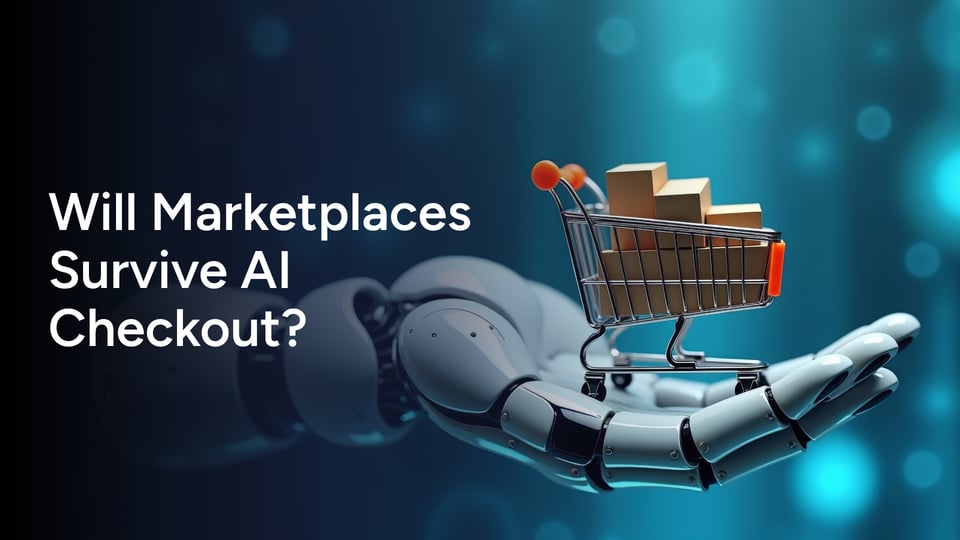
The rise of AI is rewriting the rules of ecommerce. What started as product recommendations inside chat interfaces is quickly evolving into something more transactional. With Instant Checkout, ChatGPT began enabling purchases directly within conversation, initially through U.S. Etsy sellers and expanding into broader Shopify integrations. Payments partnerships and early infrastructure standards for agentic commerce signal that this is not a feature experiment, but the foundation of a new buying interface.
It is an early glimpse into a future where discovery, decision, and purchase might all happen in one conversation. But this is still the beginning, not the end of marketplaces.
This shift has triggered a familiar question: if AI can search, recommend, and buy on behalf of shoppers, do marketplaces still matter? The short answer is yes. But not for the reasons many assume. AI checkout does not replace marketplaces. It depends on them.
AI checkout: A new ecommerce frontier
AI checkout represents more than speed; it’s about context. Whether through voice assistants, AR-enabled search, or generative shopping tools, AI removes friction by connecting need and purchase in one step.
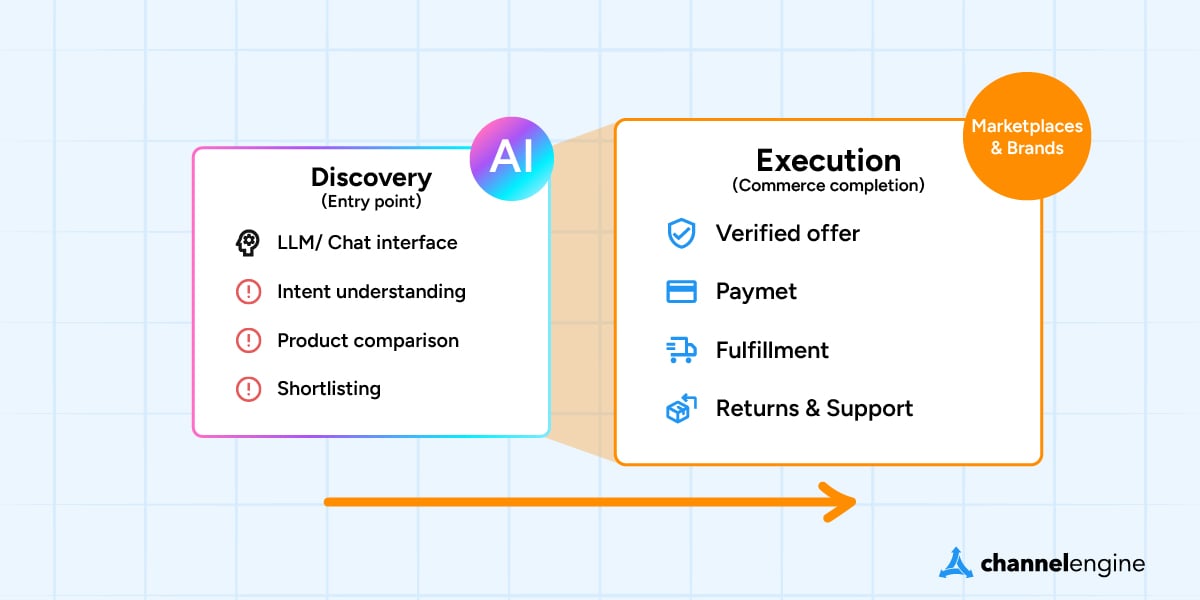
But AI checkout is not a single capability. It is a stack.
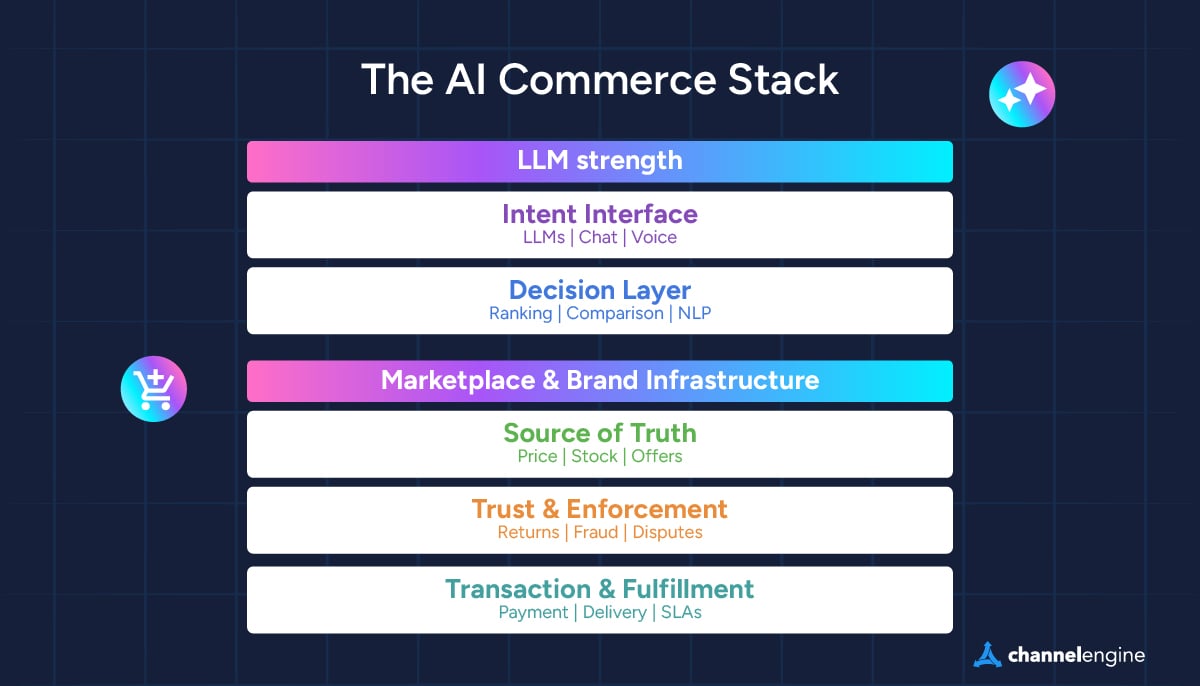
At the top sit LLM interfaces that understand intent and guide decisions. Underneath, there must be verified offers, real availability, trusted sellers, payments, and fulfillment. This is where marketplaces still do the heavy lifting.
Currently, AI checkout remains narrow. It is available only to U.S. shoppers and mostly through partnerships with established marketplace ecosystems like Etsy and Shopify. Walmart has also partnered with OpenAI, and the payments infrastructure for that collaboration is backed by Stripe. This reinforces a key point: AI isn’t replacing marketplaces - it is being built on top of them.
 Niels Floors
Discovery may shift, execution still needs trust
Despite the hype, there’s still a lot of hesitation around letting AI make purchases. A recent Riskified survey found that while nearly three-quarters of global shoppers already use AI for product research, price comparison, and review summaries, only 13% have allowed AI to complete a purchase for them.
The barrier isn’t technical - it is psychological. Shoppers still want visibility, reassurance, and control. They worry about payment security, data privacy, and who’s accountable if something goes wrong.
This is where marketplaces retain a critical role. They act as the trust and enforcement layer between emerging AI interfaces and real-world commerce.
Just as consumers once hesitated to enter credit card details online, their comfort with AI-assisted buying may grow over time as systems prove more transparent and reliable. For now, marketplaces remain the reassuring safety net - the trusted layer between new technology and consumer confidence.
What's at risk if brands do nothing
AI checkout does not fail loudly when something goes wrong. It fails quietly. When brands and marketplaces do not adapt, four things start to break:
1. Loss of discovery - As shoppers increasingly start their journeys in AI interfaces, products with incomplete or unreliable data simply stop appearing. If an AI cannot confidently recommend an item, it will not surface it at all.
2. Margin pressure - When discovery shifts away from owned channels, brands and marketplaces are forced to “buy back” visibility through partnerships, incentives, or reduced margins. What once came through repeat traffic increasingly becomes transactional.
3. Commoditization - Without rich, structured differentiation, AI treats products as interchangeable. Brand context, unique value propositions, and service quality become harder to signal, pushing competition toward price alone.
4. Invisible catalogs in AI answers - The biggest risk is not being outranked. It is being omitted. AI systems prefer certainty. Catalogs with inconsistent pricing, unclear availability, or missing attributes are filtered out long before a shopper sees an option.
In an AI-driven environment, poor data does not just underperform. It disappears.
From ranking to eligibility: Why the stakes changed
Traditional search penalizes poor data with lower rankings. A brand with incomplete attributes lands on page 3 instead of page 1 - still visible, still recoverable.
Agentic commerce works differently. Agents don't browse and deprioritize; they query, filter, and disqualify. When an agent is tasked with finding a product matching specific criteria, it retrieves a structured result set first - and only ranks within that set. If your catalog doesn't meet the data requirements to enter that initial query response, you're never evaluated at all. There's no page 3, you're just absent.
This changes what marketplaces need to guarantee their sellers. Historically, a marketplace's job was to maximize a seller's chances of being chosen - better placement, better visibility, better conversion. In an agentic environment, the prior question is whether a seller is even considered. Ensuring eligibility - complete attributes, real-time inventory, accurate pricing, fast API responses - becomes the baseline marketplaces must enforce, not a nice-to-have. Sellers who don't meet that bar underperform and eventually risk disappearing from the recommendation list entirely before a human ever sees it.
This is why data quality is no longer just operational hygiene. It is the entry condition for agentic commerce.
Brand sentiment is becoming machine-readable trust
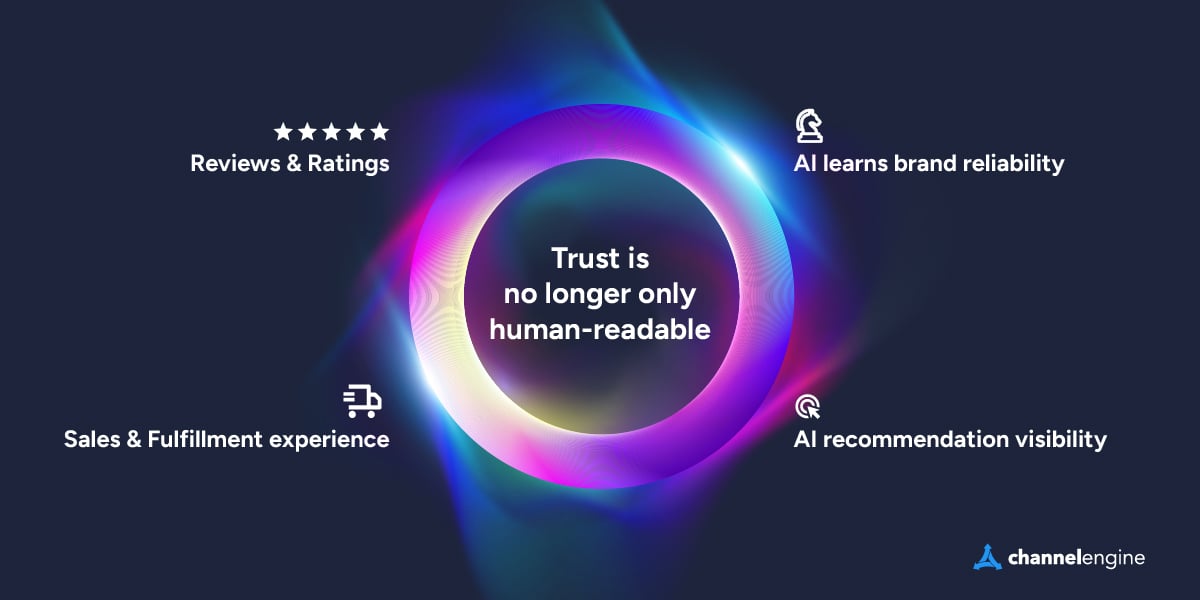
Trust today is not only about policies and guarantees. It is also about reputation. As LLMs learn from public reviews and ratings, a brand’s overall reputation increasingly shapes how (and whether) AI recommends its products. Positive reviews and consistent engagement don’t just convert human shoppers - they help algorithms understand that a brand is reliable and worth promoting.
In practice, this means poor data quality or fulfillment issues do not just hurt conversion rates. They risk lowering future visibility in AI-driven recommendations.

The marketplace advantage: Structure beats abstraction
Every large language model today - from ChatGPT to Perplexity - pulls its product information from marketplaces, social commerce channels, and brand websites. That means online marketplaces aren’t just surviving the AI wave; they’re fueling it.
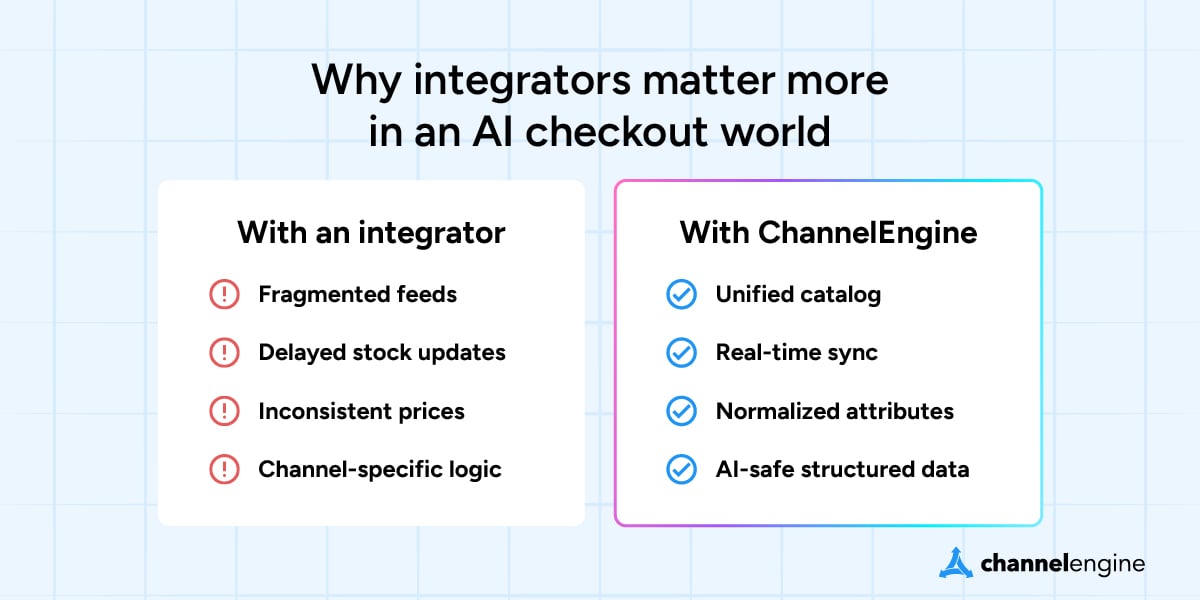
But this advantage is conditional: AI systems are only as reliable as the data they consume. If your product data is outdated, incomplete, or inconsistent across platforms, AI agents surface misleading results. In an AI-driven environment, data quality becomes a competitive moat.
For brands, that’s a complex challenge. Managing pricing, stock, and content across multiple channels and geographies requires automation - and that’s exactly where marketplace integrators like ChannelEngine come in:
- To unify catalog data across channels
- Maintain accurate pricing and availability
- Normalize attributes and product identifiers
- Ensure marketplaces and AI systems receive consistent, trusted inputs
When AI shops on behalf of consumers, brands with clean, structured, real-time data are the ones that remain visible and credible
Where marketplaces are vulnerable, and how they stay relevant
AI does introduce new pressure points. Discovery is increasingly abstracted away from individual platforms. Some marketplaces may lose traffic, advertising revenue, or upsell opportunities as LLMs become the starting point for shopping journeys.
But replacement is not the default outcome. Disintermediation risk is highest where supply is easy to aggregate, and marketplace management is thin.
Marketplaces that own risk management, fulfillment standards, returns, and dispute resolution remain difficult to replace. AI can recommend. It does not want to underwrite commerce.
Not all brands and marketplaces are equally positioned
It is tempting to talk about “marketplaces” as a single group. In reality, AI checkout will amplify differences that already exist.
Some brands and marketplaces are structurally better positioned than others.
- Highly fragmented, complex catalogs
Brands with large assortments, variants, and long-tail SKUs benefit from marketplaces and integrations that make this complexity legible. AI systems struggle without structured inputs, which makes high-quality data a competitive advantage.
- Standardized, thin-margin catalogs
Where products are highly interchangeable and differentiation is weak, AI increases price transparency and competition. These catalogs face a higher risk of margin erosion unless execution and service quality are strong.
- Strong fulfillment, returns, and service layers
Brands and marketplaces that control delivery promises, returns, and customer support remain defensible. These are areas AI prefers to rely on existing infrastructure rather than replicate.
- Weak execution and inconsistent data
Inconsistent stock updates, unclear policies, or fragmented feeds are increasingly penalized. AI systems optimize for reliability, not intent. Operational gaps quickly translate into visibility loss.
In practice, AI checkout rewards operational maturity. Clean data, consistent execution, and reliable fulfillment become the deciding factors for whether a brand remains visible in the next generation of commerce.
When AI shops for you, marketplaces still do the heavy lifting
Key Takeaways 💡
- AI checkout is emerging as a new ecommerce frontier, but it is being built on top of existing marketplace and brand ecosystems, not replacing them.
- Marketplaces provide the “source of truth” for AI: offers, availability, seller validation, and structured product data that make autonomous checkout possible.
- Trust remains the biggest barrier to AI-driven purchasing—shoppers still want visibility, control, and reliable intermediaries.
- Brand reputation and data quality increasingly shape how AI recommends products, as LLMs learn from public sentiment and performance signals.
- Marketplace integrators like ChannelEngine help brands unify catalog data, pricing, and stock, keeping products visible and trustworthy wherever AI checkout happens.
- In the long run, ecommerce power will center on who owns the most accurate, trusted, real-time product data—not just who owns the traffic.
AI checkout today relies on marketplace and brand store ecosystems, not on replacing them. LLMs need structured catalogs; shoppers need trust; and brands need reach.
As agentic commerce becomes the new interface layer, marketplaces remain the commerce backbone - the verified, data-rich infrastructure that connects shoppers, sellers, and systems.
The next generation of successful marketplaces will be the brands that lean into this shift: opening APIs, improving data quality, and integrating directly with AI ecosystems to ensure that their catalog data fuels every relevant product recommendation.
Ultimately, the future of ecommerce won’t be about who owns the traffic, but who owns the truth - the accurate, trusted, real-time data that powers every purchase decision. Marketplaces already hold that position. The challenge now is to evolve fast enough to stay essential in the AI-driven economy.