
The rise of AI shopping agents is transforming the way consumers discover, compare, and purchase products. Instead of scrolling through long lists of search results, often mixed with ads and sponsored products, shoppers increasingly rely on agents that interpret intent, scan product data across marketplaces, and recommend only a small set of relevant, trustworthy, and well-structured items.
For brands, retailers, and marketplace sellers, this fundamentally changes how products win visibility. AI agents do not skim or make assumptions. They evaluate structure, accuracy, completeness, and consistency across every channel where a product appears, combining that with trust signals like reviews and seller performance. When titles, attributes, or stock data differ between marketplaces, agents lose confidence and recommend alternatives that appear more reliable.
This shift moves ecommerce beyond classic search optimisation toward something more advanced: agent readiness
 Jorrit Steinz,
CEO & Founder of ChannelEngine

When product content is agent-ready, it improves discoverability across AI-driven shopping surfaces, increases the likelihood of being recommended during automated comparisons, and supports higher conversion by answering shopper intent precisely.
It also strengthens trust through consistent GTINs, verified brand data, and reliable performance signals such as reviews and delivery accuracy.
In this post, we explore what agent-ready product content looks like, how it differs from traditional content, and why it matters for sellers using multichannel integrators like ChannelEngine.
How AI agents evaluate product content
 Niels Floors,
VP Strategic Development at ChannelEngine
1. Structured data completeness
First, agents look at how complete your product data is. They check whether essential information, such as brand, GTIN, size, material, or ingredients, is clearly provided and structured. Missing or unclear data makes it harder for an agent to understand what you are selling and increases the chance that your product will be skipped.
2. Cross-channel consistency
Next, agents assess consistency across channels. If your product title, attributes, or specifications differ between marketplaces like Amazon, bol, or your own webshop, it creates uncertainty. Inconsistent data signals risk, and AI agents are designed to avoid risk when recommending products.
3. Accuracy and clarity
Accuracy also plays a major role. Clear measurements, exact ingredient concentrations, and realistic performance claims help agents match your product to a shopper’s intent. Vague descriptions or exaggerated promises are difficult for agents to validate and reduce confidence.
4. Media verification
Visuals are evaluated through metadata, not interpretation. AI agents cannot truly see or understand images the way humans do. Instead, they rely on attributes such as alt text, captions, file names, and linked product data to understand context.
If these attributes conflict with product details, trust quickly breaks down. For example, if you list a blue variant but the image alt text says “black variant”, the agent cannot confirm which version is correct and may exclude the product altogether.
5. Trust and performance signals
Finally, agents factor in performance signals. Customer reviews, return rates, delivery reliability, and seller reputation all influence whether a product is recommended or filtered out in favour of a stronger alternative. Even when product data is accurate, weak performance signals can cause an agent to prioritise a more reliable seller offering the same item.
This is why having a marketplace integrator that keeps product data accurate, consistent, and up-to-date across all channels becomes critical. ChannelEngine enables sellers to centralise, enrich, and distribute product content across marketplaces from a single platform, reducing inconsistencies that can confuse AI shopping agents. As AI-driven shopping and agentic commerce grow, unified product content is no longer just an operational benefit. It directly impacts visibility and sales.
Where AI agents source your product data
Before an agent evaluates your content, it has to find it. AI shopping agents do not crawl your product pages the way search engine bots do. They pull structured data from a defined set of sources, and if your product information is missing or outdated in those sources, no amount of on-site optimisation will recover your visibility.
There are three primary places agents source product data from today.
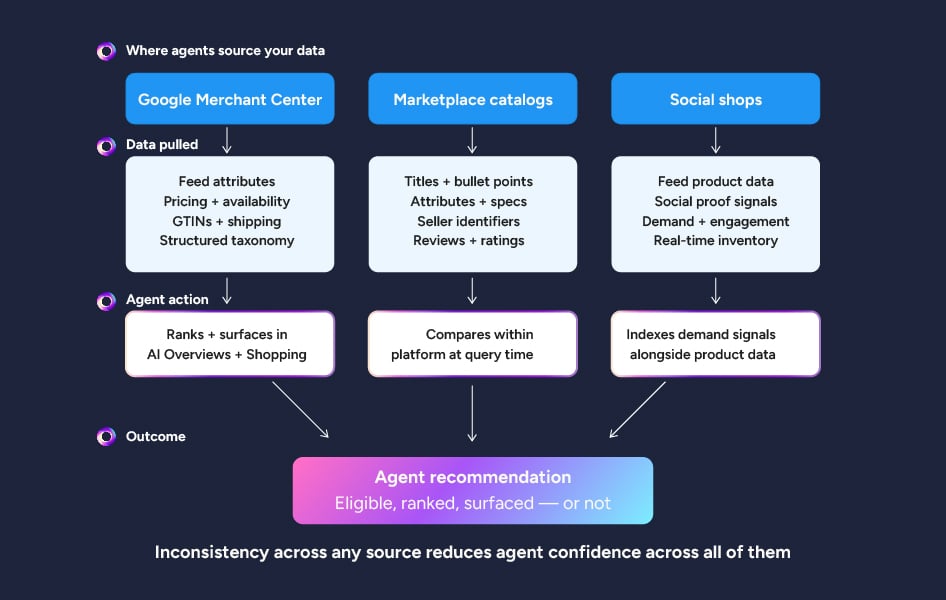
1. Google Merchant Center and the Shopping Graph
This is the most significant data layer for AI-driven product discovery. When Google's shopping agents and AI Overviews surface product recommendations, they are drawing on the structured feed data submitted through Merchant Center — not your PDP. Price, availability, attributes, GTINs, and shipping data all need to be accurate and current in your feed, because that is what gets evaluated and ranked.
This shift is part of a broader evolution in how Google structures commerce data, as outlined in Google’s Universal Commerce Protocol and Merchant Center: The new infrastructure for AI shopping.
2. Marketplace catalogs
Agents querying Amazon, bol, Zalando, or similar platforms pull from those platforms' internal catalogs. This means the product content you submit directly to each marketplace (titles, attributes, bullet points, identifiers) is what agents on those platforms see. If you have allowed that content to drift, or if you submitted a stripped-down version to save time, that is what the agent works with.
3. Social shops and emerging AI surfaces
TikTok Shop, Instagram Shopping, and Pinterest are increasingly indexed by agents looking for real-time demand signals and social proof alongside product data. These channels are earlier in maturity, but the same principle applies: what you submit to the feed is what the agent reads.
The practical implication is that agent readiness is a distribution problem as much as a content problem. You can have perfect product data centrally and still lose visibility if that data is not accurately and consistently pushed to each of these sources.
This is why feed management, keeping attributes, pricing, and identifiers synchronised across Merchant Center, marketplace catalogs, and social shops, is foundational to performing in agent-driven commerce.
What agent-ready product content looks like
How ChannelEngine supports agent-readiness
ChannelEngine already connects brands and retailers to more than 1300 online sales channels, from marketplaces and social platforms to emerging AI-driven shopping environments. This same foundation now supports the transition from traditional ecommerce to agent-driven commerce.
AI shopping agents rely on product data they can read, verify, and trust. ChannelEngine helps brands and retailers keep product identifiers, attributes, and taxonomy consistent across channels, while ensuring pricing and availability remain accurate in real time. This consistency is critical when AI agents compare products across multiple sources and decide which ones to recommend.
At the same time, ChannelEngine is actively working on integrations that help customers participate in AI-powered commerce. As a founding member of the Agentic Commerce Alliance (ACA), we collaborate with AI-first software providers, researchers, and merchants to shape open, merchant-first standards for agentic commerce and to turn AI innovation into practical, real-world applications for sellers.
As shopping journeys move from search results to single conversations, agent readiness becomes essential. At ChannelEngine, we are building the bridge that helps you stay visible, trusted, and ready to sell wherever commerce happens next.
Get the Agent-Ready Product Content Checklist:
Expand your knowledge on marketplace selling


.jpg?width=360&height=202&name=Webinar%20LP%20Featured%20image%20(3).jpg)

.png?width=152&height=152&name=Nishkarsha%20(1).png)
