
Why your product catalog needs to work for humans and AI agents

Learn how to optimize your product catalog for AI agents with accurate product data, structured feeds, and reliable information that supports agentic commerce.
Featured image for this blog post
Why your product catalog needs to work for humans and AI agents
19:11

Most brands optimize for human shoppers. But AI agents increasingly rely on structured product data to discover, compare, and recommend products. As agentic commerce develops, that data also needs to support purchasing decisions. This shift is changing what it means to have an optimized product catalog.

For years, ecommerce teams have treated the product detail page as the center of product discovery - where shoppers land, explore imagery, compare specs, read reviews, and decide whether to buy, but this model is no longer complete.

AI shopping agents don't browse product pages the way people do. They query, retrieve, compare, and filter information from structured data ecosystems. That means your product feed, marketplace catalog, attributes, APIs, schemas, social commerce catalogs, retail media feeds, stock updates, and pricing logic are no longer just operational infrastructure. They're part of the customer experience.

And as AI-assisted shopping evolves into agentic commerce, the requirements become even more demanding. AI agents may not only help shoppers discover products but also evaluate specific options and complete transactions on their behalf. To do that, they need more than relevant product descriptions. They need accurate, accessible information about product variants, availability, pricing, delivery, and other purchase conditions.

The incomplete model of product optimization


Most brands still treat the PDP as the source of truth for their products. Strong copy, detailed images, accurate pricing, compelling reviews - if those are in place, the product is considered “optimized.”

That works well for human shoppers, but agents do not rely on PDPs as their primary input. They often use structured product data from feeds, catalogs, marketplaces, comparison engines, and commerce platforms to understand what a product is, whether it matches a query, and whether it can be recommended with confidence.

This distinction matters because AI-assisted shopping is moving product discovery upstream. A shopper might ask an agent to compare waterproof jackets under €150, find a MagSafe-compatible iPhone 15 case, or recommend a coffee machine available for delivery this week. In those moments, the agent isn't admiring your PDP. It is looking for structured, reliable, current data it can use to answer the query.

This shift in how AI perceives product information was a recurring theme during the Agentic Commerce webinar we hosted in April:

"AI builds the understanding entirely from the data it can access, parse, and connect. It doesn’t see your storefront in the way humans do. So rich content still matters, but only after the basics are machine-readable."
 
Michael PfeifferMichael Pfeiffer
VP AI & Agentic Commerce at Shopware

And, our research on AI shopping behavior reinforces this shift. More than half of shoppers surveyed have used AI tools to research products, but many still return to marketplaces or brand sites to validate reviews, compare prices, check seller information, and complete the purchase. That makes AI an important discovery layer, while marketplaces and PDPs remain critical trust and conversion layers.

The product has to be understandable before the shopper ever clicks.
The two-storefront framework


For brands and retailers selling across marketplaces, webshops, social commerce, and retail media, this creates a new reality: you don't have one storefront. You have two.

➡️ The first is the human-facing storefront: PDPs, marketplace listings, imagery, video, reviews, UX, and brand storytelling. Built for shoppers who browse, interpret visuals, read context, and make decisions based on practical details and personal preference.

➡️ The second is the machine-facing storefront: structured feeds, Google Merchant Center data, marketplace catalog attributes, APIs, schema markup, retail media feeds, review syndication, inventory updates, and pricing syncs. These systems aren't designed to persuade. They're designed to make product information accessible, consistent, and usable for platforms, algorithms, and agents that need to evaluate products quickly.

 📋 The difference matters because humans and agents process information differently.


A shopper can land on a jacket PDP and, from the copy and imagery, understand that it's suitable for rainy commutes.

An agent needs that same idea expressed through structured data: waterproofing rating, breathability, available sizes, regional stock, current price, delivery options, and verified review signals.

If that information is incomplete, inconsistent, or stale, the machine-facing storefront is weak, even if the PDP looks polished.

From AI discovery to agentic purchasing


As Resignal highlights, the shift from traditional product search to agentic shopping changes the level of detail required from product data. Consider the difference:

  • Traditional search: "Women's white t-shirt UK size 12"
  • Agentic shopping request: "Find me a reasonably priced women's white t-shirt in UK size 12, made from organic cotton, that can arrive by tomorrow."

The first query requires a product to match a category, size, and color. The second introduces additional conditions that an AI agent must evaluate before recommending a product or proceeding with a purchase.

The agent needs to verify material composition, size availability, price, and delivery feasibility, all using accurate, up-to-date product information.

This is where product data quality becomes critical. Missing, outdated, or inconsistent information across a PDP, product feed, and commerce platform can make it harder for an agent to determine whether a product meets the shopper's requirements.

A competing retailer with clearer, more reliable product data may be easier for an AI agent to recommend or purchase from.

Where agents actually get product data 


AI agents build product understanding from a wide range of structured sources. For brands selling across channels, visibility depends on how well product data is represented across the broader commerce ecosystem:

  • Google Merchant Center and the Shopping Graph rely on feed quality, pricing accuracy, availability, and product attributes
  • Amazon and marketplace catalogs use titles, category attributes, variations, reviews, stock status, and delivery promises
  • Social commerce catalogs on Meta and TikTok power shoppable content, retargeting, and product discovery
  • Retail media feeds connect product information with advertising, inventory, and pricing data
  • Review platforms distribute ratings, volume, and sentiment signals beyond the PDP

The practical takeaway: Product data has to be managed as a connected system. A product can be accurate on the brand's website but incomplete in marketplace catalogs, outdated in a shopping feed, or missing key attributes in social commerce.

For AI agents, the challenge is not always that information is unavailable. Often, the information already exists somewhere within the brand's commerce ecosystem, but it isn't consistently represented or accessible across the sources an agent uses.

A product's size availability might be accurate on the website but outdated in the feed. Delivery information might appear on the PDP but not be accessible through the commerce integration. Product attributes might be described in marketing copy but missing from structured fields.
 
When that happens, an agent may struggle to establish whether the product meets a shopper's requirements. This can affect whether the product is retrieved, recommended, or considered for purchase.

The hidden differentiator: Data performance


Most ecommerce teams track familiar metrics such as PDP conversion, traffic, return on ad spend, and marketplace revenue. But these don't reveal whether a product is ready to be discovered and evaluated by AI agents.

The next layer of performance is operational: how quickly, reliably, and completely product data moves across commerce systems.

  • If a price changes in your source system, how quickly does it reach Google Merchant Center, marketplace listings, social commerce catalogs, and retail media feeds?
  • If a product sells out, how long before every connected channel reflects that?
  • If a promotion goes live, does it appear everywhere while it's still relevant, or does it arrive after competitors have already been surfaced?

These questions matter because AI agents rely on accurate, consistent, and up-to-date information to evaluate products and determine whether they meet a shopper's requirements.

When an agent is expected to complete a purchase, the stakes are even higher. Outdated stock, incorrect variants, or conflicting delivery information can prevent it from confirming a suitable product.

In competitive categories, unreliable data can mean losing a recommendation or purchase opportunity to a retailer with more dependable information.

How product data breaks agent visibility


These aren't abstract risks. Here's how they play out in practice:

 ❗ Price mismatch across channels. A coffee machine is listed at €99 in the product feed, €109 on the brand site, and €104 on a marketplace. A human shopper might click around to verify. An agent detects the inconsistency and treats the product as less reliable. A competitor with consistent pricing across sources is easier to recommend.

❗ Out-of-stock delay. A running shoe sells out on the webshop, but Merchant Center still marks it as available for several hours. The agent surfaces it. The shopper clicks through, finds it unavailable, and loses trust. Repeated availability errors weaken confidence in the source over time.

❗ Missing attributes. A phone case is compatible with the iPhone 15, but that compatibility only exists in PDP copy - not in structured fields. It never matches a query for "iPhone 15 compatible clear case with MagSafe." A jacket may be waterproof, but without structured material, weather resistance, and use-case data, it won't appear for "waterproof commuter jacket for winter."

❗ Slow feed updates. A brand launches a 48-hour discount. The price change takes six hours to sync across shopping channels. During that window, agents see the old price. Competitors with faster feeds get surfaced as the better-value option.

❗ Inconsistent data across channels. A product title emphasizes material on one marketplace, color on another, and lifestyle use on the brand site. Specs vary slightly by region. The agent receives multiple conflicting versions of the same product and has less confidence in which one is accurate.

❗ Reviews are siloed on the PDP. A product has hundreds of strong on-site reviews, but they're not syndicated or reflected in external platforms. Agents querying broader ecosystems never see those trust signals, and neither does the shopper's confidence in the recommendation.

❗Variant and delivery mismatch. A shopper asks an AI agent to purchase a pair of running shoes in a specific size, with delivery before the weekend. The product feed indicates that the shoes are available, but the selected size is out of stock. The delivery estimate is also missing from the data accessible to the agent. Even if the product is otherwise a perfect match, the agent cannot reliably confirm that it can fulfill the request.

What AI agents need to confidently complete a purchase


Being discoverable doesn't automatically make a product ready for agentic purchasing. An AI agent may understand a product's relevance but still lack the information needed to complete a transaction.

For brands and retailers, this means ensuring that key purchase information is accurate, consistent, and accessible:

  • Product suitability: Materials, compatibility, dimensions, and specifications that determine whether a product meets the shopper's needs.
  • Variant-level availability: Accurate stock information for the requested size, color, or configuration.
  • Current pricing: Up-to-date prices, promotions, and relevant purchase costs.
  • Delivery information: Shipping options, estimated arrival dates, and regional restrictions.
  • Returns and purchase conditions: Clear return policies and purchasing terms.
  • Consistent product identifiers: Reliable product and variant identification across channels and systems.

The challenge isn't always missing data. Brands often already have this information, but it's scattered across systems or represented inconsistently.

For multichannel brands, keeping product pages, structured data, feeds, pricing, and inventory aligned is essential to helping agents evaluate products and complete purchases.

A practical example: Running shoes


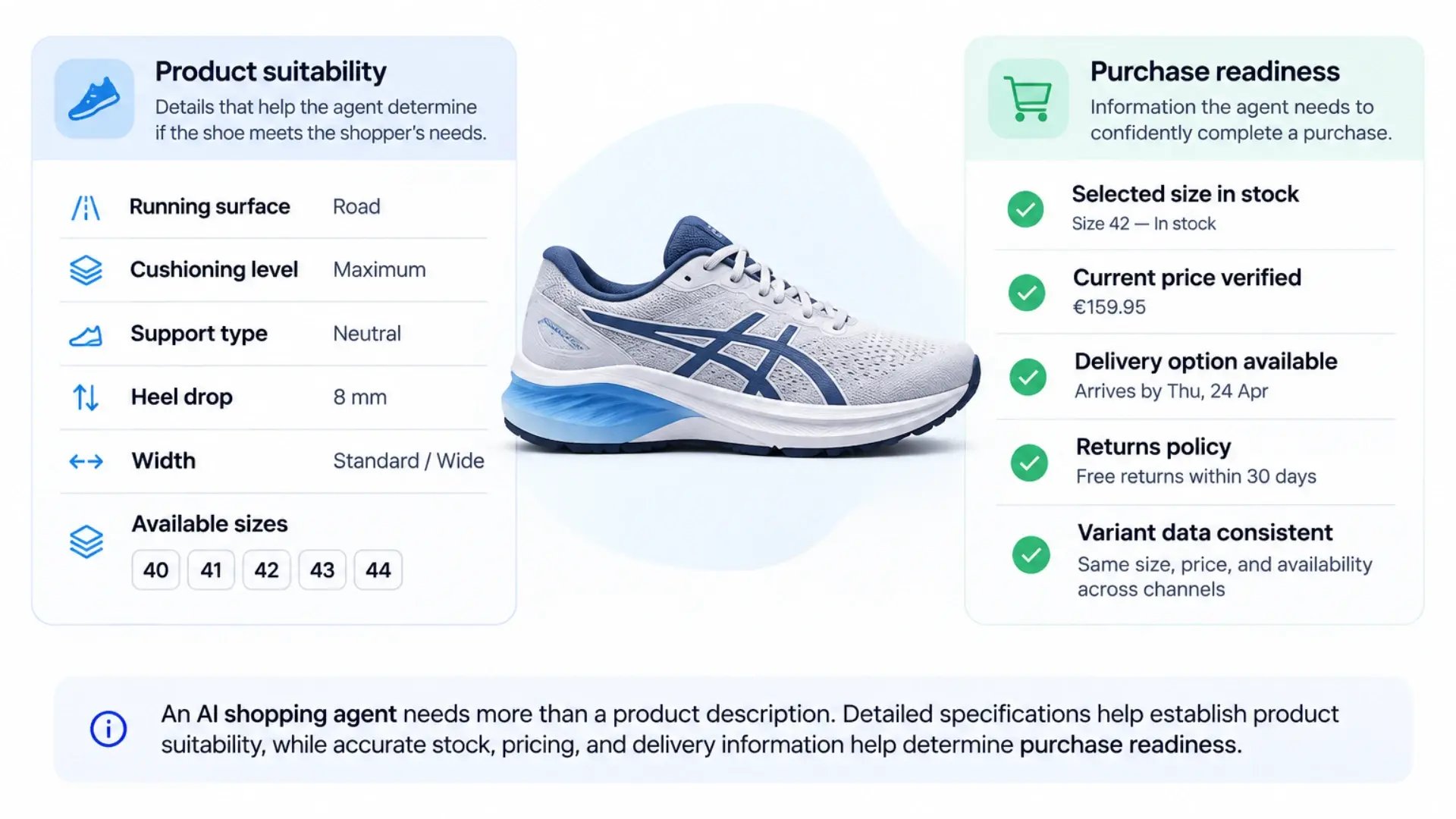
Consider a shopper asking an AI assistant to find a cushioned road-running shoe for a neutral runner, in a specific size, available for delivery within a few days.

A listing describing the shoe as "comfortable and suitable for running" gives the agent little to evaluate. A more complete product record would include running surface, cushioning level, support type, heel drop, weight, width options, and available sizes, helping the agent determine whether the shoe meets the shopper's needs.

But suitability alone isn't enough. Before purchasing, the agent must also verify size availability, current pricing, and delivery timelines.

The practical question for brands: Do their PDP, structured data, and product feeds communicate consistent, accurate information for the exact product variant?

running shoe example

What optimization for agents actually means


Optimizing for AI agents doesn't mean stripping personality from your product content. Human shoppers still need imagery, persuasive copy, reviews, and a clear reason to buy. The shift is that the same product information also needs to work in structured environments. That means five things:

1. Completeness. Go beyond the minimum fields required to publish. Size, material, compatibility, dimensions, color, fit, warranty, care instructions, energy rating, use case, and delivery options all help connect products to specific shopper queries. For agentic purchasing, variant-level stock and relevant fulfillment details are especially important.

2. Freshness. Pricing, promotions, availability, and assortment changes need to move quickly across every channel. When updates lag, agents work from outdated information, which can affect both recommendations and purchase decisions.

3. Consistency. A product shouldn't tell one story on the webshop, another on a marketplace, and a third in a shopping feed. Titles, specs, attributes, pricing, and availability should align closely enough that platforms can validate the product rather than reconcile conflicting signals.

4. Structure. Standardized schemas, clean taxonomies, normalized attributes, and reliable APIs help agents access and interpret data without guesswork. Details buried in unstructured copy may not be available when an agent tries to match a product to a query or verify a purchase requirement.

5. Coverage. Product data needs to be present across the major surfaces where discovery happens, including marketplaces, shopping feeds, review platforms, social commerce catalogs, and product discovery systems. A strong PDP is useful once a shopper arrives. Agent visibility depends on whether the product is represented well before that point.

How to audit your catalog for agentic commerce


Rather than trying to optimize an entire catalog at once, brands can start with their most important products.

Begin by identifying high-performing or strategically important SKUs and reviewing their product information across three layers:

  • Visible product content: Check whether PDPs clearly communicate relevant specifications, variants, availability, delivery information, and purchase conditions.
  • Structured data: Verify that important product attributes, offers, and availability information are represented accurately in machine-readable formats.
  • Product feeds: Confirm that the same information is consistently available across relevant marketplaces, shopping platforms, and commerce integrations.

Then compare the information across these layers. Are the product specifications consistent? Is stock accurate for each variant? Are prices and delivery conditions aligned?

The objective is not simply to add more attributes. It's to make existing product information complete, reliable, and accessible wherever AI agents and commerce platforms need it.

 📋 Operationalize this with the agent-ready product content checklist


The practical next step is to audit your catalog through the lens of agent visibility, not just human conversion.

That is where our Agent-ready product content checklist comes in. It gives teams a structured way to review and strengthen product content for AI shopping agents, from structured attributes and consistent data to trust signals and metadata.

Use it to operationalize the ideas in this article across your catalog, feeds, marketplaces, and product data workflows. The goal is not to create more content for the sake of it; it is to make sure the data powering AI-assisted discovery is complete, current, consistent, and structured wherever agents search.

The PDP is no longer the whole battlefield


The PDP still matters. It's where shoppers validate a product, understand the brand, read reviews, and decide whether to buy. But it's no longer the only part of the product experience that shapes discovery and conversion.

AI agents are adding a layer between the shopper and the product page, and that layer runs on structured data, feed reliability, attribute completeness, pricing consistency, stock accuracy, and external trust signals. 

And as AI shopping evolves from recommendations toward transactions, the quality of that information becomes even more important.

For brands and marketplace sellers, getting that layer right is now part of how products visible to AI agents. It's making sure agents have the reliable information they need to evaluate products and, where supported, complete purchases.

If you're not sure where your catalog stands, we can help you find out.

Book a free consultation call with our marketplace experts today →
Published on 04 november 2026
Nishkarsha Kotian
Nishkarsha Kotian is the Senior Content & SEO Manager at ChannelEngine. With a background in IT engineering and marketing, she brings a unique blend of technical expertise and creative strategy to her work. She knows what good code looks like, but also understands that great copy is what truly connects with audiences. Off the clock, she’s all about travel, good food, memes, and movies.
Nishkarsha Kotian
arrow_upward