
AI is changing commerce again. But this time, it is not just changing how people search. It is changing how products are discovered, evaluated, recommended, and eventually purchased.
In this webinar, Niels Floors from ChannelEngine joined Mariana Amaru of Microsoft, Michael Pfeiffer of Shopware, and Raja Saggi of Nexi Group to unpack what agentic commerce really means today, what is hype versus reality, and what brands should do now to stay visible as AI becomes a bigger part of the customer journey.
What this webinar made clear
Agentic commerce is already reshaping how products get discovered. Consumers are turning to AI tools to shortlist options, compare alternatives, and make decisions faster, even if they still complete the purchase on marketplaces or brand sites.
Visibility is no longer driven by search rankings alone, but by whether AI systems understand, trust, and recommend your product in the first place.
🎥 Missed the live session?
Here's the recording:
Top 5 takeaways
1. Discovery is already being decided before shoppers reach your channels
Agentic commerce is not waiting for full automation to matter. The shift is already happening earlier in the journey than most brands realize.
Consumers are using AI tools to narrow down options, compare products, and form preferences before they ever land on a marketplace or webshop. That changes where competition happens. It is no longer just about winning the click. It is about being part of the shortlist before the click even exists.
 Mariana Amaru
Industry Advisor at Microsoft
2. AI is replacing browsing with decision-making
Search used to be about exploration. Consumers compared options, opened multiple tabs, and built their own shortlist. AI compresses that process into a single interaction.
Instead of scanning pages of results, consumers are now presented with a small set of recommendations based on intent, context, and relevance.
 Raja Saggi
EVP E-commerce at Nexi Group
The result is a shorter path to a decision, with fewer chances to influence it along the way.
3. Product data now determines whether you are even considered
Product data has always influenced performance. What’s changed is the consequence of getting it wrong.
In a search-driven world, weak or incomplete data might push you down the rankings. In an AI-driven world, it can remove you entirely from the decision set.
 Michael Pfeiffer
VP AI & Agentic Commerce at Shopware
Attributes, pricing context, reviews, availability, and consistency across channels all feed into whether your product is surfaced. The implication is straightforward: Better product content data determines whether you are a part of a customer’s shortlist.
4. Early movers are shaping how AI decides
In previous shifts like search and social, early adopters gained an advantage through testing and iteration. In agentic commerce, that advantage runs deeper. AI systems learn from the data they ingest and the signals they observe.
That means brands that invest early in structured data, integrations, and visibility are improving performance today and at the same time are influencing how these systems learn to evaluate and recommend products over time.
This creates a compounding effect. More visibility leads to more interactions, more signals, and stronger positioning in future recommendations.
Michael PfeifferVP AI & Agentic Commerce at Shopware
The flip side is just as important. If your products are not visible early, you are not just missing traffic. You may never enter the consideration set that AI systems build over time.
5. Waiting for clarity is the fastest way to lose momentum
Agentic commerce is still evolving. The channels are not fully mature, the standards are still forming, and many capabilities are in early stages. But that is exactly why waiting creates risk.
This is a phase where advantage is built through experimentation, not certainty. Brands that start now can test, learn, and adapt while the ecosystem is still taking shape. Those who wait for a clear playbook will enter a market where others already have a head start.
"This thing has a brain, right? And it doesn't forget anything. So make sure that whatever decisions you're making are not short-term decisions, but they're actually made with that artificial intelligence in mind."
Raja SaggiEVP E-commerce at Nexi Group
Where agentic commerce actually stands today
There is a lot of hype around agentic commerce, especially around fully autonomous buying journeys where AI handles everything from discovery to checkout. And parts of that future are already starting to happen.
Today, shoppers can use tools like ChatGPT, Gemini, and other AI assistants to discover products, compare options, and in some cases even complete purchases directly within the conversation. Early integrations with platforms like Shopify and Etsy already allow transactions to happen without ever leaving the interface.
But that is not yet the dominant behavior. Most commerce still happens on marketplaces, webshops, and retail platforms. What has changed is how shoppers get there.
Instead of browsing multiple sites, shoppers are increasingly using AI to narrow down options first. By the time they click through to a product page, much of the decision has already been shaped.
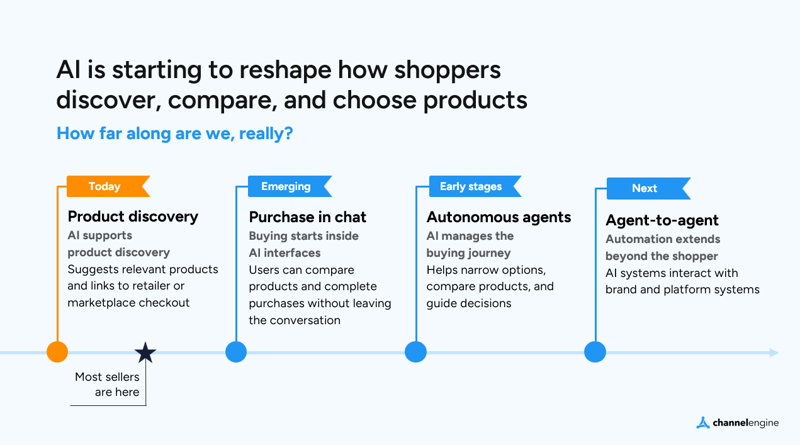
This is how that shift is currently unfolding:
-
Most sellers (and consumers) are still operating in the first phase, where AI influences product discovery and evaluation, but transactions remain anchored in existing channels.
-
The next phases, such as purchase in chat and autonomous agents, are already emerging, but not yet widely adopted. They extend the buying journey rather than replace it.
Understanding where agentic commerce stands today is one thing. The next question is what sellers should actually do about it.
Key learnings for sellers and retailers
1. Sales channels are evolving, not disappearing
One of the most important clarifications from the session is that AI is not replacing sales channels, but it is definitely reshaping their role.
AI-driven environments will increasingly handle rational purchase decisions such as price comparison, feature matching, and product selection. These are the moments where speed and efficiency matter most.
At the same time, owned channels like your webshop, brand stores, and marketplaces will play a stronger role in emotional and brand-driven experiences such as storytelling, trust-building, and loyalty.
Michael PfeifferVP AI & Agentic Commerce at Shopware
For marketplace sellers, this is critical. Discovery may shift into AI, but conversion, brand experience, and long-term value could still depend on how well you perform across your existing channels.
2. AI visibility depends on a broader set of signals than traditional search
In AI-driven discovery, visibility is not determined by ranking alone. It is shaped by a combination of structured data, behavioral signals, and contextual relevance.
The panel highlighted the key inputs that influence whether your product gets selected:
- structured product information and attributes
- reviews and ratings
- metadata and external signals
- pricing and availability
- user context and behavioral preferences
- consistent content across channels
These signals work together. Strong performance in one area cannot compensate for weak signals in another.
That is why consistency across marketplaces, your webshop, and other channels is no longer optional. AI systems compare, validate, and filter based on what they see across the ecosystem.
3. From SEO to GEO to AEO: from keywords to intent
The shift from traditional search to AI is just as conceptual as it is technical. Traditional SEO was built around keywords and ranking. AI-driven discovery is built around intent and problem-solving.
Instead of matching search terms, AI interprets what the user is trying to achieve and evaluates products based on how well they fit that context. Raja Saggi illustrated this with a practical example:
Raja SaggiEVP E-commerce at Nexi Group
That means for optimizing your product listings, you not only have to insert the right keywords but also have to make your product understandable in real-world scenarios.
4. Data readiness is operational, not optional
AI readiness is not a new initiative. It is the execution of work that many organizations already know needs to happen, but the urgency levels are different today.
AI systems depend entirely on the quality, structure, and accessibility of your data. If that foundation is weak, your visibility will be limited regardless of your channel strategy.
As Mariana Amaru emphasized: "Data is really the backbone of your agentic success."
For most retailers, that translates into a clear set of priorities:
- cleaning and enriching product catalogs
- padding more complete product attributes
- improving machine-readable product content
- strengthening reviews and review generation
- reducing data silos across teams and systems
- working with partners and vendors, building for agentic commerce
Why community, experimentation, and speed matter
The agentic commerce ecosystem is still evolving, and both merchants and technology providers are figuring it out in real time which makes experimentation essential.
This is also why partnerships, ecosystem collaboration, and practical testing matter so much right now. Waiting for a finalized playbook is a losing strategy.
 Niels Floors
 VP Strategic Development at ChannelEngine
No single brand or platform has all the answers yet. The fastest progress is happening through shared learning, partnerships, and real-world experimentation, making collaboration just as important.
Initiatives like the Agentic Commerce Alliance are emerging to bring brands, partners, and tech providers together to share learnings and test what works in practice. As Michael Pfeiffer put it: "We are all figuring this out as an industry."
Final thoughts
Brands shouldn’t look at agentic commerce as just another channel shift, as it is fundamentally changing where decisions are made. For years, ecommerce strategy has focused on driving traffic and converting it efficiently.
That model assumes the moment of influence happens on your product page or within your channel mix. That is no longer guaranteed.
As AI takes on a larger role in discovery and evaluation, the moment of influence is moving upstream, into systems that decide which products are even worth considering. That creates a new layer of competition, one that happens before a shopper ever reaches your storefront.
The brands that adapt fastest will not be the ones reacting to this shift once it is fully mature. They will be the ones building visibility, consistency, and trust into their product data and channel strategy now, while the rules are still being shaped.
Mariana AmaruIndustry Advisor at Microsoft
The next phase of commerce will not be defined by who shows up first in search results, but by who gets selected in the first place.
Book a free consultation with our team today →