Marketplace margins are under pressure. What can you control?

Profitability is moving up the marketplace agenda as costs and operational complexity grow. The Marketplace Seller Trends Report 2026 reveals where businesses have the greatest opportunity to improve efficiency.
Featured image for this blog post
Marketplace margins are under pressure. What can you control?
10:29

Marketplace sellers are still expanding. But in 2026, the way they measure whether that expansion is actually working is changing. A year ago, net sales was the most commonly tracked metric for marketplace success. In 2025, it ranked first at 33%, while profit margin per marketplace ranked second at 31%.

In 2026, those positions have reversed. Profit margin per marketplace is now the number-one success metric, while net sales has dropped to third place.

This shift suggests that marketplace teams are looking beyond how much they sell and paying closer attention to what remains after the costs of selling are taken into account.

And those costs are coming from two directions. Some are built into the increasingly competitive economics of marketplace selling: Pricing pressure, marketplace fees, fulfillment costs, and advertising spend. Others sit closer to home: Manual processes, slow listing launches, inventory issues, and returns.

Businesses cannot control every part of that equation equally. But knowing where they have the most influence is becoming increasingly important to profitable marketplace growth.

Sales are growing. But are margins keeping up?


Marketplace growth has traditionally been easy to frame around volume: More marketplaces, more products, more orders, and ultimately, more revenue. And brands and retailers are still pursuing that growth. Brands and retailers are still pursuing that growth, with 39% now active across seven or more marketplaces, compared with 34% in 2025. They also entered an average of three new marketplaces in the past 12 months.

But every new channel brings additional operational demands, from marketplace-specific listing requirements and pricing rules to inventory updates, order management, returns, advertising, and fulfillment. That means growth in revenue can come with an increase in the resources needed to manage it.

The metrics brands and retailers are tracking suggest that this balance is receiving more attention. ChannelEngine’s Marketplace Seller Trends Report 2026 shows a clear shift: In 2025, net sales was the most-tracked metric for marketplace success. In 2026, profit margin per marketplace has moved into the top position, while net sales has fallen to third place.

That doesn't mean sales have become less important. Rather, sales alone don't show the full picture of marketplace performance. Once fees, fulfillment, advertising, returns, and operational resources are taken into account, a marketplace generating substantial revenue may tell a very different profitability story.

The question, then, is not only how much a marketplace sells, but how profitably it can scale.

Marketplace margins are being squeezed from both sides


So, what is putting the most pressure on profitability?

ChannelEngine’s research points to a mix of market-driven and operational pressures. 

Marketplace margins are under pressure blog

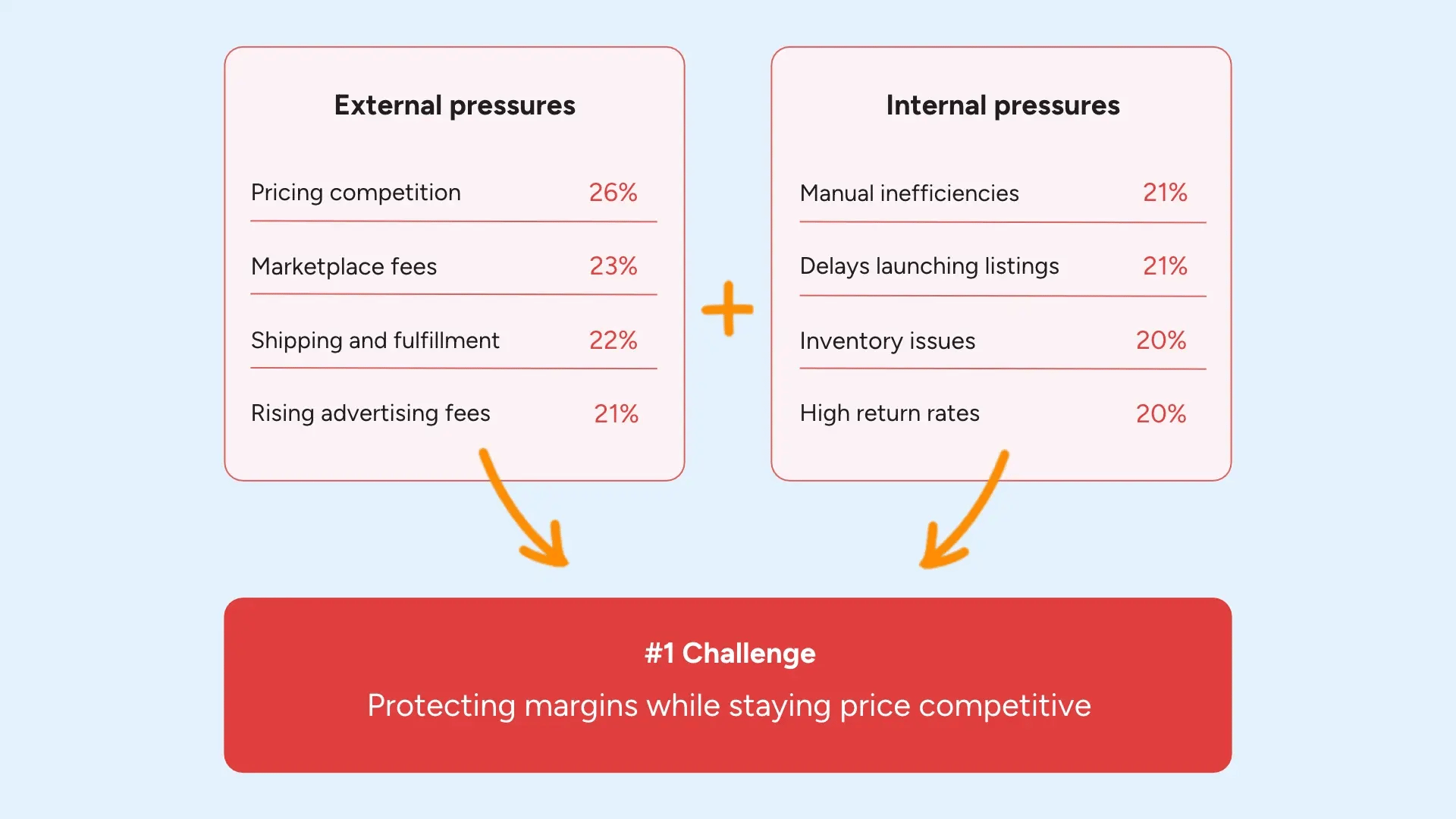
Maintaining margin while staying price competitive tops the list at 26%, followed by marketplace fees and commissions at 23%, shipping and fulfillment costs at 22%, and rising advertising and retail media costs at 21%.

At the same time, pressures within marketplace operations are close behind. Manual processes and operational inefficiencies are cited by 21% of brands and retailers, as are delays in launching or updating listings. Inventory issues and high return rates or return costs each stand at 20%.

The key difference is how much influence businesses have over these pressures. Marketplace fees, competitive pricing, and changes in advertising costs are shaped heavily by the wider marketplace environment. Internal processes, however, are more directly within their control. 

The margin equation looks different for every business


The balance between these pressures also varies by business model.

  • For brands selling their own products, marketplace fees and commissions are the most-cited pressure at 27%.
  • Retailers selling third-party products are more likely to point to maintaining margin while staying price competitive, at 30%.
  • For retailers combining their own brands with third-party products, shipping and fulfillment costs rank first at 32%

There is no universal margin challenge. A brand dealing with marketplace fees faces a different pressure from a retailer competing on price or a hybrid business managing higher fulfillment costs. But each needs to understand which costs it can influence and where operational changes can make a difference.

Ultimately, the question is the same: After the costs of selling and operating on a marketplace are taken into account, what is that channel actually contributing? 

Operational efficiency is part of the margin conversation


On average, 32% of weekly marketplace operations still rely on manual work. While that has improved from 36% in 2025, manual processes still account for a significant share of marketplace operations.

The research does not show that manual work directly causes lower margins, but it does reveal a relationship with outcomes that matter to profitability. Among organizations relying on manual marketplace operations, 37% cite higher operational costs as one of the biggest business impacts, while 34% report slower marketplace expansion and 33% point to more listing, pricing, or inventory errors. Another 30% report missed sales opportunities.

There is also the question of where teams are spending their time. Almost a third, 32%, say manual processes leave less time for marketplace performance optimization, while 28% report having less time for advertising and promotional planning.

This becomes particularly relevant as marketplace portfolios grow. Organizations managing more than 10 marketplaces are significantly more likely to spend a larger proportion of their week on manual operations, highlighting the challenge of keeping operational efficiency in step with expansion.

Taken together, manual operations are associated with higher costs, more errors, slower expansion, and missed opportunities at a time when marketplace teams are paying closer attention to profitability.

 📋 Download the Marketplace Seller Report 2026


The Marketplace Sellers Research 2026 surveyed 550 ecommerce marketplace decision-makers across the US, UK, France, Germany, and the Netherlands.

Learn more about marketplace expansion, profitability pressures, operational challenges, automation, AI adoption, and the priorities shaping marketplace strategy in 2026. 

👉 [Download the full report here]

The internal fixes that help protect margin at scale


Marketplace businesses may have limited influence over fees or competitive pressure, but they have more control over how efficiently their own operations run. ChannelEngine’s research shows this in their priorities for the next 12 months: AI for marketplace operations ranks first at 26%, followed by boosting profitability at 25%. Increasing automation comes in at 20%, ahead of expanding to more marketplaces at 19%.

So where can marketplace sellers focus to improve the economics of marketplace growth?

1. Reduce repetitive marketplace work


Not every marketplace task needs manual intervention. Product updates, inventory synchronization, pricing changes, and order processing are all areas where automation can reduce repetitive work and free up teams to focus on activities that require more strategic input.

There is still considerable room to improve. 45% of organizations use manual updates in marketplace portals to manage product content and pricing, alongside methods such as product feeds and multichannel software. 

🎯The goal isn't automation for its own sake. It's to identify work that consumes resources without requiring the judgment or expertise of the marketplace team.

2. Centralize product and marketplace data


As marketplace portfolios expand, managing channels through disconnected processes becomes harder to sustain.

Today, only 12% of organizations describe their marketplace operations as highly automated, with connected systems, workflows, and reporting.

🎯Connecting product information, pricing, inventory, orders, and reporting can reduce the need to repeat the same work across individual marketplaces and give teams better visibility across their operations. 

3. Make faster launches part of the profitability conversation


Efficiency is not only about reducing manual work. It also affects how quickly brands and retailers can get products in front of customers.

Delays in launching or updating listings are cited by 21% of respondents as a pressure on marketplace profitability, while 47% frequently encounter manual effort when launching new products. 

🎯When launching a product requires repeated manual adaptation for individual marketplaces, the cost includes both the work itself and the time before the product can begin generating sales. Reducing that friction can therefore become part of a broader profitability strategy.

4. Measure marketplaces by contribution, not just sales


If profit margin per marketplace is becoming a more important success metric, marketplace teams need visibility into what sits behind their revenue.

Two marketplaces generating similar sales can come with very different fees, fulfillment requirements, return rates, advertising costs, and operational demands. 

🎯Looking at performance through a profitability lens gives brands and retailers a better basis for deciding where to optimize operations, where to invest in automation, and where to focus their resources. 

From marketplace growth to profitable marketplace growth


Marketplace expansion is continuing, but the way success is measured is changing. Profit margin per marketplace has moved ahead of net sales as the most-tracked measure of marketplace success, while boosting profitability is the second-highest priority for the next 12 months.

Not every pressure on profitability is equally within a business's control. But improving internal operations, from reducing manual work and connecting data to getting products live faster, gives marketplace teams levers they can influence more directly.

Volume without operational efficiency isn't necessarily profitable growth. For ecommerce decision-makers, the next stage of marketplace scale is about making sure the economics grow with the sales. 

See what is shaping marketplace growth in 2026

Download the full Marketplace Sellers Research 2026 to benchmark your marketplace strategy and see how sellers are approaching profitable growth at scale.

Published on 30 september 2026
Nishkarsha Kotian
Nishkarsha Kotian is the Senior Content & SEO Manager at ChannelEngine. With a background in IT engineering and marketing, she brings a unique blend of technical expertise and creative strategy to her work. She knows what good code looks like, but also understands that great copy is what truly connects with audiences. Off the clock, she’s all about travel, good food, memes, and movies.
Nishkarsha Kotian
arrow_upward