Amazon Vendor Central: How to protect margins and grow in 2026

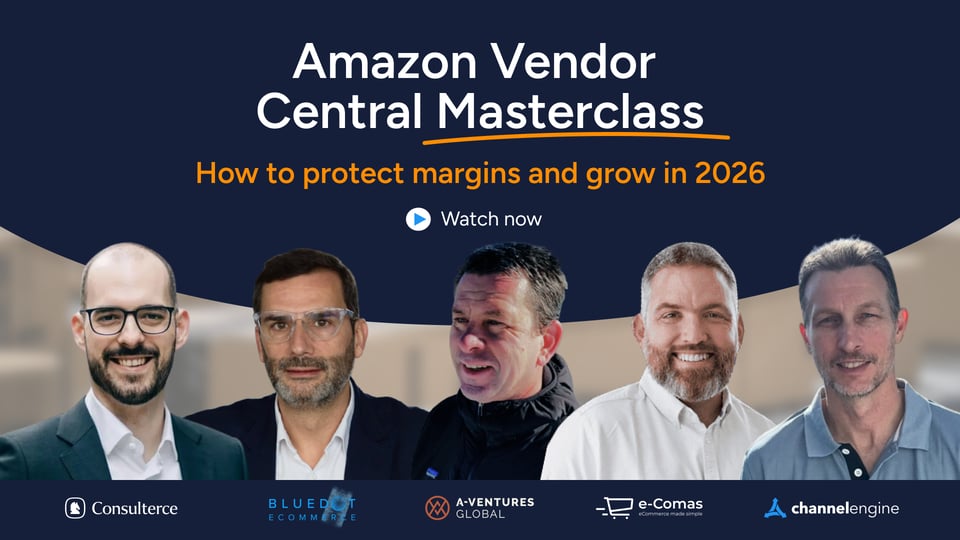
Amazon's Vendor model is changing fast. In this webinar, hosted on June 30, we explored how brands can protect margins, improve operations, and negotiate more effectively in 2026.

Featured image for this blog post
Amazon Vendor Central: How to protect margins and grow in 2026
8:52

Every Amazon vendor wants the same outcome: stronger growth without sacrificing profitability. In 2026, that's becoming harder and harder to achieve. Vendor managers face increasing pressure to hit profitability targets, operational standards keep rising, and Amazon is investing heavily in automating its own retail organisation.

In this webinar, Bobby Peloquin, Global Vendor Lead at ChannelEngine, was joined by Martin Heubel, Founder of Consulterce; Bruno Ferreira, Founder of BlueDot Ecommerce; George Wescott, Founder & Managing Partner at A-Ventures Global; and Jérôme de Guigné, Founder & CEO of e-Comas, to discuss how the vendor landscape is evolving and what brands need to do to protect margins while positioning for long-term growth.

Their conclusion was clear: success in 2026 won't be decided during annual negotiations. It will be determined by the operational decisions and groundwork brands make throughout the year.

In a nutshell


Profitability is increasingly shaped by what happens before negotiations begin. What was once primarily a buying relationship has evolved into a highly interconnected ecosystem, where catalog quality, operational performance, content, profitability, retail media, AI-driven discovery, and commercial negotiations all influence one another.

Brands that consistently outperform are treating catalog management, operational excellence, and clean product data as strategic advantages. Those foundations reduce costs, strengthen your negotiating position, and create a more resilient Amazon business.
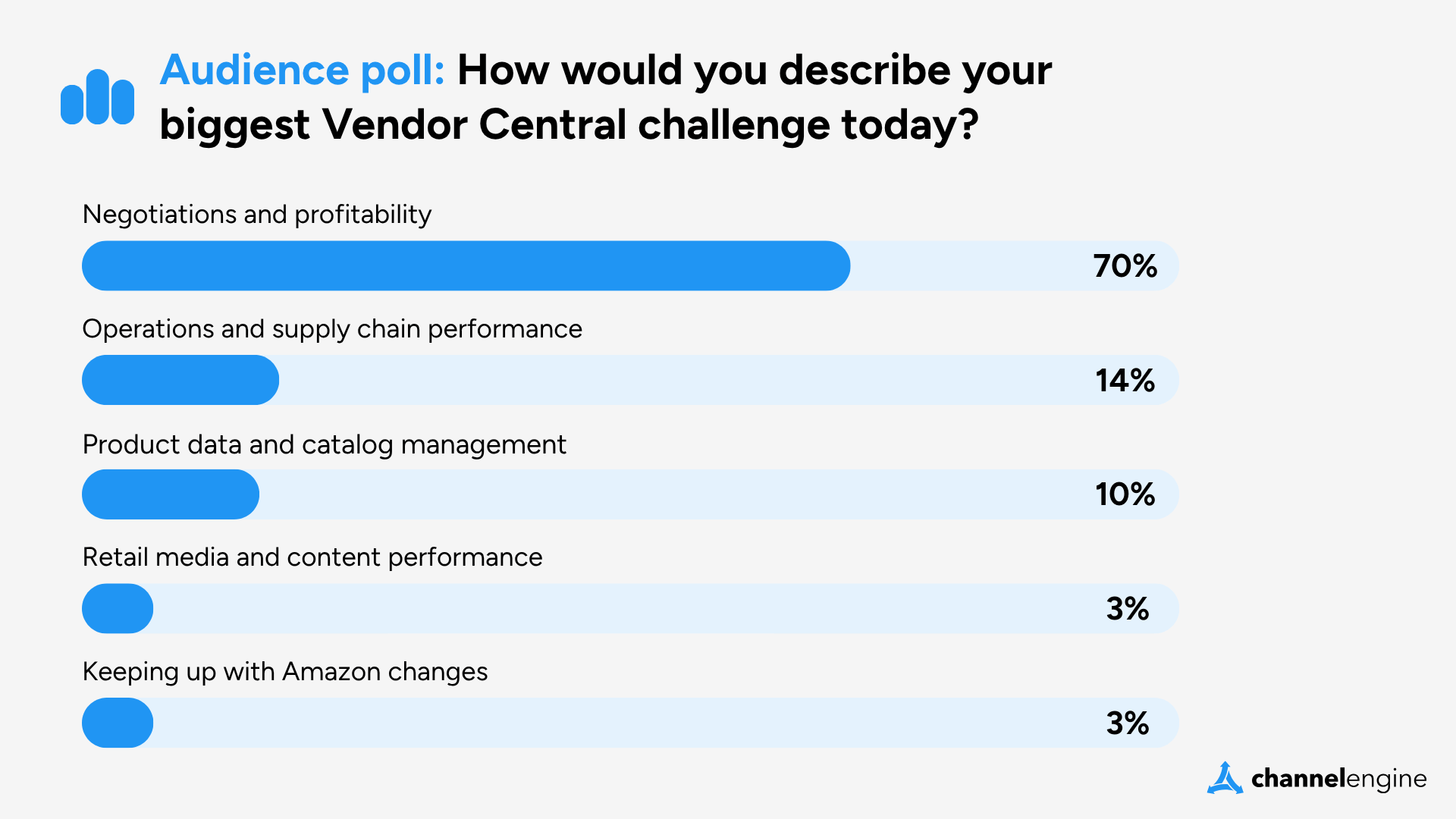
What vendors said their biggest challenge is right now


Before diving into the session, we asked attendees: "How would you describe your biggest Vendor Central challenge today?" 70% of attendees pointed to the same pain point: negotiations and profitability. It's a signal that most vendors know their margins are under pressure but they just need a clearer path forward. The panel addressed exactly that.

Vendor Central Webinar Poll Results

🎥 Watch the recording


Watch the full webinar recording here.


🎙️ Prefer reading? Jump to the full webinar transcript.

 Top 5 takeaways


1. Amazon's priorities have shifted from growth at all costs to profitable growth.

2. Your product catalog is a commercial asset that directly impacts profitability.

3. Operational excellence strengthens your negotiating position long before annual vendor meetings.

4. Data visibility and process ownership are becoming essential competitive advantages.

5. Technology can automate workflows, but experienced people remain critical to long-term success.

Best practices and key learnings


Amazon's priorities have changed. Has your business?


Amazon no longer operates like a traditional retailer. Its retail organisation is increasingly automated, vendor managers are measured on profitability over revenue growth, and the expectation is that brands keep pace with that shift

"Amazon's retail teams are on a journey to automating themselves. If your internal organisation and processes have not caught up with that reality, this is typically when the issues around profitability start to creep in."

That said, the panel didn't see this as a simple picture. Whether you're 1P, 3P, or somewhere in between still matters, particularly given the evolving regulatory environment, which George flagged as one of the most underappreciated factors shaping the landscape right now.

Your catalog isn't an operational task. It's a profit driver.


Every product attribute, identifier, dimension, and case pack influences how Amazon buys, stores, ships, and sells your products. Small mistakes at setup create costly issues that compound and the complexity is even greater for brands who inherit ASINs originally created by distributors or third parties.

One of the most common errors Bruno Ferreira sees: vendors invoicing in units but set up in cases, or distributing in cases but receiving orders in units. The mismatch runs deeper than it looks. 

"If you don't select the right identifier when receiving orders, if you don't check your invoice layout, and if there's a disconnection between your catalog and your ERP, a lot of the downstream issues - shortage claims, chargebacks - are caused by things that, if done correctly at the start, will help."

Review ASIN by ASIN. Confirm identifiers match your ERP. Get case packs right before your first delivery, Amazon will waive the first chargeback, but that's a warning, not a pass.

And getting the data right internally is only half the battle. Jérôme flagged a problem many brands don't anticipate: you can send content to Amazon, Amazon can receive it, and it still won't appear on the listing. Chasing that down requires people, not just tools.

Operational excellence isn't glamorous, but it protects your margins


Every chargeback, shortage claim, and compliance issue quietly chips away at margin, and many vendors don't realise how much is leaking until they run a full audit. 

According to Bobby, many vendors overlook co-op fees and chargebacks because reviewing them is time-consuming. However, once an audit is completed, it's not uncommon to uncover millions of dollars in lost revenue. He also notes that Amazon's decisions aren't always correct, making it worthwhile to regularly review and challenge deductions where appropriate.

One underused signal worth noting is waived chargebacks. Most vendors ignore them because no money has been deducted. In reality, they're an early warning system.

Lastly, keep an eye on your forecasting data. Amazon's tool shows sell-out volume, not your replenishment quantity. If your catalog is in units but you distribute in cases, you'll generate shortage claims that were never real, and spend time disputing things that were never actually wrong.

Negotiations are won long before you enter the room


Brands that spend the year improving operations and building a clear view of their commercial position enter negotiations with far more leverage than those scrambling to justify a cost increase at the last minute.

"You will never negotiate your way out of unprofitable products with Amazon."

George WescottGeorge Wescott
Founder & Managing PartnerA-VENTURES GLOBAL

George's point went further than tactics. He argued that treating the annual vendor meeting as a negotiation is itself the problem. Amazon has more operational data on your brand than you do on theirs. The strongest vendors start with their most profitable ASIN, close operational gaps based on data, and expand from there.

Martin added a point many leadership teams find difficult: you cannot simultaneously grow top-line sales, protect profitability, and avoid sales disruption. You can achieve two of those three, but not all three. Deciding which two matter most before you sit down is what separates vendors who negotiate with confidence from those who compromise under pressure.

The panel also flagged that portfolio leverage plays out differently by market. In Europe, selectively withholding low-margin products from 1P can create room. In the US, Martin cautioned, brands above a certain scale can trigger Amazon's Standards for Brands policies, where a shift toward 3P suppresses distributor listings rather than creating leverage. Any strategy involving channel structure needs legal and commercial scrutiny first.

Download now: The Ultimate Amazon Vendor Playbook

Discover strategies, insights, and frameworks from the world’s leading Amazon 1P experts. The Ultimate Amazon Vendor Playbook reveals how to drive profitability, control, and growth on Vendor Central.

Download your playbook →

Technology enables growth, but people make it work


The temptation to treat technology, and increasingly AI, as the answer to Amazon's complexity is understandable. However, the panel’s view was more grounded.

"The task force and technology need to work together. A tool doesn't work alone, because Amazon will still have problems and you need people to talk to. Even if you have AVS, it doesn't always do the trick. There's no magic here. It's work."

Jérôme de GuignéJérôme de Guigné
Founder & CEOe-Comas
"AI is great, but it still requires the brand to have full ownership over processes. It is not going to solve all of your pain points in the foreseeable future." 

AI trains on historical data, which makes it a poor guide for what's changing right now. However, George pointed to where the real forward-looking opportunity lies: the new backend data fields Amazon is surfacing, such as item of origin and TAA compliance. These are signals most vendors aren't watching yet, and they represent genuine growth levers for brands willing to move on them early.

Final thoughts


Annual negotiations still matter, but they're increasingly the outcome of everything that happens throughout the rest of the year. Profitability is no longer owned by one department. It's shaped by every team that touches your Amazon business, from product data and supply chain to finance, operations, and commercial leadership. When those functions work together, negotiations become easier, operations become more efficient, and sustainable growth becomes achievable.

Ready to strengthen your Amazon Vendor strategy?

Discover how ChannelEngine can help you build a stronger, more profitable Amazon Vendor strategy for 2026 and beyond.

Book a free consultation call →

Read the full webinar transcript 👇

Speaker introductions and ChannelEngine overview

00:03:22 Bobby Peloquin: Hello, I'm your host today. I am Bobby Peloquin. I'm the global vendor lead here at ChannelEngine. I've been part of the team for just over 2 years and focused on our Amazon 1P products. Prior to that, I was the CEO of a little company called Retail Data Partners. We had developed the first vendor tools in the marketplace many years ago and then were eventually acquired by ChannelEngine. We're really excited that you guys can join us. We're looking forward to this conversation. I think it's going to be very insightful and thank you for taking time out of your business to join. I know it's a very busy time right now, so we thank you for being part of this.

00:03:56 Bobby Peloquin: Just to tell you a little about ChannelEngine, if you're not familiar with us, we are a global marketplace integrator, connected to over 1,300 marketplaces. Our corporate office, our headquarters are in Leiden, Netherlands, with offices around the globe. And really what we do is help you make it easy to manage and grow your business on marketplaces. So whether it's pushing content, getting all of your sales analytics and insights, dynamic pricing tools we have, inventory order management, really making it easy to manage and grow on multiple marketplaces. Whether it's Amazon, eBay, Target, Walmart, Bol.com, we're connected to them.

00:04:47 Bobby Peloquin: I'm going to let you guys introduce yourself. Martin, we'll start with you.

00:04:51 Martin Heubel: Thanks, Bobby. Thanks, everyone, for joining us. I know, as Bobby said, it's a very busy time. So we appreciate you sharing your time and schedule with us today. My name is Martin Heubel. I used to work at Amazon in the capacity of a vendor and senior category manager, took responsibility for various product categories from hardlines over to CPG or FMCG. And now since a little bit over five years, advise first-party vendors on their commercial needs and demands with the online channel, particularly coming in when it comes to annual vendor negotiations, go-to-market strategies, or the assessment of any profitability initiatives needed with Amazon. Thanks for having me, and I look forward to the conversation.

00:05:36 Bobby Peloquin: Bruno, you're up next.

00:05:40 Bruno Ferreira: Hi, I'm Bruno Ferreira. So I'm from Blue Dot eCommerce. I worked — before I founded Blue Dot — as a global account manager for vendor accounts in the gaming category for about 7 years. It was an amazing experience. We had no training from Amazon. We learned everything and I fell in love with it. So I set up BlueDot to help vendors on their internal setup. We help them to build compliant processes, how to have visibility and trace back all the operations internally. We also support them aligning the cross-functional team and the ways of communicating. We usually find them working in silos. And I'm really looking forward for this discussion with this amazing group here.

00:06:34 Bobby Peloquin: All right, George.

00:06:42 George Wescott: Hey, Bobby, thank you for having me and I really appreciate the group. My background is I'm a pioneer — one of the first people to ever feed data to Amazon at scale, started in 2002. So I've been around the game a while. I work with best-in-class technology providers in the commerce space, such as Channel Advisor, to help them go to market and develop their business and meet their goals. My area of expertise is data automation and at scale. So really excited to be here. Hope that the people watching get some value out of this. That's the goal here for me.

00:07:46 Bobby Peloquin: Jerome.

00:07:48 Jérôme de Guigné: So last but not least, I'm Jérôme. Happy to be — very happy like the others — to be here in such an amazing group. I'm the founder of e-commerce. The e-commerce group is now several years old. And we started as an agency helping brands expand into Amazon as a vendor very much at the beginning. Now we have a mix of vendors and sellers because that's how businesses have been going. We help Europeans expand into Europe, Europeans go to the US, Americans go to Europe. We have now inside the group a large assortment of solutions for brands who want to grow fast. So we have the agency, but we have a distribution leg with our own warehouses in the UK and in mainland Europe. We do typical distribution 3PL. We've got the digital marketing team with e-commerce digital marketing, and we have our own tool called Clarisix, which I think would be very interesting for you guys to follow up. So we help brands on multiple elements. The promise is to grow and expand fast.

The Amazon vendor flywheel: how it has evolved

00:10:31 Bobby Peloquin: We're going to start with what is the Amazon vendor flywheel. For those people that — Amazon has changed a lot, especially over the last couple of years, whether it's negotiations getting harder, Amazon being ultra focused on profitability, AI is changing the way people shop — it's all interconnected now. You cannot be in silos. And more and more we see teams in silos. So I'm going to leave it to the team. What would you guys, for those people who may be new, haven't heard of the term Amazon Flywheel, how would you define it and why is it important to get it right?

00:11:38 Martin Heubel: I'm happy to start. I mean, generally speaking, I think it has evolved a lot. We all know this classic flywheel that Jeff Bezos introduced to shareholders back in the early 2000s, where they said, look, having your selection paired with a good customer experience — i.e. prime benefit offering — is leading to growth and thereby attracts more brands to actually come to the platform, which then creates this vicious cycle of more sales, more growth, which again then attracts and allows us to lower prices over time and start price matching more and more.

00:12:13 Martin Heubel: What we've been seeing in the past few years, specifically following the final stages of the pandemic, is that vendor managers and Amazon's retail teams are increasingly becoming focused on profitability, and that the business model of Amazon has changed in its totality as well. If you're just looking at 2025 and Amazon's latest shareholder report, we now know that Amazon is very serious about spending their $200 billion in the expansion of AI solutions, and their AI footprint — which is the race between tech giants that's currently unfolding, not only in the US, but also over here in Europe and in other marketplaces — which these days has real world consequences for vendors and suppliers operating their business with Amazon.

00:13:01 Martin Heubel: What I keep seeing in my work with clients, in my work with brands, is that Amazon is commonly mistaken as a retailer with whom you can have a true and meaningful partnership. While that may be true in the past, and while that is also certainly true when you talk with your advertising, your AWS counterparts who truly want to set sails with you — deeply embed also their supply chain solutions into your organization — what brands with this new flywheel need to be really careful about is that Amazon's retail teams are on a journey to automating themselves. And I always call Amazon not a retailer, but a tech-enabled marketplace platform. Whether you have a go-to-market strategy that is 1P or 3P is almost irrelevant today. But if your internal organization and your internal processes have not caught up with that reality, this is typically when the issues around profitability start to creep in.

00:14:20 George Wescott: I think I can add, from my 20-some years, the difference today is Amazon's no longer a platform where moving fast and breaking things leads to any kind of success. Automated inventory feeds, things like that at scale are super meaningful today. It's a very different environment — and to your point, Martin, about it doesn't really matter, 1P or 3P, it actually does matter because of the regulations. And we can get into that, but that's another factor — how much the regulatory environment impacts things within the marketplace and external to the marketplace. But yeah, it's just no longer the wild wild west.

Catalog accuracy: the foundation of vendor success

00:15:44 Bobby Peloquin: Let's start with the foundation — the catalog. It's where usually the vendor journey starts. I've seen a lot — I think everybody I speak with, they have some challenges typically — but you guys made a comment the other day that you've never seen a catalog 100% accurate. So if it's so important, it is the foundation as we know. I'd love to know where brands are making mistakes, maybe where they underestimate an impact. We know now that a catalog impacts your operations, your negotiations, your profitability, and your leverage with Amazon. So I'd love to hear what you guys have experienced with catalogs that are not 100% correct and how they can improve.

00:16:34 Bruno Ferreira: If I'm allowed, I'll start immediately with the initial load of the catalog. I've seen vendors — they invoice in units, they set up in cases because they actually got someone to help them. Or the reverse: they invoice in cases, but they didn't set up the catalog, so they receive the orders in units. We've seen — if you don't select what you're using as an identifier, a lot of vendors still don't know about that small but big detail. What's the identifier that you actually want to match if you're using EDI — with your invoicing system, your ERP, the dimensions.

00:17:22 Bruno Ferreira: The NIS — it's a flat file on steroids. Now we have some improvements in the web interface, but the file is still the same. We have like 87 or 92 columns to complete. Some of them are conditional, mandatory. And I think the errors start in the initial catalog. When a brand is invited, probably a lot of the ASINs that are their brand are already someone 3P — someone is already selling them through Amazon, so the ASIN is already created. These new vendors don't have the support from Amazon teams to initiate them on how to complete the file, and they don't verify all the data. Probably whoever created that ASIN was a third party, a distributor, who didn't care about nurturing the brand or getting the dimensions properly aligned with the product.

00:18:31 Bruno Ferreira: For me, it starts there. Nail it in the catalog. Do it properly. Review ASIN by ASIN. Select your identifier when you're receiving the orders. Check your invoice layout. It's very important — also the disconnection between your catalog and your ERP. Are you using EDI? If you are, you selected the identifier, but then you need to match. If Amazon is ordering in cases, match your system to cases too. If you can't make it cases, don't make it more complex — just align it in units for the orders and then invoice in units too. We see a lot of shortage claims caused by these things that, if done properly at the start, will really help downstream.

00:19:18 Martin Heubel: If I can take the position of somebody in the audience, listening to all of this — what would any one of you recommend? How to execute this? Do you need extra headcount to do it? Should you automate this? If you know that you have already service providers in place, you have a certain tech stack in place, but you're running into these catalog issues — what's the best way to address these issues?

00:19:42 Bruno Ferreira: Depending on the size of the catalog, I would agree to get third-party software to help with that and get your marketing and content team on it. Another thing — don't get your commercial team to do it. Yes, they sit in the big chair managing Amazon, but get the help from marketing and content teams, definitely.

00:20:11 Jérôme de Guigné: I totally agree with what you've said. What I wanted to add — and it also connects to what Martin said earlier about the transformation of Amazon and AI — our lives are being changed by AI, literally. But some things are not changing at all, and sometimes it's more important to understand what is not changing versus what is changing. Amazon is doing a lot of noise around AI investment because there's a PR battle, they've also fired a lot of staff because of AI — but you have to understand, a lot of things are still not working with Amazon. There's something making everyone pretend that it's amazing, it's all automated — it's not.

00:21:23 Jérôme de Guigné: The point is — the barrier to entry, to be successful, is no longer with the buyer. It's really about how you make your catalog appear properly on Amazon. And the larger the company, the more complex it becomes. It could be internally inside your own company — you're not matching the right things together, or your content is not actually very clean. Or generally it's okay, but it's not okay for all 20 or 50 attributes Amazon is asking for. That's the first issue. The second issue is syndicating the content to Amazon — you can do it manually, or automate it through a tool, which is the best solution. And then you need to make sure it appears, because you can send it, Amazon can receive it, and still not make it appear.

00:22:33 Jérôme de Guigné: You are the brand owner, you've got all the rights, but for whatever reason the content in Germany is driven by an account in the US which has account ownership — nobody knows why and Amazon can't solve it. That's typically something AI will never solve. So for me — it's first understanding it's very complex, understanding that it has a big impact on how you're selling, and then making a task force around it. Task force plus technology, and both need to work together. But the technology — a tool on its own, from my experience, doesn't work alone because Amazon will still have problems and you need people to talk. So even if you have an AVS, that probably will help, but it doesn't always do the trick. There's no magic here. It's work — hours of work — and you can't automate all of it.

00:23:49 Bobby Peloquin: And then when you do get it right, you have Amazon things break. We have one client where it was their single biggest issue growing on Amazon. It hurts best ad conversion, hurts best seller rank, and it's just been a nightmare. Along with that — the same client was getting Doc Martens shoes put in as their image, which they don't sell. How do we — do you think any of the changes Amazon's made this past year will help? With brand registry now, the owner is the only one that can create the actual listing. I don't know if it's going to help though at the end of the day. Things keep breaking.

00:24:43 George Wescott: Are you referring to the changes in contribution of content? The scale of the content still presents massive challenges because of — purely scale. I think people are going to be challenged with the integration of tools that Amazon's integrating as well. So I don't necessarily expect a massive difference one way or the other.

00:25:27 Bobby Peloquin: Things are still going to break.

00:25:29 George Wescott: Absolutely. At the scale that we're talking, I think that's the one thing that a lot of people have a really hard time wrapping their mind around — the literal scale of things. A lot of the companies that we all work with have seen the NIS, the new item setup sheet, and seen maybe 1,000 rows of data being fed. And there are hundreds of thousands of those. I've reached the limit of 150,000 rows and found out that AWS has limits of how much data you can feed. It's a massive amount. And with that, all kinds of problems happen. The critical part is — back to Bruno's point — case packs, things that are so simple in the setup process of the NIS. When you make a mistake on the NIS and add it into Vendor Central, it gets accepted. It's not like a typical platform that would reject it because it's wrong. They accept it. And then basically every part of the flywheel breaks because it's wrong. So back to getting just the basics right. We live in an environment where it's cobotic — meaning there's going to be humans and machines involved.

00:27:35 Martin Heubel: And to add to your point, George — a lot of brands are still expecting Amazon to solve it for them. This is where the worlds of brands and Amazon clash, because Amazon sees itself — and this is to my point earlier — it doesn't matter whether you're 1P or 3P. Amazon sees itself as a marketplace that simply connects available demand in the market with the available supply from the brand. If you are not owning your brand, if you're not owning the processes, you have to deal with the end result, which is then your problem. Sure, Amazon will give you some tools and sometimes even human support to figure it out. But particularly over here in Europe, we're seeing quite the opposite. Amazon offshoring more and more teams to India and Eastern Europe — in the US, we haven't seen that too much yet, but it's going to happen in the near future.

00:28:39 Martin Heubel: Sometimes they're very good because they're really excited to work on these problems, but as with any human, sometimes you're on the end of the stick where you're in an endless loop. You first get reviewed by an AI, they forward you to a human, and then it's a little bit like a lottery ticket whether they really know how to resolve your unique issue. So a key takeaway for brands is ownership of the processes — but also creating controlling loops to understand: once I upload my catalog, once I upload my NIS sheet, this is not the end of the process. I need to have certain controlling mechanisms in place over the next couple of weeks and months to understand, does it create unintended consequences with penalty charges, chargebacks, or shortages? And then to act fairly quickly. Amazon has shortened the disputing time frames that they allow to dispute these issues, and brands are often caught off guard — because they think they can just negotiate that away with their vendor manager. The reality today is it's not as simple as that.

00:29:50 Bruno Ferreira: That's a good point, Martin. And just grabbing the chargeback part — when a vendor starts, they'll usually get between 60 to 120 days for a grace period. The grace period gives the vendor the chance to actually align the internal setup. But it's lacking this understanding of how chargebacks work. It's a 90-day period. The first time you deliver to a specific fulfillment center, it will be waived — it doesn't matter if it's grace period, it will be waived the first time. And people will laugh. But this is actually the fair part of it — Amazon is telling the vendor: you did this wrong, I'm waiving it this time, you have 90 days to fix it, if you don't fix it I'll start charging you. And we keep finding vendors that only pay attention to charge values. Waived ones — that's where the powerful messages are. And the risk is: from one week to the next, what will be the value converted from waived to charged?

00:31:40 Bruno Ferreira: This is something that starts right at the beginning — once again, uploading the catalog, do it properly. Don't sign to your catalog apple cider vinegar in a glass jar. It's liquid, it's glass. Read the compliance. Glass and liquid are two of the worst attributes for an ASIN. You need individual prep, bubble wrap. Amazon didn't explain it to you, but they are warning you every time you deliver to a fulfillment center — there will be a prep-related chargeback that will be waived. But vendors are not looking into that.

Operational excellence: fulfillment, chargebacks, and shortage claims

00:32:22 Bobby Peloquin: Yeah, I think this is a good segue to switch from catalog to operational excellence. You can have your catalog set up perfectly — everything pushed into Amazon — but are you set up to fulfill the orders? Do you have the inventory? Are you accepting the POs on time? Chargebacks — you mentioned. I can't tell you how many people we talk to, because we have the automated tool that disputes these — a lot of brands don't even look at co-op fees and chargebacks. And to your point, Martin, Amazon switched from five years to two years for shortages. I expect that to happen in Europe as well at some point. Let's talk about how we can help on the operational side. Bruno, what's one of the biggest problems that you see — a quick win, a quick fix that anybody could do to prevent some of these?

00:33:22 Bruno Ferreira: I will start with this one — start measuring the waived values of the chargebacks. Don't see them as something you're not paying, so not a priority. It is a priority, because that's where the message is that something is not properly aligned with Amazon compliance. Start there. Another thing that really helps a lot — don't go forecasting without knowing if you're going with Amazon forecasting data. First of all, be aware that everybody knows where to go to the forecasting model on Vendor Central, but that's actually sell-out. It doesn't mean that will be your stock — it's a global figure that Amazon thinks they're going to sell of that ASIN. So align the catalog in cases or units and make sure that your forecasting is aligned in the unit of measurement.

00:34:30 Bruno Ferreira: Another thing that we find really important about shortage claims — coming from the units issue again. Vendors set up the catalog in units. They distribute in cases. Amazon orders 10 units of this. It's a case pack of two. They send five. There's a five-unit shortage claim. It's not a real shortage — they actually delivered it. It will be quickly disputed and reversed. But what about the time for the cross-functional team? They could be focusing on something else. So we truly believe at Blue Dot that success for vendor profitability lies in the sell-in part. Because the sell-out part, you have all of these amazing tools to help — but the sell-in, that's where you really need to know the game and know the rules.

00:35:27 Bruno Ferreira: And I will leave here again this message for all the vendors in the audience: Amazon Vendor Central — the web interface — is a self-service tool. Amazon didn't train you for that, but you can learn how to do it. It's a self-service tool. Definitely your teams can improve the knowledge and the management. A lot of our work is aligning the cross-functional team to work in a single voice — the same data, the same acronyms. Sometimes we work with teams where in Italy they're using some acronyms and in Spain a different acronym for the same meaning, and then everything gets mixed up in the middle of a meeting. It's this level of detail sometimes that will bring success.

00:36:39 Jérôme de Guigné: Well, I totally agree. There's a lot of operational stuff which is still very manual. And what I wanted to add — you have to see that the way Amazon works a lot is in silos or in business units which don't always work a lot together. The global system of Amazon was built by different teams who, at the beginning at least, I don't think spoke a lot to each other. That's why in Europe, the system was completely copied from what was happening in the States, and typically in Europe all the charges are on prices with VAT — which doesn't make any sense, but it just copied what was happening in the States.

00:37:42 Jérôme de Guigné: They've worked and invested all their money on the front end for customers — it's very seamless, you don't see the complexity behind. But for the brand, they under-invested, and the systems are very complex. That's typically an example where AI will not solve lots of different systems that have a hard time talking to each other. And usually Amazon announces something and then tests it after it's announced. So you have to be very reactive, very ready. One of the key factors of success is having a team or people who are really involved — who do things but also follow up on things. You upload content, you look at chargebacks, you look at quantities — you need to check that Amazon is right, that the data in the system is right. So there's a lot of human intelligence and business acumen involved in sense-checking all the information Amazon is providing.

00:39:11 Bobby Peloquin: Yeah, we see that a lot. Back in the day I had a lot of conversations where people had no idea this was an issue. Then you do an audit and it's literally millions of dollars being lost. I think now a lot more people are aware that Amazon isn't always right. I remember one call where they said, what are you talking about? Amazon data is always right. And I said, no, that's not the case.

Vendor negotiations and profitability: strategy and mindset

00:39:34 Bobby Peloquin: And this all obviously leads to negotiations and profitability. I want to make sure we spend time there. We're hearing more and more — I'm getting calls asking for help where clients are really worried. They're being pushed harder. We had one client say that the net PPM being requested was just outrageous. They're worried about getting kicked off of Vendor Central. How do you approach these negotiations, especially knowing they're getting harder? Amazon's asking for more, demanding more. What do you accept? What's a short-term concession versus long-term profitability that you're going to hurt down the road?

00:40:43 Martin Heubel: I always say — look, it's about doing the homework that you have been avoiding for a while. A lot of brands, especially large organizations, think of negotiations as: I have my budget, I start a little bit higher where I anchor and then Amazon anchors high as well and we meet in the middle. That is not how a negotiation with vendor managers and Amazon's retail teams will perform today. They have very strict targets on what they want to achieve. And increasingly, vendor managers have no problem with your account not growing by a single percentage point year over year, as long as they hit their profitability target.

00:41:25 Martin Heubel: That means we can no longer just negotiate about budgets or about a cost price increase. We also need to really look at — is our portfolio strategy of listing 100% of our assortment via 1P still the right approach? Or do we need to become more nuanced, potentially withholding part of our selection to then also gain some leverage when Amazon knocks on the door and wants us to list our low ASP everyday essentials that they're very desperate to get in order to fuel their sub-same day delivery in the US and increasingly also over here in Europe? But that requires nerves of steel, particularly from leadership teams.

00:42:19 Martin Heubel: Before you even enter a negotiation, it's incredibly important to be very clear-eyed and also to educate your leadership teams on what success can look like. If your leadership team comes to you and says, we must avoid sales disruption, we need to grow top-line sales, and we must protect our bottom line — you're going to fail. You cannot achieve all three at once. You need to pick your battles. Out of the three — sales growth, profit growth, and avoiding sales disruption — you can have maximum two at the same time. And I think this is sometimes the very hard part, and something that a lot of leadership teams and sales teams cannot wrap their head around. This is why most negotiations feel very one-sided.

00:42:49 Bruno Ferreira: I will give my two insights for the negotiation coming from operations. First — align your internal setup. Think about shortage claims. Big vendors are being put in a position that: I can't close my account because I have $1.6 million in shortage claims that my CFO can't reconcile. Clean the house first. Don't go to negotiation with these values. Align your setup, align your supply chain.

00:44:09 Bruno Ferreira: The second thing — think about chargebacks. Chargebacks don't get disputed that easily, but if you improve them, you're showing Amazon year on year that you're improving your performance. We get told by Amazon teams that performance is very important for a vendor. So let's start demonstrating that to them. Another thing from operations — think about damage allowance. Amazon Vendor is a B2B business. We partner with Amazon to grow our brand, but in the end we're selling and Amazon is doing the retail part. When Amazon says, you sold me your stock and I sold 100 units and got 10 returns — that's a 10% return rate — I'm always on the other side of the table saying, well, you know what? I sold you 1,000. So you only have 10 returns, so it's a 1% return rate. Vendors need to start realizing it's B2B.

00:45:36 Jérôme de Guigné: My take on that is — it's a power play, basically. You have the buyer — the vendor manager — who wants to increase their margin, and there's a clash because you want to not give them too much margin because you want to save your own. So understanding how the Amazon psychology works, which is a bit different from a typical buyer, and being prepared — having all your numbers, understanding what the target of the vendor manager is. Is it growth or is it profitability only? The question is all about how you play that power play.

00:46:46 Jérôme de Guigné: If the power is all in their hands, you will be in a very difficult situation. Because if they can switch on and off your brand, that's a very weak position. The whole question is — how real is his perceived power? How important is your brand to his category? How important is Amazon in your own mix? Do you have other ways of selling? Where you could say, I'm playing in a game that the vendor manager's own sales will go down a lot if you leave, for example. So for me, it's really this negotiation tactic where you have to understand what's in it for him, what is his real target, and how you can level the playing field — not very easy, but sometimes you have to leave the table and explore another way to sell.

00:48:18 Martin Heubel: I think we need to be careful to differentiate between the US and Europe here. I think in Europe, hybrid is okay. I've seen this strategy backfire quite a lot when a 1P vendor says mid-AVN, I'm just going 3P. Just ask most brands over 15 million US dollars in the US, where Amazon then activates a standards for brands policy — where they become almost locked in, and even distributors and other third parties selling on your behalf are not going to be able to win the buy box and get effectively suppressed. So it is also about really looking at — do I fundamentally have the basics under control? And what are my realistic diversification plays that my business is also willing to accept?

00:49:21 Jérôme de Guigné: Yeah, I just wanted to make sure — I don't think it's a good thing to try to go with a hammer and try to reverse a part like that. I totally agree — it's a bad idea because they could start to put trouble. They have indeed a lot of power. So it's more in your preparation of where — and like you said — either there's a way out or there's no way out. If you can't go without the 1P solution, then you need to prepare yourself in a position which is not ideal because you need them.

00:50:18 George Wescott: I'm fascinated because at the core principle of Amazon, they do not negotiate. Amazon's very famous for being misunderstood and they often do it to basically have an advantage. To call it an Amazon vendor negotiation is actually, in my opinion, a pretty big red flag. It's not a negotiation at all. Amazon has more operational data on your brand than you do on them. So you're never going to technically negotiate with them.

00:51:02 George Wescott: So having that philosophy at the very beginning of entering a NIS into Amazon Vendor Central is really important. Just at the very top of the org, understanding: you will never negotiate your way out of unprofitable products with Amazon. It's never going to happen. So back to the operational part — how do you get to profitability? You start with your number one hero product and you go basically in deep on that from a data perspective and start to fill the gaps operationally on that one based on data, then expand again based on profitability. Most companies will take an A-to-Z approach or audit everything alphabetically. Have a critical high-level understanding that you're not going to negotiate with Amazon, and it really boils down to understanding core principles at Amazon, what it is, what's going to happen in the future because of regulatory environments — that's where you're going to see the most impact on profitability.

00:52:58 Bruno Ferreira: Amazing words, George. And we keep seeing — vendors keep going to these negotiations thinking that Amazon is making them lose money. But actually it happens in the sell-in. If you do it right, if you reduce your shortage claims, if you fix the root causes for the chargebacks — because they are basically there for you to fix, and you will stop them. If vendors actually realize they don't have visibility and traceability, if they make it profitable in the sell-in, they won't be so nervous in the negotiation. And then maybe they don't need a cost price increase — because that's usually a demand every year from brands.

00:54:14 Bruno Ferreira: I remember a couple of years ago one of our clients approached us wanting us to help them build the narrative for requesting a cost price increase. I asked for a couple of weeks to analyze the operations, and while they wanted to increase on average 4%, we found 6-point-something percent that we could reduce and save in the logistics operation. All of this will help vendors sit at that table differently and talk differently with Amazon.

00:55:05 Martin Heubel: You can reduce terms. You can reduce terms fairly regularly. The question is, what are you willing to accept in terms of commercial headwinds? It is more common than most people think. If you want to reduce terms, you need to look at it through the lens of your vendor manager. You're basically asking them to accept a lower margin. No retailer — it doesn't matter whether it's Amazon, Walmart, or any retailer in Europe — will just say yes to this. It is you as the brand who need to show them the way of how you're going to stabilize their margin. It is not Amazon's job to do that. It is your job to do that. And once you switch to that mindset and perspective, usually you will be able to have a much more fruitful conversation, not only during AVNs but also when it comes to cost price increases.

00:56:19 George Wescott: One really simple example that people don't often think about — literally from my very first meeting with a vendor manager. I told him I'd built a marketplace like Amazon in the past, and that I was working with a brand to send traffic to the detail page from outside Amazon. And he goes, what? You're going to send traffic from off Amazon to the product detail page? I said, yeah, we're going to use that data to get a better deal from you. And he laughed. My point is simply that you can use things outside of Amazon — data-wise, operational, third party — to help you and offset. I don't look at it as a negotiation, but as an offset. Get to a point of profitability or growth where you can reinvest back into an ASIN. A lot of times the data that can help is not internal to Amazon — it's external — and it can be significant.

Q&A: net PPM agreements, advertising contribution, and price match profitability

00:58:28 Martin Heubel: There are lots of interesting questions already in the chat. A recurring topic is around costs, support agreements, and Amazon's net PPM requests. One of the key recommendations I give in terms of net PPM or margin-bound agreements: acknowledge them, do not agree to them. It's a one-way road. Once you align and assign a net PPM target where you say, okay, I'm compensating you whenever you fall below that threshold, it's very difficult to get out of it. Given that you do not have under control how Amazon prices from a legal and compliance standpoint — whether there is a pricing error, or even if Amazon decides to mark down items because they are overstocked following a deal event like Prime Day — you're going to pay them if there is an active guaranteed margin agreement in place. So if you really find yourself in a situation where you have to say yes to it — at least cap these at a certain dollar, euro, or British pounds amount, so that it's not open-ended without any kind of ceiling.

00:59:43 Bobby Peloquin: Does Amazon One Vendor count advertising spend toward the contribution margin?

00:59:55 Martin Heubel: There are two views. Algorithmically, yes, to a certain extent. The vendor manager will typically see a view where this is not the case, because Amazon follows the principle that for your advertising spending, you receive a marketing service that is being funded, so they cannot spend the money twice to then also fund retail profitability. And this is why retail sales teams will be very adamant. But if you go up the ladder to VP of sales or sales directors at Amazon, they will typically look at a combined view and do what's best for the one Amazon company that they're working with.

01:00:27 George Wescott: Call the category GL, right Martin.

01:00:30 Martin Heubel: Exactly.

01:00:41 Bobby Peloquin: Somebody want to take the question — thoughts on AVS and the best approach to get the most value out of it?

01:01:13 Bobby Peloquin: If the problem is profitability, is it mainly due to price match and what do you suggest to do?

01:01:19 Martin Heubel: I think it's two-sided. One — distribution control seems to not be in place as much as it could be. And that's not an issue that the sales team can often solve — it needs to be solved at the leadership team level. But if you're the sales team or sales operations team, it's your job to educate your internal organization on why that creates a lot of issues and headaches. The second part — which is a little bit more in your control — become more focused on where you spend your money with activations. You can shift your advertising and media spend towards products that are a little bit more accretive than those items already boosted by price promotional headwinds.

01:02:01 Martin Heubel: The second part is — if you're constantly seeing that products are being suppressed by Amazon — sometimes it may actually make sense to use part of your price promotional funding and attribute it to those ASINs or SKUs that really struggle the most. Don't give it as a structural accrual to Amazon, because then it applies to the entire account and the products that struggle the most get only a little bit of a boost. Really focus it with a SKU or ASIN filter on those items in your agreement structure. That way it's time-limited and it's a two-way door — you can backtrack from it.

01:02:46 George Wescott: I'll add — I believe you're correct on both fronts, Martin. The one thing I do see, or have seen over many years, is people underestimate the gray market aspect of things. They may have control channels, but then they'll have sellers pop up during promotional events that actually drag things down. And you can tell this through data — you measure your effectiveness over time on promotions and deals, and you can start to see this trend.

Closing advice: priorities for the next 12 months

01:03:40 Bobby Peloquin: All right. Any — I guess we're going to end it with a piece of advice. What should they prioritize in the next 12 months, knowing all the changes happening?

01:03:51 George Wescott: Figure out what the most profitable ASIN is, work down the list. One, two, three, four, five, six, seven, eight, nine, and just keep going. Build a repeatable process from the first ASIN.

01:04:08 Bruno Ferreira: I will say — it's B2B, guys. Stop talking about Amazon profitability. Start looking within first.

01:04:17 Martin Heubel: I would say — don't get blinded by chasing shiny objects. AI is great, but it still requires the brand to have full ownership over processes. And it is not going to solve — also to Jérôme's point from earlier — all of your pain points from one day to the other, or even in the foreseeable future. It is a great tool. Use it, experiment with it. But it is not going to be the shiny object that will make all of the profitability issues go away in the next 12 months.

01:04:48 Jérôme de Guigné: And for me — I think Martin said it — be creative. So it's hard work, smart work, and also being creative. Lots of issues need approaches you didn't use before. Amazon pushes you into things like creating new products, having new commercial policies — there's a lot of things you need to rethink if you want to be successful on Amazon. It's a lot of hard work, especially if you're an old company with a lot of legacy and a lot of things happening in the market. So yeah, think out of the box — it's more important than ever. Maybe use AI to have new ideas. That could help.

01:05:34 George Wescott: The problem with AI is it trains on your old data. So if you're looking ahead and trying to understand what to do — look at the regulatory environment. Look at the backend data fields that Amazon gives you access to now that they haven't ever before. Like item of origin, TAA compliant. These sorts of things are the biggest opportunities for growth in the US. No one's talking about it. So this is what's coming. It's not the wild wild west anymore. The data has become 100 times more important than it ever has been, in my opinion. Hopefully this helped everyone a little bit. And again, thanks for the invite here, Bobby. It's been great.

01:06:25 Bobby Peloquin: Yeah, thank you guys all. I'd love to do this again. I think there's a lot of topics we didn't get to cover because there's so much good information being shared. And thank you all for joining. If you'd like to get in touch with us, we'd love to talk and see if we can help with your vendor business. And like I said, follow these guys — they're the best in the business. They share a lot of great information and insights on LinkedIn. Have a great day, everybody. Good luck. And let's get profitable.

arrow_upward